
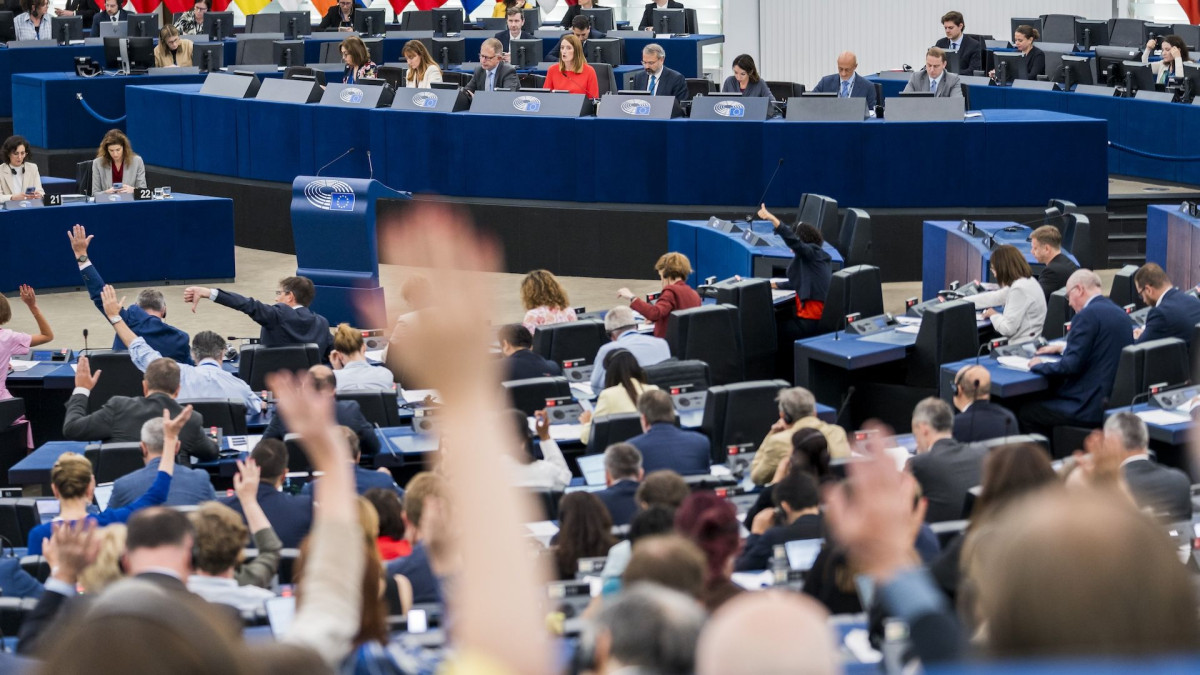
In Strasbourg last Monday, the mood was strained at a gathering of the Socialists and Democrats (S&D), with tension notably prominent among the German delegation, which ranks as the third-largest after the Spanish.
The spark came from a request to strip parliamentary immunity from a German MEP belonging to the Christian Democratic Union (CDU) — the leading party within Germany’s ruling coalition and the flagship force of the European People’s Party (EPP). An important detail: the S&D group’s unwritten convention is typically to back the lifting of immunity.
“The gathering grew heated when René Repasi, head of the German Social Democrats in Brussels, argued against stripping immunity and thereby protecting a conservative MP”
At the heart of the discussion at the S&D meeting was whether a vote already taken by the Legal Affairs Committee (JURI) should be revisited. That committee had opposed removing immunity for the CDU parliamentarian. That sparked an internal debate led by the German delegation against its own leader — René Repasi, who heads the JURI and had advocated voting against lifting immunity. The session grew even tenser when Repasi, the SPD’s leader in Brussels, defended his stance: the S&D should vote “no” on lifting immunity to save the conservative MP.
A messenger from the Chancellery
Watching Repasi play the role of the CDU’s savior was difficult for many to swallow. He is a professor and doctor of law, serving as the group’s spokesman at the Legal Affairs Committee.
Several of Germany’s Social Democratic MEPs rose up against the decision. Shielding a rival felt like an insult to their constituencies. How could they justify to their districts voting to protect the conservatives?
“The CDU’s federal directorate had phoned the SPD leadership to ask the favor directly”
That was when Repasi disclosed his reasoning: the defense had been requested in a message from Berlin, after the CDU’s federal directorate contacted the SPD leadership to make a direct appeal. In Germany’s fragile political landscape, the durability of coalitions and national governance demands tacit non-aggression from both the Social Democrats and the Christian Democrats in response to the rise of extremist parties. Reciprocity thus becomes a highly valued currency; and so Repasi carried out the order.
Although public remarks were restrained, the Spanish delegation was notably discreet in private, because in the European Parliament, granting a favor to the German delegation is effectively a loan to be repaid with interest when Madrid needs cover in sensitive debates on national policy or on financial support for southern European priorities. Even so, many were surprised by Repasi’s failure to discipline his own delegation and to reach the meeting with the issue settled.
The EPP bear-hug as strategic trap
But reducing that episode to a mere internecine quarrel would miss the deeper dynamics at work within the S&D group in the European Parliament. Sources within the Social Democrats justify Repasi’s move as part of a broader logic essential to preserving Europe’s delicate cordon sanitaire: the imperative to maintain bridges of trust with Manfred Weber’s EPP.
In today’s Parliament, forces on the radical right — notably the ECR and Patriots for Europe — have increased their sway since the last elections. Consequently, the S&D’s current preoccupation is preventing any structural shift of the EPP to the right. Saving an MEP from the CDU was essentially a peace offering — and a signal from Europe’s S&D groups to the People’s parties.
The issue is that this appeasement tactic leaves the Social Democrats in the role of a “responsible hostage.” By willingly shouldering the political and moral costs of shielding a rival to placate the EPP, they risk paying a loyalty price that the center-right frequently ignores whenever it requires votes from the hard right to overturn Green Deal initiatives or to tighten immigration policies.
“Weber and the EPP leverage their ability to forge agreements with radical-right groups to strengthen their bargaining position with the S&D on broader legislative matters”
Yet, Manfred Weber and the EPP can sense the structural fragility of the S&D bloc, which fears marginalization from decision-making. They exploit their capacity to strike deals with radical-right groups to bolster their leverage against the S&Ds on major legislative issues.
The greatest danger posed by this latest immunity pact is the rhetorical advantage it grants anti-system voices and the radical right. For parties such as the AfD or Vox, these instances provide empirical support for their narrative of transnational “partitocracy” and a Brussels political cartel, where the two big political families stage confrontations for their home audiences while quietly agreeing and shielding one another in committees and in plenary sessions of the European Parliament.
In the plenary, immunity was indeed preserved for the MEP in question, thereby maintaining a balance in German politics and fueling some hope of nudging the EPP toward the center — at the expense of the Social Democrats’ strategic stance.
BONUS: Heads up, because within the CDU’s parliamentary ranks, some are privately dreaming of a minority government, bypassing the SPD entirely. Former Chancellor Olaf Scholz echoed that notion yesterday in a video circulated on social media. But beware, because a future scenario in which the CDU could partner with the AfD has already been sketched out: “If the Christian Democrats struck a deal with the AfD, it would probably split the party apart.”
