
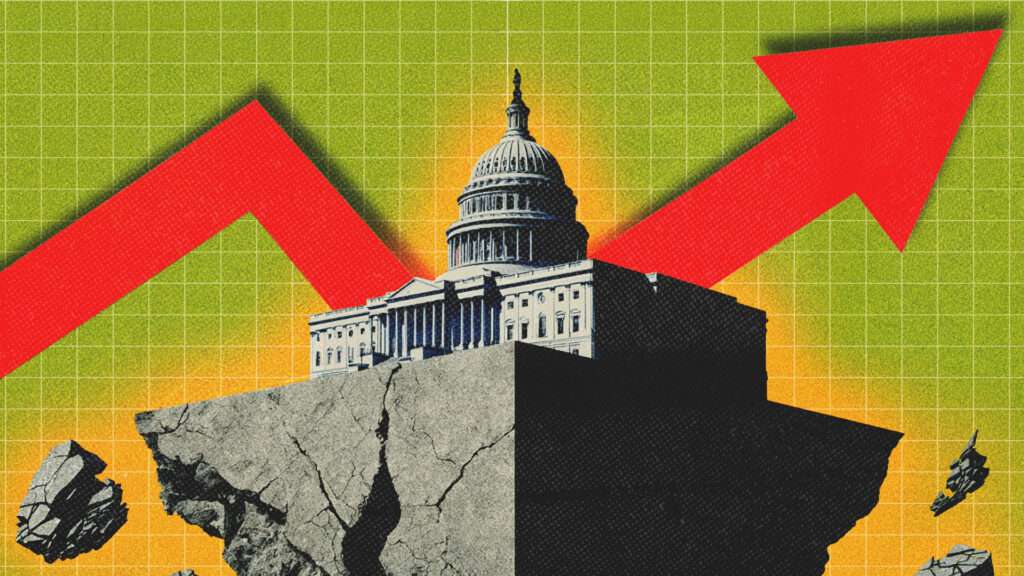
Taken together, the rise in 10-year Treasury yields hints that the bond market remains unconvinced that Donald Trump will curb inflation or rein in government spending.
Ten-year rates have climbed from about 4.5 percent in July to nearly 5.3 percent this week. That may seem modest, yet such a swift upward move in rates is almost unmatched in the annals of bond trading. The closest parallel occurred in 1994, when financially vigilant investors pressured the market in response to Hillary Clinton’s proposal for “managed competition” in healthcare. The everyday public may know more about stocks than about government bonds, but the bond market wields the leverage to enforce fiscal restraint on the government.
Even though the Clintons pulled back from their healthcare agenda in 1994, there is little sign that Treasury Secretary Scott Bessent or President Donald Trump has learned that lesson. Rather than engaging in real talks about trimming spending and entitlements, they appear to be scheming to manipulate the bond market to achieve lower interest rates.
To put this in perspective, many assume the bond market is in disarray because inflation is high. That assumption is off the mark. Inflation, as measured by the Consumer Price Index (CPI), stands at 3.4 percent and is moving lower—well below the 9.1 percent level reached in 2022. The Fed’s preferred gauge, the personal consumption expenditures price index, is also subdued and trending downward.
You may notice elevated energy prices in the real world—diesel, in particular, remains expensive—and diesel costs contribute to inflation since a large portion of goods in the U.S. are transported by truck. Yet policymakers strip out volatile food and energy in the “core” CPI, a construction dating back to the 1970s, and even when energy is included, inflation appears to be headed somewhat lower. Thus, inflation is not the primary reason interest rates are high.
Many people also contend that deficits drive higher rates, which carries some truth. When the government needs to issue more debt, the increased supply can overwhelm demand, pushing bond prices down and yields up. Although a $2 trillion deficit sounds alarming, when scaled to the size of the economy, the fear eases somewhat. Deficits were twice as large after the financial crisis during Barack Obama’s presidency, and interest rates fell. A deficit-to-GDP rate of around 6 percent is high, but it’s roughly in the same ballpark as Reagan’s first term, and we managed to grow out of those deficits and even reached a surplus by 2000. Not to say the deficit isn’t a problem or a crisis in its own right, but a sincere effort to trim spending and bring the deficit toward about 3 percent of GDP could lead to a healthier outcome and falling rates.
So if it’s not inflation, and it’s not the deficit, what is it? The answer is a crisis of credibility: the credibility of Bessent, of Federal Reserve Chairman Kevin Warsh, and of Trump. The bond market doubts that these officials will take meaningful actions to address inflation or spending. When the Warsh-led Fed raised rates last month, the bond market nonetheless rebelled. Bessent, instead of tackling structural problems, blames the “Bloomberg terminal crowd” for pushing rates higher, which isn’t far from blaming bond traders for a government’s rate problem, a tactic not dissimilar to political blame games in other contexts.
About a month ago, Bessent intervened in a limited fashion by announcing repurchases of long-term bonds of up to $4 billion per operation. In the scale of fixed-income markets, that is a modest move—bond trading involves hundreds of billions of dollars changing hands daily. The Treasury Department occasionally conducts buybacks to improve liquidity in off-the-run issues, but Bessent later intensified the program, boosting buybacks to $6 billion per operation, which coincided with even higher yields and contributed to the credibility problem. If the aim is to push rates down, the intervention would need to be far more expansive and sustained.
There are other steps the administration could pursue to push yields lower. Trump could instruct Fannie Mae and Freddie Mac to increase their purchases of mortgage-backed securities, and since these government-sponsored enterprises remain under government conservatorship, they would have little choice but to comply. Such moves would, however, heighten risk at Fannie Mae and Freddie Mac; they required an almost $200 billion bailout when they faltered in 2008.
Bessent could also consider revoking the 20-year and/or 30-year bond programs. From a treasury-secretary’s perspective, that would make sense—rather than locking in high rates for 30 years, you might halt issuance and wait for rates to fall. The risk, however, is that yields could climb further and that you would miss the opportunity to lock in around 5.5 percent for the 30-year issue, which might look favorable in hindsight.
Yet the central issue remains yield curve control, or debt monetization. This would entail the Fed printing money to buy unlimited quantities of Treasury bonds, effectively pegging interest rates at predetermined levels. Everyone knows that monetizing debt has precipitated hyperinflationary episodes in history—Weimar Germany, Zimbabwe, and Argentina—so yield curve control is unlikely, not least because it would require the Fed’s buy-in, and the current composition of the Fed’s governing board makes such an agreement improbable.
The 10-year rate stands as the single most important price in the economy. A rise signals the market’s warning to borrow less and save more. It is the only mechanism capable of forcing fiscal discipline on the government, given that voters and lawmakers appear disinclined to impose it. If someone tampers with that price signal, the economy undergoes substantial distortions, and the government will keep borrowing; in the event of yield curve control, it would be financed by money that is created rather than earned.
James Carville, the Democratic strategist, once quipped: “I used to think that if there were reincarnation, I’d come back as the president or the pope or a .400 baseball hitter. But now I want to come back as the bond market. You can intimidate everybody.” Bessent shows no sign of being cowed and is pursuing means to sidestep the free market. The average person who follows politics closely tends to focus on social issues rather than the mechanics of government bond issuance, which is unfortunate because what unfolds next at the Treasury could have consequences that ripple for decades to come.
