
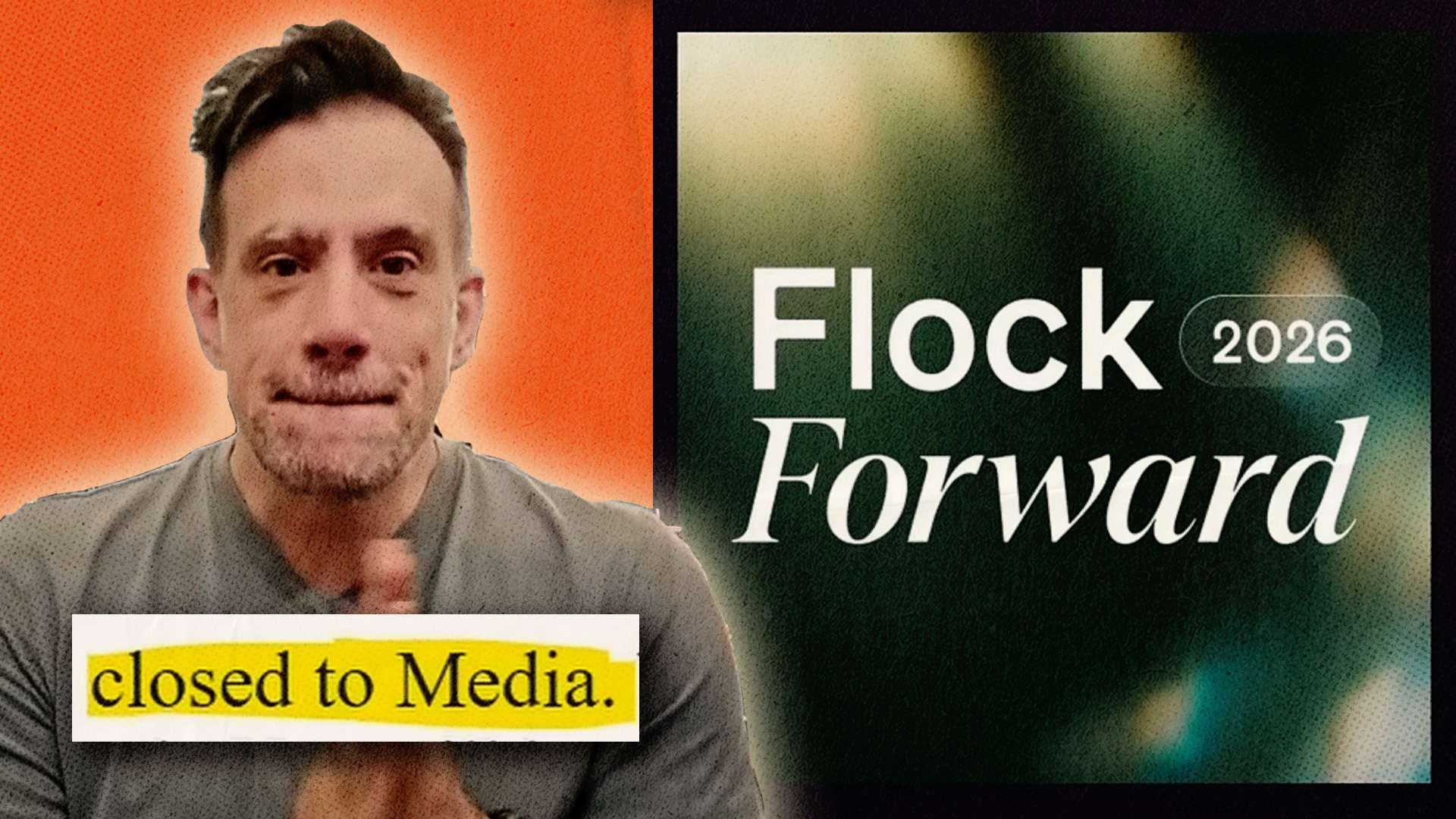
Benn Jordan aims to leave the snoopers feeling a touch unsettled.
The surveillance contractor Flock Safety contends that law enforcement clients don’t need a warrant to monitor drivers with its automated license plate reading systems because drivers have “no reasonable expectation of privacy” on public roadways. In response, YouTube host Benn Jordan applied the same logic to Flock. He stationed himself outside Flock’s recent police convention in Atlanta equipped with radio gear and a drone, which he used to identify attendees and even eavesdrop on microphones inside the convention hall.
“Flock values their privacy. Oh well,” Jordan wrote in the title of his video about the event.
His plans didn’t go off without a hitch. Jordan, an early and vocal critic of Flock, wanted to attend the convention to observe the dynamic between police and the company after a string of Georgia cases involving officers misusing Flock products, he explains to Reason. After downloading the conference app, he dug into the source code and found that it exposed the entire guest list. Jordan alerted Flock to the data exposure.
Once the company learned that Jordan planned to attend, it canceled his tickets. But efforts to keep him out extended further. A Flock employee phoned the hotel to cancel Jordan’s room reservation, which he had booked independently, according to a video Jordan shared of a call with the hotel. (Flock did not respond to Reason‘s request for comment.) Jordan even discovered that all the other rooms, and even the parking spaces around the hotel, had been fully booked.
Nevertheless, he managed to locate a public parking spot within sight of the hotel, where he parked a van outfitted with numerous WiFi adapters, a parabolic dish antenna, and a dipole array. This setup intercepted the convention hall’s wireless microphone signals, enabling Jordan to listen to attendees’ conversations. “Everything was on public channels,” he notes. He then used a drone to photograph attendees as they left and employed facial recognition to identify them.
Ironically, government regulations aided Jordan’s surveillance efforts because the Federal Communications Commission limits wireless microphones to operate on specific frequencies.
While it’s certainly within a private organization’s right to decide who can attend its conference—and Jordan acknowledges that keeping outsiders away from the hotel can be a prudent security measure—many attendees were police officials, presumably paying with public funds. More fundamentally, it’s a matter of unequal rights for different people. While Flock and its law-enforcement clients are comfortable eroding ordinary privacy expectations, they carve out highly private spaces for themselves.
Indeed, Jordan is careful not to reveal anything he captured through his radio surveillance, telling Reason that the point was solely to demonstrate that it could be done. “Public officials should understand that you can’t attend a private event where journalists aren’t allowed and not expect someone to fly a drone into view from public space. You should feel a bit unsettled about participating in something like that,” Jordan adds. He says he’s ultimately glad his stunt drew attention to the lack of transparency.
Although automatic license plate readers have long raised privacy concerns, Flock’s rapid expansion is particularly troubling because the company links police departments nationwide to a central database that isn’t subject to court orders or the Fourth Amendment. And the lack of oversight isn’t merely theoretical. Officers have been caught using Flock data to stalk romantic interests. One woman spent two weeks in jail, while another was detained at gunpoint due to mistaken identifications from Flock cameras.
Public sentiment in the United States toward these cameras is turning hostile. At least 56 municipalities ended their contracts with Flock in 2026 over privacy worries. Ring, the Amazon-owned doorbell camera company, likewise terminated its planned collaboration with Flock in response to public backlash. Even more troubling, residents have begun vandalizing the cameras themselves.
Jordan, whose YouTube channel covers a broad array of scientific topics—from animal hearing to contemporary train synthesizers—found himself at the forefront of the movement against Flock. He noticed enigmatic new cameras in his neighborhood early last year, followed his instincts to reverse engineer everything, and uncovered security gaps that allowed anyone to access Flock footage without a password.
In response to Jordan’s video, Flock’s CEO Garrett Langley sent officials nationwide a letter in December 2025 asserting that “Flock has never been hacked” and is “under coordinated attack…from the same activist groups who want to defund the police, weaken public safety, and normalize lawlessness.” The city of Staunton, Virginia, made public the letter in announcing that it was severing ties with Flock.
Although he hasn’t yet received a response regarding his surveillance of the Flock conference, Jordan tells Reason that he has had police show up outside his home “and blast their siren” on occasion. He also says he spotted a private investigator (unlicensed and a convicted felon) lurking near his residence, though he hasn’t determined who hired them.
Despite the unwanted attention, Jordan continues speaking to city councils and police departments across the country. While he says he would prefer to see license plate tracking eliminated entirely, he has been proposing a compromise for cities that will implement it anyway: locally owned cameras feeding into locally controlled databases that require a judge’s warrant to access.
“I’d like to see this investigation come to a close… I generally don’t make videos about the same topic twice,” Jordan tells Reason. “But I live with cameras all around my neighborhood, so I can’t stop thinking about it.”
