
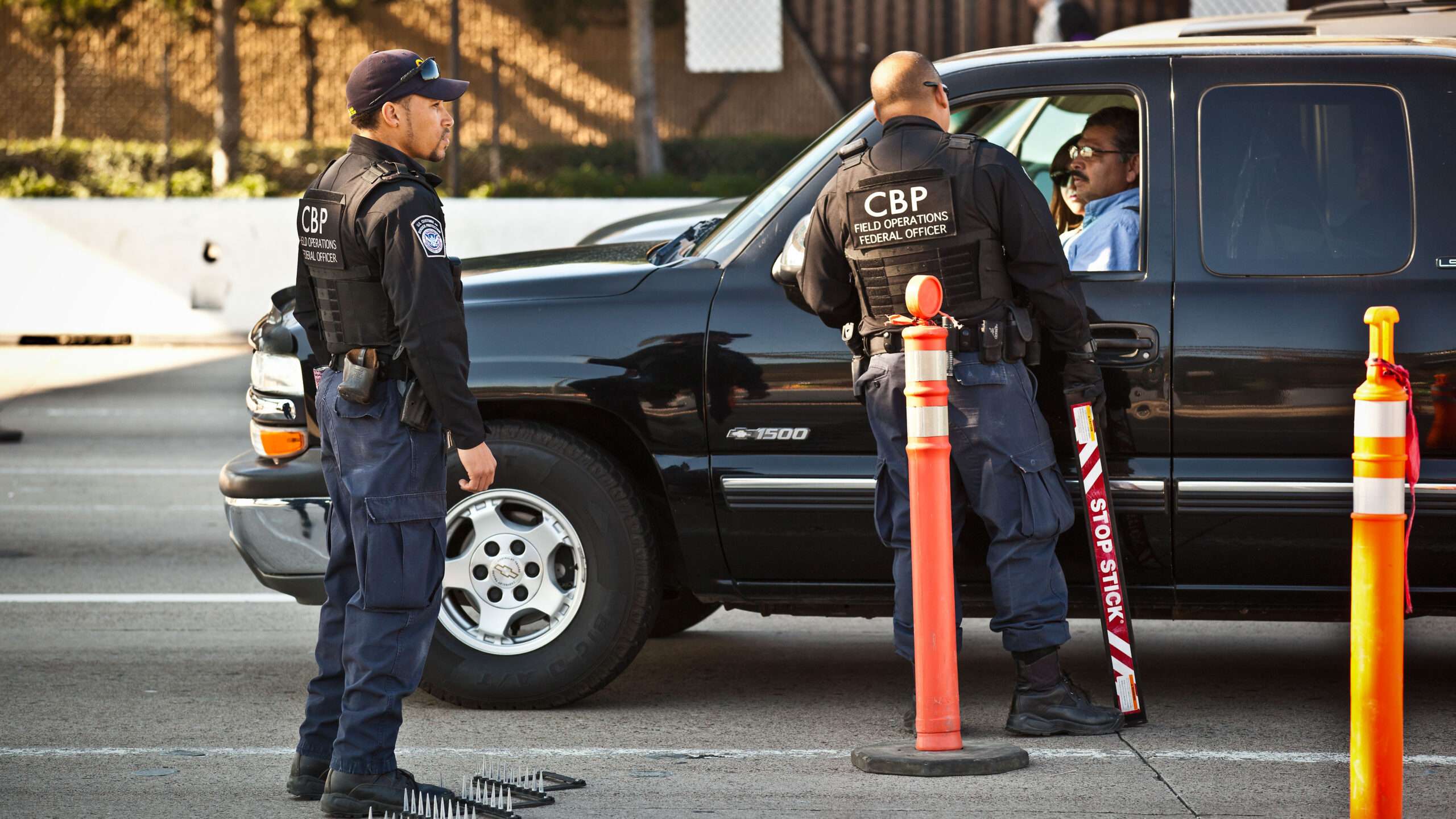
They may inspect it without a warrant if you’re abroad. And yes, this applies to American citizens too.
Returning from a remote vacation? Traveling overseas for work? Just happened to be within 100 miles of a U.S. border? I must inform you that officers from U.S. Customs and Border Protection (CBP) have the authority to search your phone, laptop, GPS unit, smartwatch, or other digital devices with little grounds. No concrete suspicion of criminal activity is required. No probable cause. No warrant.
At the physical border, the border’s functional equivalent (for example, an incoming or outgoing flight at an international airport), or the so‑called extended border, the policy permits device searches “with or without suspicion.”
Wilmer Chavarria is seeking to change this. The Vermont-based school superintendent has filed a lawsuit against the Department of Homeland Security, arguing that his Fourth Amendment rights were violated when border agents checked his personal and professional devices as he traveled back to the U.S. after visiting relatives in Nicaragua.
You are reading Sex & Tech, by Elizabeth Nolan Brown. Access more of Elizabeth’s coverage on sex, technology, bodily autonomy, law, and online culture.
You might be surprised by how far border controls extend when it comes to examining electronic devices.
A January 2026 directive states that CBP officers may search “any device that could contain information in electronic or digital form, such as computers, tablets, disks, drives, tapes, flash drives, SIM cards, GPS units, unmanned aircraft systems, vehicle infotainment systems, smartwatches, mobile phones and other communication devices, cameras, music and other media players.” If you are entering, leaving, or within 100 miles of a border, the search is allowed.
Broadening Border Search and Data Retention Policies
CBP has long maintained that it can search whatever devices it chooses, without a warrant or probable cause, when those being searched are entering the country or are within 100 miles of a border. It labels this the border search exception. “While historically a tool against smuggling, in a post‑9/11 era it has evolved into a mandate to inspect people’s technology and access their files and data,” noted Scott Shackford of Reason in 2019.
In fiscal year 2025, CBP carried out 55,318 border searches of electronic devices. The majority involved noncitizens, but 13,590 of those searches concerned U.S. citizens.
That is a sharp rise from 2023, when total border searches of electronic devices numbered 37,778, with 8,657 involving U.S. citizens.
And it marks a substantial leap from 2015, when roughly 8,500 such searches were recorded for both citizens and noncitizens, according to a policy explainer from the Pacific Legal Foundation, which represents Chavarria. “CBP officers increasingly conduct warrantless searches of personal devices like phones and laptops” and “sometimes even retain data from devices,” write Kyle Sweetland, Amy Peikoff, and Mitchell Scacchi.
Earlier this year, the Trump administration quietly issued fresh guidance about CBP’s authority to search devices.
Under a 2018 directive, an electronic device was defined as “any device that may contain information in an electronic or digital form, such as computers, tablets, disks, drives, tapes, mobile phones and other communication devices, cameras, music and other media players.” That prior definition could have encompassed flash drives, SIM cards, a vehicle’s GPS, drones, car infotainment systems, and smart watches—indeed, devices “that may contain information in an electronic or digital form.” But it did not explicitly name these devices as fair game for warrantless search.
The updated directive does. And it’s reasonable to assume that isn’t an accident. It implies border agents are or will be increasingly permitted to search these kinds of devices. It appears they are being encouraged, or at least explicitly permitted, to extend beyond the basics like tablets, laptops, and smartphones.
CBP officers have also received an expanded justification for retaining your data.
Under both the old and new policy, they may keep data if there is probable cause that it relates to contraband, criminal activity, or immigration enforcement. But if “there exists no probable cause to seize the information, CBP will retain no copies of the information,” the old directive stated.
Under the new directive, digital data can be kept if doing so might be “consistent with discovery obligations in ongoing or reasonably anticipated litigation.”
Without clarifying what might trigger a “reasonable anticipation” of litigation, that language grants CBP considerable leeway to retain any and all data under the prospect that it could be needed in a future lawsuit.
Advanced Searches OK Without Reasonable Suspicion
The new directive could broaden border search powers in other respects, including expanding when border officers can perform an advanced search.
A basic search—defined in the latest directive as an officer reviewing or analyzing information stored on the device—may be carried out “with or without suspicion.”
This includes scenarios where officers use equipment to bypass a password, defeat encryption, translate content, view files on an external drive or other device without a screen, or charge a device.
However, to conduct an advanced search—where the officer uses specialized tools “to copy and/or analyze the contents of an electronic device”—CBP personnel must present some justification for the search.
Under the previous policy, advanced searches could occur only when there was “reasonable suspicion of activity in violation of the laws enforced or administered by CBP, or when there is a national security concern.”
That phrasing was a bit ambiguous—did a “national security concern” alone justify an advanced search, or must officers have reasonable suspicion of a national security concern?
With the new policy, that ambiguity is removed. An officer “may perform an advanced search of an electronic device only in instances in which there is reasonable suspicion of activity in violation of the laws enforced or administered by CBP or, in the absence of individualized reasonable suspicion[,] when there is a national
security concern,” it states.
Immigration attorney Rosanna Berardi believes this change in wording is meaningful. Advanced device searches “can now occur based on a national security concern alone, without reasonable suspicion,” she recently observed.
Berardi notes another shift in CBP’s justification for why searches are permissible. “The earlier directive emphasized terrorism, national security, smuggling, child exploitation offenses, and commercial crimes,” Berardi said in a recent video:
The updated version explains that list and adds several more categories, including firearms, smuggling, export‑controlled information, proprietary data theft, restricted information, and digital contraband. So why does this matter?
Because policy language reveals how an agency intends to enforce rules. When I see a broadened list of concerns, I pay close attention. It doesn’t automatically mean more searches will occur tomorrow, and it doesn’t necessarily mean the average traveler will notice a change. But it does suggest CBP is considering a wider array of issues when evaluating information found on electronic devices.
Moreover, the directive notes that there is no specific basis on which such a national security “concern” must rest, remarks the Pacific Legal Foundation’s Chavarria complaint.
Some Limitations
Under both the current and the prior policies, CBP agents can search only the data stored on the device and that is “accessible through the device’s operating system or through other software, tools, or applications.” They cannot legally access information that is solely stored remotely.
That’s an important caveat to keep in mind if you’re ever asked to surrender your devices for CBP examination.
The policy instructions even advise agents to “request that the traveler disable connectivity to any network (for instance, by putting the device into airplane mode and turning off Bluetooth and Wi‑Fi)” or to do so themselves.
“Officers should also ensure, throughout a border search, that they do not take actions that would alter the contents of the device,” the guidance adds.
And, for what it’s worth, authorities aren’t supposed to retain device passwords. “Passcodes or other means of access should only be recorded by the officer in a temporary format and should not be uploaded into CBP systems,” states the current directive.
Fighting Back
Wilmer Chavarria and the Pacific Legal Foundation are pushing for far tighter restrictions on border searches of electronic devices.
Their lawsuit against DHS arises from a 2025 incident at Houston’s George Bush Intercontinental Airport, where CBP agents detained Chavarria for more than four hours. They agreed to release him only after he allowed them to search his personal phone and tablet, as well as his work laptop.
The work laptop contained student records, and Chavarria objected to its search, according to a complaint filed in the U.S. District Court for the District of Columbia. “When he objected, he was told he had no Fourth Amendment rights at the border,” it states. “Moreover, he was told that simply by asserting those rights and refusing consent to the device searches, he was acting suspiciously,” and “his requests to contact his family and attorney were denied during the detention.”
This, the Pacific Legal Foundation argues, is illegal. “The Fourth Amendment to the U.S. Constitution prohibits ‘unreasonable searches and seizures’ of ‘persons, houses, papers, and effects,’” it notes.
“The documents, media, and information stored on [Chavarria]’s devices, as well as the devices themselves, are his private property and are ‘papers’ and ‘effects’ protected by the Fourth Amendment against unreasonable searches and seizures,” they contend. And CBP “policies authorizing warrantless, suspicionless searches and seizures of electronic devices at the border, to which [Chavarria] has been subjected in the past and risks facing again in the future, violate the Fourth Amendment.”
In the News
The end of reading? The Atlantic recently published a piece titled “The End of Reading Is Here.” It presents itself as a sober investigation into a supposed decline of a particular kind of reading in America, rich with familiar complaints about technology—from television to tablets and smartphones—that this might imply. Kindergartners are getting tablets! TikTok is like cocaine to a lab rat! Romance novels are no Doctor Zhivago!
It reads as though crafted to reassure readers of The Atlantic that the world is at risk because fewer people engage with traditional print culture. I expected something fresh to justify all the chatter about this lengthy piece, but it comes across as fairly predictable.
There are a few intriguing morsels, such as:
A study of 236,000 responses from the American Time Use Survey found that the share of Americans who read for pleasure on any given day dropped from 28 percent in 2004 to 16 percent in 2023.
Yet such dramatic numbers can be misleading. As the article notes, “the study counted people who read a book, magazine, or newspaper; listened to an audiobook; or read an e-book.” It did not include reading blogs, newsletters, or news sites—digital sources many people consume daily.
The time use study (https://t.co/R7KLOxWWNk) covers print newspapers and magazines, but it says its “measures are…unlikely to have included” their online counterparts, “such as reading blogs or the news online.” So we don’t know how much of that fall is just a change in medium. https://t.co/tKypNusOJm
— Jesse Walker (@notjessewalker) July 10, 2026
Among those who did read for pleasure between 2004 and 2023, the average time spent reading was at its peak in 2023. Some earlier studies counted Bible reading as reading for pleasure, while later ones did not, which could skew results.
It’s not guaranteed that the decline in “book reading” will persist, or that it cannot rebound, as Jonathan Minnema notes. Younger generations continually rediscover and grow fond of analog formats, there’s a notable backlash against social media, and so on. (Even the shorter sentences found in many contemporary books aren’t necessarily a sign of something dire, Minnema suggests. Perhaps it signals that writers are improving.)
There’s also a question of whether this is truly a reading crisis or a comprehension crisis:
Great piece but the headline is misleading and I worry will make it harder to address the problem at hand. People are reading more than ever per the article, they’re just losing comprehension skills. That seems like a much more difficult problem to fix https://t.co/wc9unvjMWP
— Taylor Lorenz (@TaylorLorenz) July 8, 2026
The piece acknowledges that Americans are likely consuming more words than ever, but that they tend to read fragments rather than sustained pieces that convey complex information. The author implies this may contribute to decreasing reading comprehension. And that explanation is plausible, even if not the only possible one. I wish the piece had focused more on that angle rather than presenting a broad, sensational “no one reads” narrative.
More Sex & Tech
What if it isn’t the phones? An additional Atlantic article surveys psychologist Peter Gray—once a colleague of Jonathan Haidt—who argues against a common view by proposing that children need more freedom to play and explore both in the real world and online. Gray’s book Restoring Childhood is due out in September.
“To grow up well, children must be able to play in the world they are growing up in,” Gray maintains, calling Haidt’s critique of “The Anxious Generation” maddening and “unethical.” (For more of Gray’s critique of Haidt’s book, see here.) Kaitlyn Tiffany of The Atlantic notes that many researchers worry Haidt emphasizes correlational findings and misstates causation.
Biohacking pregnancy: “Pregnancy meant my commitment to biohacking was about to intensify—even as the tools available were about to become less useful,” writes Sarah Rose Siskind in a witty Reason piece about biohacking while pregnant:
I now recommend procreation to everyone I meet at parties the same way I used to push creatine. My son has put more serotonin in my brain than any Selective Serotonin Reuptake Inhibitor ever has. One could say I biohacked my soul. And it feels optimal.
Blue laws for babymaking? Reason‘s Meagan O’Rourke examines the Institute for Family Studies’ farcical suggestions for raising birth rates:
It’s Sunday. You want to head into town to run errands or perhaps meet friends at a bar, but you stay home because blue laws force shops to close on the Lord’s day. You consider going online, but there is a data usage tax, and all nonessential websites are disabled for the day. You’re invited to a city-sponsored lecture by a C‑list celebrity on boosting the fertility rate. Do you want to have a baby now? Are you feeling the urge?
