
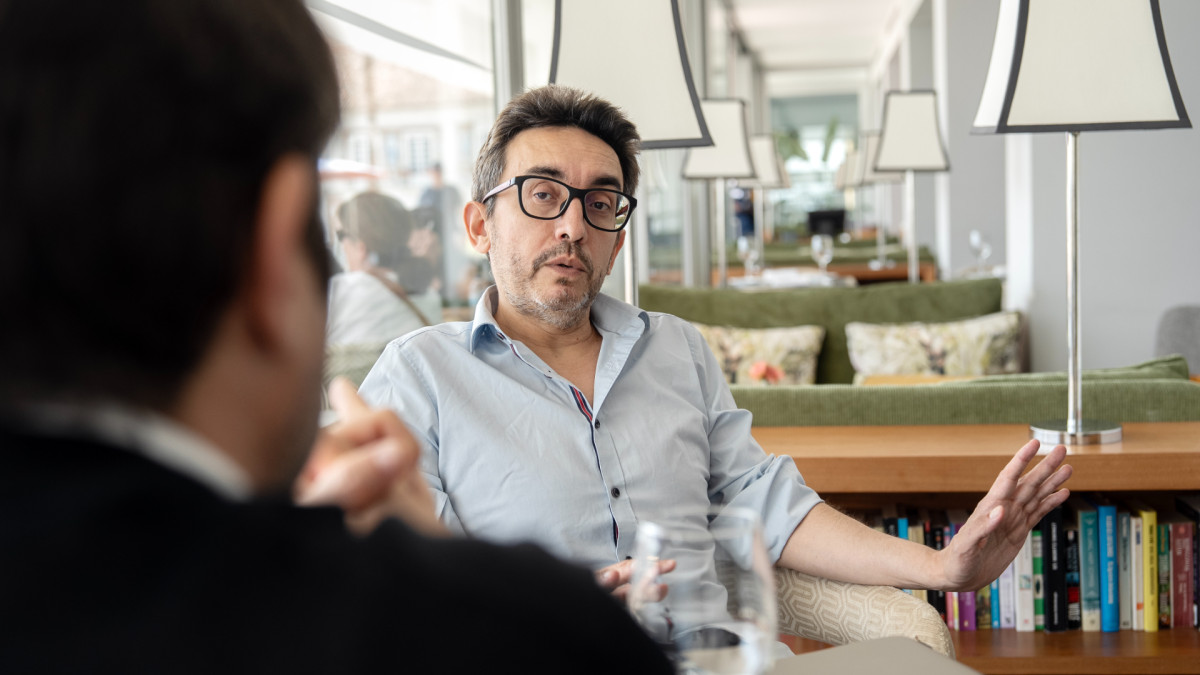
Bruno Maçães served as Portugal’s secretary of state for European Affairs from 2013 to 2015, but since then he has become one of the sharpest analysts of a new epoch. In a conversation conducted in Portugal, this Portuguese writer examines the political, intellectual, and strategic blockages that prevent Europe from acting with autonomy. Maçães characterizes the rise of the radical right as “a kind of collapse of European politics.” In his view, these parties do not offer a political theory on par with those of past ideological movements, but rather a mixture of emotion, simplification, and aggression. In a similar vein, he views the growing influence of tech oligarchs as a symptom of societies where institutions fail to balance interests and hold those in power to account.
The discussion also moves to the United States, where Maçães contends that “Trump is not the problem. He is a symptom.” His critique targets a system that, in his view, no longer responds democratically to its citizens. In the concluding portion, the Portuguese writer applies the diagnostic to the intellectual sphere: Europe, he argues, lacks think tanks with sufficient scale to challenge strategic agendas. “We don’t really have think tanks that are genuinely European,” he laments.
Bruno Maçães is a PhD in Political Science from Harvard University Photo: Agenda Pública / Ana Brígida.
Let me begin with a question about Spain. You express strong support for Spain’s role in Europe and in global affairs.
I would position myself as someone leaning toward the center-right. Yet I also carry some left-wing and even socialist strands in my approach. For example, we must think in systemic terms. Societies are integrated systems. China grasps this more fully.
For me, the core question isn’t purely political in that sense. It concerns strategy and national strategy. Spain, more than any other country, under this government—though not exclusively because of it—has demonstrated an awareness of how the world is shifting and is preparing the nation for a fundamentally altered world order.
The other European countries aren’t merely conservative; many are reactive and passive. They largely cling to a past that is paralyzing. There are several illustrations of this.
On the energy issue, it seems evident to me that we are moving toward a new energy paradigm. A decade ago, Europe’s interest in renewables stemmed largely from environmental concerns. That isn’t the full story, nor the central question. It acts as a trigger for the energy transition, but the transition must occur regardless, because we possess energy sources that are cheaper and more powerful.
“It is indisputable — you would have to be blind not to realize — that the world is no longer dominated by the West. The West remains a source of geopolitical power, but others exist,”
As our societies demand more and more energy, it becomes clear that harnessing solar energy—an essential energy source for the planet—will be crucial. Virtually all energy reaching the planet is solar in some form or another, so it makes sense to harness it directly at the source. Spain recognizes this. Many other European countries, perhaps for ideological reasons and also due to their political-economic setups, are moving very slowly, with setbacks along the way.
Then there is the question of the global order. It is undeniable — you would have to be blind not to realize — that the world is no longer under Western hegemony. The West remains a seat of geopolitical power, but there are other centers. By the way, I prefer not to speak of multipolarity as such, because the issue isn’t merely the existence of multiple poles. The problem is how these poles organize themselves.
Multipolarity is a fact, but we must raise the normative question of how these poles will coexist. It’s not enough to assert that there will be different poles that somehow understand each other. We must work on institutions fit for a new world. Pedro Sánchez’s speech in Beijing touched on this. In fact, he didn’t discuss multipolarity in depth; he acknowledged it as a fact and then asked: how will we manage this fact?
On these two fundamental questions—energy and global order—it seems to me that Spain is adapting and moving toward a new world precisely because it understands this reality as inevitable. The early movers who grasp this always enjoy an advantage over the rest.
If the transition is planned and deliberate, it can succeed. But if countries merely react—whether to shocks or to a sense of crisis—many European nations will undergo this shift as a jolt rather than a process. I view Spain as embodying a move toward this new world that is proactive rather than reactive; a choice rather than a shock. That is the central issue.
And which other European nations do you think are aligned with Spain, attempting to be first movers? Are there any others?
None as clearly, comprehensively, and deliberately as Spain. Still, there are other countries that, in specific areas, could be good partners.
For instance, on geopolitical questions there is a notable convergence of Spain’s and France’s views. Interestingly, five years ago one might have expected France to take on the role Spain is now playing regarding geopolitics. And for reasons we can discuss, that didn’t happen.
When it came to condemning the war in Iran, the initial French Foreign Ministry statements were very supportive. I can point them out; they are accessible. Macron was somewhat more cautious, but public statements from the Foreign Ministry were full-throated. One would have expected France to take the lead in a principled reaction early on, as happened with the Iraq War, but the mantle was taken by Spain.
Regarding Gaza, it appears France lacks the capacity to critically assess Israel. Macron seems unable to challenge it. His government includes members who are ardent supporters of Israel. This isn’t surprising. Yet France has long spoken of European strategic autonomy, and in the last five years, especially since October 7, it has fallen short. Since Trump’s return to power, France no longer represents that goal.
Thus, Spain unexpectedly took the lead. That said, this doesn’t mean the two countries aren’t aligned on these issues; they clearly are close and could benefit from deeper collaboration. On energy-transition matters, Northern European and Scandinavian countries can also be strong partners. Spain must cultivate those ties.
It is worth noting that the current Spanish government has consistently spoken on behalf of Europe. It is sometimes accused of representing what’s called a Third-Worldist or Global South perspective, but that interpretation seems misguided to me. There have been times in the past when European states acted that way, but that is not the case now. The question is how Europe should position itself.
“When Pedro Sánchez recently reached out to China […] he was trying to lead a European policy toward China, not a Spanish policy”
So when Pedro Sánchez recently engaged with China, in my view he was attempting to steer a European policy toward China, not merely a national one. What he seeks is to push the EU in a particular direction. Yet, on energy, on global order, and on China, Spain has been ahead of the pack as well.
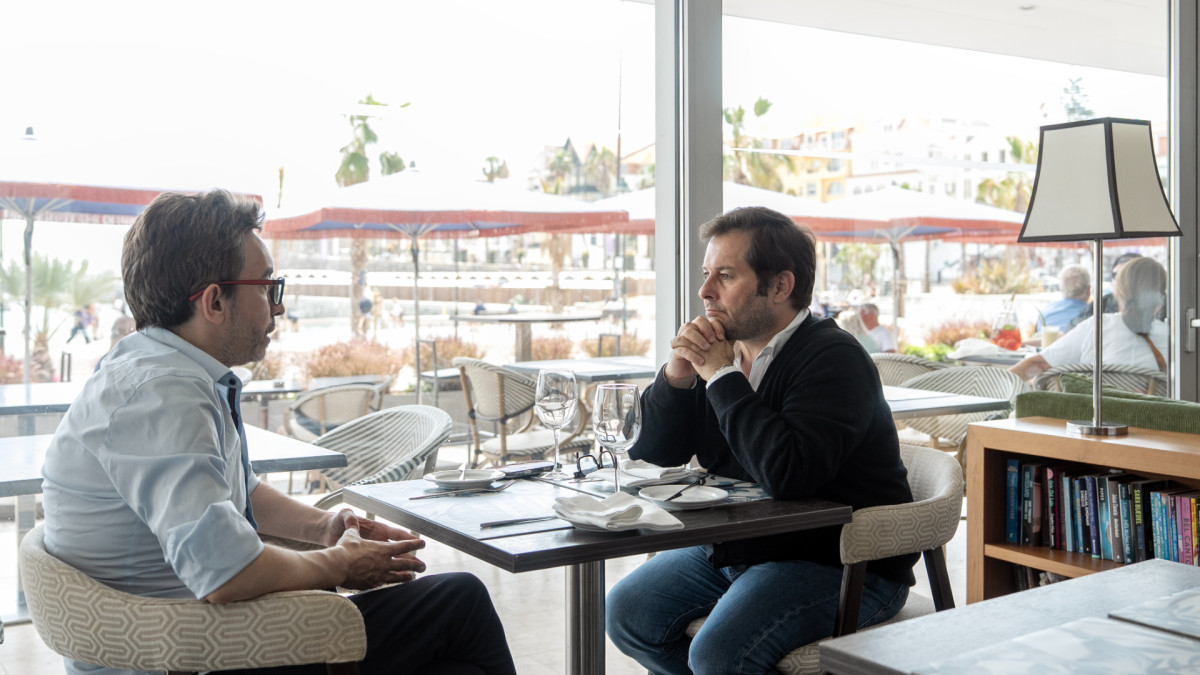
López Plana asks Maçães about his view of Spain’s role in Europe and in the new global order. Photo: Agenda Pública / Ana Brígida.
If Europe can count on only two or three countries that truly grasp what is unfolding, what about the rest of Europe? If the bulk of European nations are ill-prepared for the new order, how can Europe claim a meaningful global role?
That will be tough. It is turning out far more difficult than I anticipated a decade ago. There are several reasons for this.
In fact, you were secretary of state for European Affairs, right?
Yes, about ten years ago. Now the situation is more challenging than I expected. Europe has proved weaker than we believed, often driven by fear. The American presence has turned out to be deeply ingrained. The most surprising factor has been the prevailing mentalities.
Looking back, I understand it better: the generation currently in power in Europe—let’s say those born roughly between 1955 and 1965—experienced the end of the Cold War, the collapse of the Soviet Union, and the fall of the Berlin Wall. That experience has shaped their entire worldview. In a sense, today’s leaders inhabit a 1989 mindset. They still believe the American presence is entirely benign and they conceive of the world through Cold War lenses of victory over the Soviet Union. They are stuck in that moment and want to repeat it. It’s almost a Freudian urge to reenact a Cold War triumph against China, even though China is not the Soviet Union. 2026 is not 1989. History moves, changes. Yet they seem oblivious to that reality.
“They are sometimes still in Berlin in 1989, dancing at night when the Wall fell. They cannot move on to different moments in history.”
There are moments when they are still in Berlin in 1989, celebrating the fall of the Wall. They cannot progress to newer moments in history. I’m not sure of Pedro Sánchez’s exact age, but for me, I am around 40, 45, or 46. That helps, because you were too young to have lived through those pivotal late-teens or early-twenties moments that shape a person’s life. I was also too young and too distant; I wasn’t in Berlin. That helps you think outside the box, beyond that 1989 box. And that is a significant problem, though it will presumably be resolved as a new generation takes the reins, a generation shaped more by the Iraq War than by 1989.
People who were twenty during the Iraq War are now in their forties. Once this generation occupies positions of authority, the dynamic will change. I place great emphasis on the importance of generational change—more than on individuals. Generations are shaped by the past, and history moves forward when generations are replaced. Thomas Kuhn spoke of scientific revolutions when the old generation dies; likewise, political revolutions occur when the preceding generation retires.
And I do not want them to die, but to step back. That’s a crucial factor. Yet Europe has proven strikingly ineffective at shaping this new world, stuck in the past and fearful of change.
Let us pause to reflect on far-right parties as major forces that could redefine how we understand the European Union. We can see what is happening in Spain and France, but also with AfD in Germany or with Meloni and Fratelli d’Italia.
And this is evident today as well. In Portugal, we have a party that could win the next election. I perceive this as a sign of political and cultural decline because, when I examine these populist formations, I do not observe a coherent political doctrine; they cannot even be compared to communist parties, which at least articulated a worldview.
“They represent merely a fall from the previous style of politics into something much less rational, much less organized and much less ordered.”
These parties essentially symbolize a collapse of European politics. They embody phenomena of decay and corruption, the simplification of political discourse, and, of course, highly emotional forms of politics rooted in resentment, envy, and anger. The rational debate that once characterized politics seems to have vanished. Their strategy often assigns blame to outsiders.
They are expressions of emotion, simplification, and aggression. They signal a system that is deteriorating, breaking down, and failing to perform as it should. That is my reading of European populism, and the far right stands as a wholly negative force. It signals a fall from the prior political style into something far less rational, less organized, and less orderly.

Maçães discusses the rise of the far right and his reading of it as a symptom of the deterioration of European politics. Photo: Agenda Pública / Ana Brígida.
What role do tech oligarchs play in this far-right phenomenon?
That is another arena where Spain is, somewhat cautiously, attempting to lead the discussion. The focus is on how to regulate these new technologies and new sources of technological power. It isn’t a left-versus-right issue; it is a question that both sides will eventually have to confront.
What this reveals is a society cracking under pressure. Many of the phenomena we have discussed are often treated as visions of the future or, in the case of populism, painted by its adherents as a return to reason.
But I would ask people to consider how they would view this phenomenon if it occurred in other societies. It would likely be seen as a sign of disintegration. For example, if a political leader in Latin America or Africa used the language of football or a simplistic rhetoric of emotion and anger, it would probably be ridiculed and attacked in Europe. Yet when Europeans adopt the same rhetoric, we tend to accord it a veneer of respectability.
What I would argue is that we must treat this for what it is: indicators of decline, corruption, decay, and disorder. And regarding the role of tech oligarchs, their emergence clearly arises from places where political order is dissolving, where the balance between interests can no longer be achieved, where power is exercised directly, bypassing traditional political institutions, and where accountability and transparency are absent.
“If we observed this phenomenon in an African country in sub-Saharan Africa, we would know exactly what to call it.”
There is no great mystery here. If this were happening in an African country in sub-Saharan Africa, we would name it plainly: a society on the brink of collapse, with institutions, rules, and balances dissolving. This poses a real danger because it can fuel social conflict, produce poorer outcomes, and pave the way for forms of control, authoritarianism, and potentially totalitarianism down the road.
I’m struck by how often we seem unable to name this phenomenon in our own societies. Across these domains, that is what you observe. What surprises me about digital platforms and tech oligarchs is that we are witnessing patterns similar to those seen in Russia after the dissolution of the Soviet Union—institutions disappear and a law of the jungle emerges, where power is exercised directly, not through the state and its institutions.
And much of this is taking place within our own societies. It is clear that the state can no longer respond to this phenomenon. It lacks the power, the institutions, and the framework to do so. A second wave would only worsen things, because as people observe that many elites do not respect norms or patterns of behavior, the conviction grows that everyone should behave likewise.
Thus the current U.S. debate contemplates whether it is permissible to shoplift in supermarkets. The New York Times even carried a discussion on this. Two young activists argued that, if nothing else works, one should engage in direct action—anarchist or revolutionary. But I cannot present this as a political virtue, and it can only end badly.
Is it possible today to conduct democratic politics in the United States?
Not really. The political system does not respond. The Democratic Party appears to be uninterested in winning elections. It keeps itself distant from its voters and from public opinion. One would expect that in a democracy, if a poll shows 90% public support for a position, politicians would move in that direction. Yet the Democratic Party is so controlled by a small cadre of elites that it answers to those elites rather than to voters.
This pattern exists elsewhere, and we recognize it when we see it, but we fail to acknowledge it in the United States. On Gaza, public opinion exists, but the parties do not respond to it. And now the question is: if democracy stops working, should non-democratic means be used?
“It is possible that in the future there will be a non-democratic movement in the US trying to reestablish economic equality.”
It is possible that, for the first time in its history, the United States could face a non-democratic movement aimed at restoring economic equality. We have democratic attempts, like Bernie Sanders and others, but their reach is limited. Non-democratic attempts could emerge as well.
Either way, the real danger lies in the system becoming non-democratic.
What changed in the United States to allow someone like Trump to become president?
Trump is not the problem. He is a symptom.
Joe Biden, whom the European left appears to admire, was responsible for the complete destruction of Gaza, perhaps even more than Trump. He undertook the action in a way that was crude and unserious. He mocked and dismissed it. He governed in many cases without mental clarity, and this was concealed.
Numerous individuals knew about this and did not expose it. When it became public, it was denied. Those who tried to reveal it were threatened. So this did not happen under Trump. The problem runs deeper. It is a system that no longer operates in a principled or democratic manner.
During the Iran conflict, we also see that information from the U.S. is frequently incomplete or manipulated. We know that damage to American bases has been far greater than reported. Journalists who report this run into trouble. There is little transparency from the White House.
What occurred with CBS News was shocking. Longtime employees were fired without explanation because of their positions on Israel and Palestine. This is not a marginal newspaper; it is a major network. And Europe shows little curiosity about this.
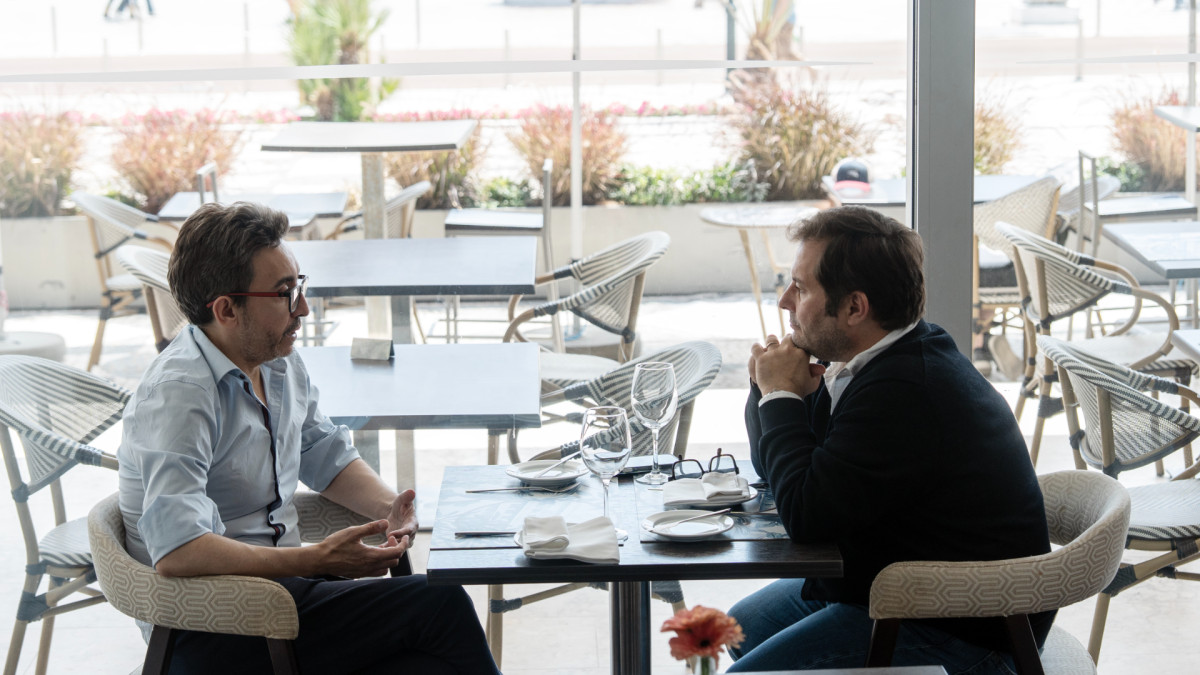
The conversation turns to the United States, Trump and the current limits of democratic politics. Photo: Agenda Pública / Ana Brígida.
Meanwhile, China presents a distinct political system. Yet as Europeans, we lack a clear European stance toward China. We have national positions, but not a unified European policy.
Ultimately, a European stance is required. But, as a rule and from my political experience, European positions emerge when states push forward. Sometimes states must chart a path of their own, and then the EU will follow in some form.
States should not be required to await the EU’s stance. Because the EU’s position forms from the positions of its member states. If states do not wish to take a stand and instead wait for the EU to have one, the EU will never articulate a position.
By the way, this is a longstanding mistake in Portuguese European policy that I always sensed, even during my government service: Portugal tends to wait for the European position. But there is no single European position to wait for. If Portugal waits, the European position will be defined by those countries that do define it. That’s simply how it operates.
“Spain is doing well in trying to provide an orientation for what the EU position should be on China.”
Thus, Spain is doing well in offering an orientation for what the EU stance on China should be. And as long as this is pursued through dialogue rather than unilateral actions, it will eventually be recognized. Because a position on China will soon be required. And then what options will be available?
There is the American position, and perhaps a nascent Spanish position. The Spanish position will appear more attractive because it can be effective. The American approach, by contrast, seems to be aimed at making China disappear, a goal I never understood.
China is not going to vanish. It is deeply rooted in Chinese history. Some in the United States seem to believe China became an industrial powerhouse solely because the West allowed it. But that is not accurate. It is rooted in centuries of history, and it will not disappear.
Thus a policy advocating increased confrontation while expecting China’s collapse is utter folly. In many respects, it is self-defeating and accelerates China’s development. By denying China access to critical chips, we simply accelerate its ability to produce them. It is a self-defeating strategy that creates instability and could lead to serious conflict.
I would not rule out a scenario in which the United States triggers a war over Taiwan and then expects European forces to bear the burden. We already glimpsed a similar dynamic in the Hormuz Strait episode, where the U.S. created a problem and then looked to European ships to resolve it.
What’s needed is a new policy toward China: not a pro-China stance, but a realistic one. China will remain a major economic and technological power. Spain has an interest in benefiting from Chinese technology. In ten to fifteen years, the tech we need may come not from the United States but from China.
“With energy and a new energy policy, and access to Chinese technology, Spain could become an industrial powerhouse very quickly.”
Countries that build those bridges will reap substantial rewards. With energy, a fresh energy strategy, and access to Chinese technology, Spain could rapidly become an industrial powerhouse. Competing with U.S. natural gas, or with American green technologies or automobiles, will not be easy.
Again, Friedrich Merz seems to be living in the 1960s. That is not the real world.
Yet it remains a real concern, in my view, that Merz and Macron appear distant from grasping what is unfolding. France and Germany have traditionally been the engines of European power. Without this shared strength, Europe’s ascent becomes harder to understand.
These shifts are accelerating, and they will intensify quickly. Even the election of Donald Trump accelerates history. If a Democrat had won, the process would unfold more slowly, but the trajectory would be similar.
This divorce between America and Europe deepens with each passing week. It isn’t inherently negative that change moves faster; speed must be managed. The divorce is accelerating because people are adapting.
Politics is typically slow, but once momentum starts, it accelerates. Many developments that now seem normal would have been unimaginable a year ago. Yesterday’s comment by Merz—that America is being humiliated by Iran—almost felt like a psychological break. It will likely irritate Donald Trump. In his mind, a change has already occurred: he no longer fully concerns himself with Trump’s reaction.
Merz senses volatility and growing voter pressure. Politicians begin to respond when they sense change around them. Meloni has already altered her stance in recent weeks. Merz appears to be adjusting as well.
The only two who seem not to change are Mark Rutte and Ursula von der Leyen. Coincidentally, they are not elected. So they do not face electoral incentives. And that pressure—survival, elections, competition—is essential. Meloni will have elections, and if she loses, it may reflect her earlier alignment with Trump. So she, too, must adapt quickly. Merz may face early elections as well.
So, things are moving.
On China, changes will occur more slowly because Europeans do not truly know China. They view it with suspicion, as a black box. It is helpful that Pedro Sánchez travels there regularly. That helps reduce fear and misunderstanding.
You begin to see how to benefit from relations with China. Chinese vehicles will arrive anyway. The question is whether we can integrate them in a way that creates jobs and facilitates technology transfer. China has accomplished this with Western firms by importing factories, not merely products. So why not pursue the same model in Europe?
Maçães analyzes Europe’s relationship with China and the need for a more realistic European policy. Photo: Agenda Pública / Ana Brígida.
Let me ask you about democracies competing with autocracies. Is speed a disadvantage for democracies in this competition?
I would disagree with that premise. The Chinese system also moves slowly. That is a fair critique to some extent.
The problem in Europe is mentality. People are afraid: fear of Russia, fear of Trump, fear of China, fear of the future. The deeper issue is that our democracies have become less democratic than before. Debate is curtailed. New ideas are punished. If you propose different policies, you are attacked.
It isn’t that we are too democratic; it is that we are not democratic enough. Certain forces block change and stifle debate. That is what yields paralysis.
What role do you assign to the center-right in Europe?
I am not fully center-right. In Spain, the PP is influenced by populism, which I dislike. But I do hold traditional conservative convictions. I reject the destruction of traditional societies in service of ideological projects.
I also hold liberal views: freedom of expression is essential. The left-right divide is increasingly irrational and tribal. We must think in systems. Societies are integrated systems. China grasps this better.
Energy, for example, must be understood as part of a system. The blackout in Spain and Portugal shows this clearly.
What about the European public sphere and the role of think tanks and opinion leaders like you?
We need a completely new landscape because Europe’s think-tank ecosystem is dominated by American organizations. They are large, well-funded, and have networks. This has been a major obstacle to Europe achieving strategic autonomy, because think tanks wield enormous influence over politicians, the public debate, and media.
And we don’t actually have think tanks that are truly European. The ones we have are relatively small. Yet everyone knows the well-known names of think tanks. They are all European and deeply committed, but not necessarily to European strategic autonomy. In many cases, they are aligned with American interests.
There are also questions about their funding. Many are wholly committed to foreign policies favoring increased defense spending. This is troubling. No one has managed to alter it. Attempts to reform are minor; in the realm of think tanks, scale and mass matter.
I also think American think tanks have evolved. I worked for one when I was younger, so I have seen changes. They have become far less tolerant of difference, far more political. They have stopped thinking in a broad sense and resemble propaganda outlets more than think tanks.
Hence the need for European think tanks that are more liberal in outlook and genuinely European. Three decades ago, think tanks could host diverse voices inside, allowing ideas to be tested against disagreement. That is how you refine your policy. In my experience, that dynamic has vanished. American think tanks today are almost authoritarian in character. Anyone who questions the prevailing line is removed. This should be a top priority for European media and think tanks. Otherwise, strategic autonomy will remain out of reach.
Perhaps we can end here with a reflection: I found Macron a disappointment because he arrived with strong ideas and a French tradition, but then he lost them. He lacked the conditions to sustain them. He enjoyed broad media praise. He remains somewhat influential, but there was one barrier—permanently aligning with the US. Had he insisted that Europe could forge an independent voice, he would have faced fierce attacks from powerful media groups. Over time, he grew more cautious and pursued that stance less and less, because doing so invited constant criticism. That makes it exceptionally difficult for a politician to maintain such positions.
“It may not just be Pedro Sánchez’s qualities, but that he has space others do not.”
There is a certain mystery surrounding why Pedro Sánchez has been able to maneuver in this space. One plausible reason is that Spain offers a bit more room for such initiatives. You do not face immediate pressure in the same way as other countries. Spain is not as dependent on the United States as many European states are.
So perhaps it isn’t only about Sánchez’s personal qualities, but also about the space available to him. He must contend with the PP, of course, but that is a different story. He may have somewhat more room to act, and he seems to have recognized an opportunity that others did not grasp.
Thank you very much.
