
Bruno Maçães served as Portugal’s Secretary of State for European Affairs from 2013 to 2015, but since then he has established himself as one of the foremost analysts of the turning point we are living through. In our conversation during a gathering in Portugal, the Portuguese writer analyzes the political, intellectual, and strategic blockages that prevent Europe from acting with autonomy. Maçães interprets the rise of the radical right as “a kind of collapse of European politics.” In his view, these parties do not offer a political theory comparable to that of other ideological movements of the past, but a mix of emotion, simplification, and aggression. In that same logic, he places the growing power of tech oligarchs, which he reads as a symptom of societies where institutions lose the capacity to balance interests and hold power to account.
The conversation also stops at the United States, where Maçães argues that “Trump is not the problem. He is a symptom.” His critique targets a system that, he claims, no longer responds democratically to its citizens. In the final part, the Portuguese writer takes the diagnosis into the intellectual realm: Europe, he says, lacks think tanks with sufficient scale to challenge the strategic agenda. “We do not have genuinely European think tanks,” he laments.
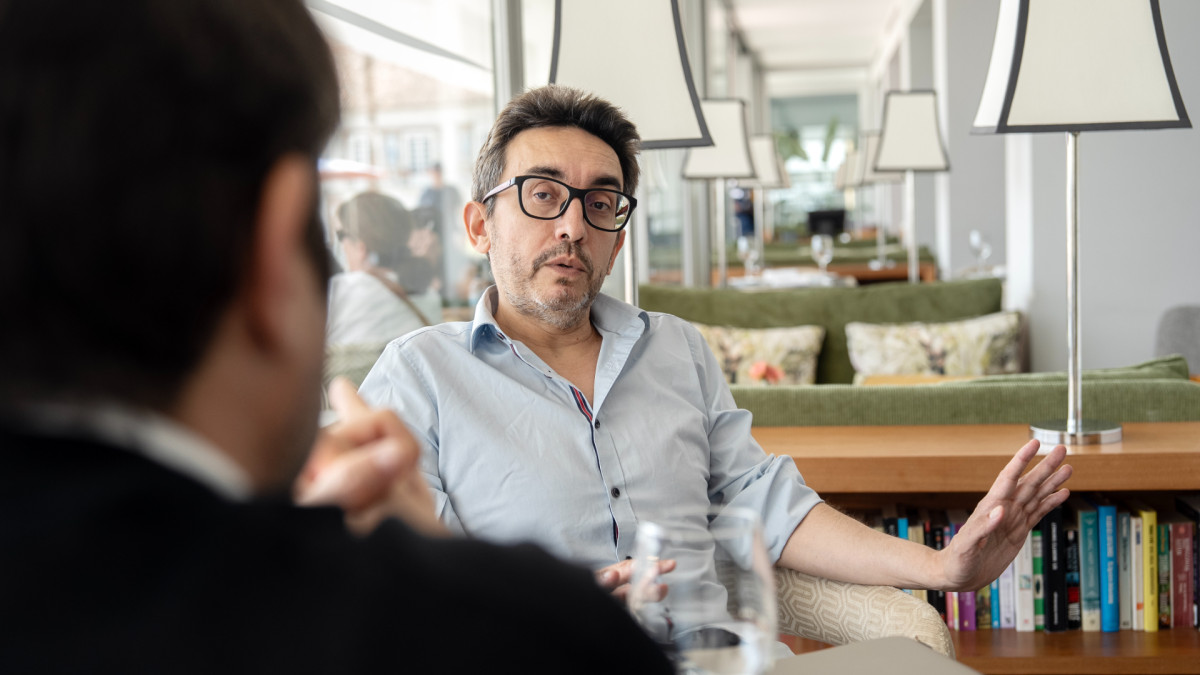
Bruno Maçães holds a PhD in Political Science from Harvard University. Photo: Agenda Pública / Ana Brígida.
Let me begin with a question about Spain. You defend a lot the role of Spain in Europe and in global politics.
I am supposed to be someone from the center-right. But for me the question isn’t political in that sense. It has more to do with strategy and national strategy. Spain, more than any other country, with this government, but not only and not necessarily because of this government, has shown awareness of how the world is changing and is preparing the country for a world fundamentally different.
The other European countries aren’t even conservative; they are reactive and passive. For the most part, they are nostalgic for the past, which is deeply paralyzing. There are several examples of this.
On the one hand, in the energy question, it seems evident to me that we are moving toward a new energy paradigm. In Europe, a decade ago there was interest in renewables, but it actually stemmed more from environmental concerns. For me, that is not the whole issue, not even the main one. That is a trigger for the energy transition, but the energy transition must be done anyway because we have cheaper and more powerful energy sources.
“It is undeniable—one would have to be blind not to see it—that the world is no longer dominated by the West. The West is a source of geopolitical power, but there are other sources”
As our societies increasingly need energy, it’s very clear that we will have to harness solar energy, which is a fundamental source of power on our planet. 99.98% of the energy that reaches the planet is solar in one form or another, so it is much better to use it directly at the source. Spain has realized this. Many other European countries, possibly for ideological reasons, but also because of how the political economy works in those countries, are moving very, very slowly, even with reversals.
Then there is the issue of the global order. It is undeniable—there is no way around it—that the world is no longer Western-dominated. the West is a source of geopolitical power, but there are other sources. By the way, I don’t like calling it multipolar because the matter isn’t just the existence of different poles. The question is how these poles are organized.
So multipolarity is simply a fact, but we need to address the normative question of how these different poles will coexist. It is not enough to say there will be different poles and they will somehow find a way to understand each other. We must work on institutions for a new world. Pedro Sánchez’s speech in Beijing touched on this. In fact, he didn’t speak so much of multipolarity because he simply recognized it as a fact. And then he asked: how are we going to manage this fact?
Thus, on these two fundamental questions—energy and global order—I think Spain is adapting and advancing toward a new world with the awareness that this is inevitable. And the countries that do it first always have an advantage. They are pioneers, ahead of the rest.
If the transition is planned and deliberate, it can turn out well. But if it is only reactive, or reactive to a shock, many European countries will experience this transition more as a shock than as a process. That is why I see Spain as representative of a movement toward this new world that is not reactive but active; a choice rather than a clash. That is the main issue.
And which other European countries do you think are in the same line as Spain, trying to be the first to move?
No country matches Spain so clearly, none as completely, none as deliberate and strategic as Spain. But there are other countries that, in different areas, could be good allies.
For example, in geopolitical matters, there is clearly a coincidence of positions between Spain and France. Interestingly, five years ago one would have expected France to play the role Spain is playing now in geopolitics. And, for reasons we could discuss, that didn’t happen.
In criticizing this senseless war in Iran, the French Foreign Ministry’s early statements on the war were extremely favorable. I can find them. Anyone can find them. They are available. Macron was somewhat more prudent, but from the Foreign Ministry the support was total. One would have expected France, in the first two days, to lead a principled reaction, as happened with the Iraq War, but it ended up being Spain.
And in Gaza it seems that France is completely unable to be critical of Israel. Macron appears utterly unable to do so. His government contains members who are fanatical supporters of Israel. So it’s not surprising. But again, it must be said that France has spoken for a long time about European strategic autonomy and, in the last five years, especially since October 7, has utterly failed. And, particularly since Trump returned to power, France no longer represents that.
So, somewhat surprisingly, it was Spain that did it. But that does not negate that, in these matters, the two countries are clearly close and perhaps should work together more than they do. And on energy transition, Northern European countries, Scandinavia, can also be good partners. Spain must work with these alliances.
Also it should be noted that the current Spanish government has always made clear that it speaks on behalf of Europe. Sometimes it is accused of representing what is called a third-world or Global South view, but I think that is quite mistaken. That has happened in the past with certain European countries, but now it is not the case at all. It is about how Europe should position itself.
“When Pedro Sánchez recently approached China […] he was trying to lead a European policy toward China, not a Spanish policy”
That is why, when Pedro Sánchez recently approached China, in my view, he was trying to lead a European policy toward China, not a Spanish policy. What he is trying to do is push the EU in a particular direction. But again, on these energy, global order, and China issues, Spain has also been at the forefront.
Lopez Plana examines Maçães’ view on Spain’s role in Europe and the new global order. Photo: Agenda Pública / Ana Brígida.
If only two or three countries in the European Union are capable of understanding what is happening right now, what about Europe as a whole? Because if the vast majority of European countries are less prepared to face the new situation or the new global order, what happens to Europe’s ability to play a meaningful role in the world?
It will be difficult. It has proven far harder than I thought ten years ago. There are several reasons for that.
In fact, you were Secretary of State for European Affairs back then, right?
Yes, about ten years ago. Now it’s harder than I thought. Europe turned out to be weaker than we believed, quite dominated by fear in many cases. The American presence turned out to be very deep. The mindsets were the biggest surprise to me.
In retrospect, I understand it better now: the generation in power in Europe — let us say, people born between 1955 and 1965 — is the generation that lived the end of the Cold War, the collapse of the Soviet Union, and the fall of the Berlin Wall. And that completely shaped their worldview. In a way, the generation in power in Europe still lives in 1989.
They continue to live in a world where the American presence is entirely benign. They live in a world defined by the Cold War and by the victory over the Soviet Union. They are stuck in that moment and want to repeat it. It is almost like a Freud’s repetition compulsion. And now they want to have a Cold War victory over China, even though China is not the Soviet Union. 2026 is not 1989. History moves on, changes. But they do not seem to realize it.
“Sometimes they are still in Berlin in 1989, dancing at night when the Wall fell. They cannot move on to other moments in history”
Sometimes they are still in Berlin in 1989, dancing at night when the Wall fell. They cannot move on to other moments in history. I don’t remember exactly how old Pedro Sánchez is, but in my case, for example, I am 40, 45, 46 years old. That helps, because you were too young to have lived those moments at the end of adolescence or the beginning of adulthood, which are the moments that shape a life.
I was also too young and too far away. I wasn’t in Berlin. That helps to think outside the box, outside that 1989 box. And that is a big problem, but it will be resolved in a sense because very soon we will be speaking of a completely different generation, shaped by very different events. Soon we will speak of a generation more defined by the Iraq War than by 1989.
Those who were 20 years old during the Iraq War are now 40, 43, 45 years old. When this generation comes to power, it will be different. I attach great importance to the generation, more than to the individual. The generation is shaped by the past, and history advances when generations are replaced. Thomas Kuhn used to say that revolutions in science occur when the old generation of scientists dies. And revolutions in politics occur when the old generation of politicians retires.
And I don’t want them to die, but to retire. That is an important part. But Europe has proved very ineffective at shaping this new world, very trapped in the past and with a lot of fear of change.
Let us talk for a moment about the far-right parties as major movements that could change how we understand the European Union. It is important, because we are now seeing what is happening in Spain and France, but also with AfD in Germany or with Meloni and Fratelli d’Italia.
And here too, these days. In Portugal we also have a party that could even win elections at some point in the future. I see this as a sign of decadence in our politics and our political culture, because when I look at these populist parties I do not see a theory of politics. They cannot even compare with communist parties. Communist parties had a worldview.
“They essentially represent a collapse in European politics from the old style to something much less rational, much less organized and much less orderly”
These parties essentially represent a kind of collapse of European politics. They reflect phenomena that are clearly signs of deterioration and corruption, of simplification of political discourse; of course, very emotional forms of politics based on resentment, envy, and anger. The disappearance of rationalism from our politics or from rational debate. An attempt to blame outsiders.
They are phenomena of emotion, of simplification, of aggression. All of them are phenomena of a system that is deteriorating, eroding, and no longer functioning as it should. That is my interpretation of populism in Europe, and the far-right is an entirely negative phenomenon. They simply represent a fall from the previous political style toward something much less rational, much less organized, and much less orderly.

Maçães discusses the rise of the radical right and his reading of it as a symptom of the deterioration of European politics. Photo: Agenda Pública / Ana Brígida.
What role do tech oligarchs play in this phenomenon of radical-right parties?
That is another area where Spain, somewhat more tentatively, is trying to lead the discussion. I am referring to how to regulate these new technologies and these new sources of tech power. It is not a matter of left or right. It is an issue that both the left and the right will have to address.
That also reveals societies cracking under pressure. Many of the phenomena we discuss are treated as visions of the future, or, in the case of populism, populists like to describe their movement as a return to reason.
But I would ask people to consider how they would view this phenomenon if it were happening in other societies. Without a doubt, they would see it as signs of disintegration. For example, if a political leader in Latin America or Africa used football-language or a very basic emotional-and-anger language, they would probably be ridiculed and attacked in Europe. But when Europeans do it, we tend to lend it a layer of respectability.
What I would say is that we should treat this for what it is: signs of decadence, corruption, deterioration, and disorder. As for the role of tech oligarchs, it is clear that it stems from places where political order is disappearing, where it is no longer possible to balance competing interests, where power begins to be exercised very directly, not through political institutions, and where there is no accountability or transparency.
“We are seeing phenomena that we already saw in Russia after the end of the Soviet Union, when institutions disappear and a jungle-law begins to prevail”
There is no great mystery to this. If we saw this phenomenon in an African country in Sub-Saharan Africa, we would know exactly what to call it. We would say that society is on the brink of collapse, that its institutions, rules, sense of order and balance are disappearing. And this is potentially very dangerous because it leads to greater social conflict, worse social and economic outcomes, and can lead to forms of control, authoritarianism, and later totalitarianism.
I’m surprised that, when we see this phenomenon in our own society, we seem unable to call it by its name. In all these areas, that is what is seen. What surprises me about the issue of digital platforms and tech oligarchs is that we are seeing phenomena we already saw in Russia after the end of the Soviet Union, when institutions disappear and a jungle-law prevails, where power is exercised directly, not filtered through the state and institutions.
And much of that is happening in our societies. The obvious thing is that the state can no longer react to this phenomenon. It has neither the power nor the capacity nor the institutions nor the structure to do so. And in a second wave, it gets even worse, because when people begin to see that many elites do not respect norms or patterns of behavior, the conviction grows that everyone should do the same.
So the debate now in the United States is whether shoplifting in supermarkets should be allowed. There was a debate in The New York Times about this. And the two people, young influential activists, argued that if nothing else works, one may resort to direct action, anarchist or revolutionary direct action. But I cannot present that as a political virtue, and it can only end very badly.
Is it possible today to practice democratic politics in the United States?
No, it seems almost impossible. The political system does not respond. It’s evident that the Democratic Party does not even seem to want to win elections. It distances itself from its voters and from the polls. One would think that in a democracy, if a poll shows that 90% of the citizenry supports a position, a politician would move toward it. But the Democratic Party is so controlled by a small number of elites who respond to those elites and not to the voters.
This happens in other countries, and we recognize it when we see it, but we do not recognize it there. In Gaza, the citizenry has a certain position, but the parties do not respond to it. And now the question is: if democracy does not work, should non-democratic means be used?
“It is possible that in the future there will be in the United States a non-democratic movement that tries to restore economic equality”
It is possible that in the future there will be in the United States a non-democratic movement that tries to restore economic equality. Perhaps for the first time in its history, the United States faces a radical left movement, but non-democratic. There are democratic attempts like Bernie Sanders and Mamdani, but they are limited. And perhaps soon we will see non-democratic attempts.
In any case, the real danger is that the system becomes non-democratic.
What changed in the United States to allow someone like Trump to reach the presidency?
Trump is not the problem. He is a symptom.
Joe Biden, whom the European left seems to admire, was responsible for the complete destruction of Gaza, even more than Trump. He did most of the work. And he did it in an offensive and unserious manner. He mocked it and disdained it. He governed with limited mental capacity in many cases, and this was concealed.
Hundreds of people knew, and they did not speak up. When it became public, it was denied. People who tried to expose him were threatened. So this did not happen under Trump. The problem goes beyond him. It is a system that no longer functions democratically or on principled grounds.
During the war in Iran, we also see that information coming from the United States is often incomplete or manipulated. We know that the damage to American bases is far worse than reported. Journalists who report on it get into trouble. There is no transparency from the White House.
The incident with CBS News was shocking. People who had worked there for twenty-five years are being fired without explanation for their positions on Israel and Palestine. It is not a small newspaper; it is one of the major networks. And Europe shows little curiosity about it.
The discussion shifts toward the United States, Trump, and the current limits of democratic politics. Photo: Agenda Pública / Ana Brígida.
And on the other hand, we have China, with a very different political system. But, as Europeans, we do not have a real position on China. We have national positions, but not a European stance.
In the end, we need a European position. But as a rule, and also from my experience in politics, European positions develop when the States push. Sometimes the States even have to forge their own path and then the EU follows in some way.
Therefore, it cannot be that the States have to wait for the EU. Because the EU’s position is formed from the States’ positions. If the States do not want to have a position and wait for the EU to have one, then the EU will never have one.
This is a mistake, by the way, in Portuguese European policy that I have always perceived, even when I was in government: Portugal always waits for the European position. But there is not a European position. If Portugal waits, the position that will be called European will be the position shaped by those countries that defined it. That’s simply how it works.
“Spain is doing well by trying to offer guidance on what the EU’s position toward China should be”
That is why Spain is doing well by trying to offer guidance on what the EU’s position toward China should be. And as long as this is done with dialogue, without unilateral measures, it will eventually be recognized. Because soon a position on China will be needed. And then you look around: what is available?
There is the American position and perhaps a small embryo of a Spanish position. The Spanish position will look more attractive because it can actually work. The American position is the one that wants China to disappear, something I have never understood.
China is not going to disappear. It is deeply rooted in Chinese history. Some people in the United States seem to believe that China became an industrial power only because the West allowed it. But that is not true. It is rooted in centuries of history and it will not disappear.
Therefore, a policy of growing confrontation waiting for collapse is pure madness. In many respects, it is counterproductive and accelerates Chinese development. When we deprive China of access to chips, we ensure that China develops them first. It is a counterproductive policy. And it creates instability and conflict, and could end very badly.
I wouldn’t rule out a scenario in which the United States sparks a war over Taiwan and then expects Europeans to fight it. We already saw something similar in the Strait of Hormuz, where the United States created a problem and then expected European warships to solve it.
So we need a new policy toward China. Not a pro-China policy, but a realistic one. China will remain a major economic and technological power. Spain is interested in benefiting from Chinese technology. In ten or fifteen years, the technology we need may not be American, but Chinese.
“With energy, a new energy policy, and access to Chinese technology, Spain could become a major industrial power very quickly”
Countries that build those bridges will reap substantial benefits. With energy and a new energy policy, and access to Chinese technology, Spain could become a major industrial power very quickly. It will not be competitive with American natural gas, nor with green technology or American cars.
Again, Friedrich Merz is living in the sixties. He is not living in the real world.
But it is a real problem, in my view, that Merz and Macron seem far from understanding what is happening right now. France and Germany have always been the powers that build Europe. Without that common power, it is hard to understand how Europe could become stronger.
Things are changing and they will change very rapidly now because events are accelerating. Even Donald Trump’s election accelerates history. If a Democrat had won, the same process would be occurring, but more slowly.
This divorce between the United States and Europe is deepening week by week. It is not bad that things move faster. One must manage the speed, but the divorce is happening quickly because people are adapting.
Politics is slow, but when things start to move, they accelerate. Many things that now seem normal would have been impossible a year ago. Yesterday’s statement by Merz, in which he said the United States is being humiliated by Iran, almost seems like a psychological rupture. And it will probably anger Donald Trump. In his mind, something has already changed: he no longer cares completely about Trump’s reaction.
Merz sees unpredictability and voter pressure. Politicians begin to react when they see changes around them. Meloni has already shifted her position in recent weeks. Merz seems to be changing as well.
The only two who do not change are Mark Rutte and Ursula von der Leyen. Coincidentally, they were not elected. So they do not face electoral incentives. And that pressure is needed: survival, elections, competition. Meloni will have elections and, if she loses, perhaps for her prior alignment with Trump. So she must change quickly. Merz could also face early elections.
So things are moving.
On China, things will change more slowly because in Europe people do not know China. They distrust it and see it as a black box. It is positive that Pedro Sánchez travels regularly. That helps reduce fear and misunderstanding.
One begins to see how to benefit from relations with China. Chinese vehicles will arrive anyway. The question is whether we integrate them in a way that creates employment and technology transfer. China did this with Western companies by bringing in factories, not just products. Then, why not do the same in Europe?
Maçães analyzes Europe’s relationship with China and the need for a more realistic European policy. Photo: Agenda Pública / Ana Brígida.
Permit me to ask you about the competition between democracies and autocracies. Is it a problem for democracies to compete with autocracies on speed?
I disagree. The Chinese system also moves slowly. That is a critique one could make.
The problem in Europe is the mindset. People are afraid: fear of Russia, fear of Trump, fear of China, fear of the future. The deeper problem is that our democracies are less democratic than before. The debate is restricted. Ideas are punished. If one proposes different policies, one is attacked.
This does not happen because we are democracies, but because we are less democratic than before. We are not too democratic. We are not democratic enough. Certain forces block change and repress debate. That is what creates paralysis.
Let’s talk about the role of the center-right in Europe.
I am not entirely center-right. In Spain, the PP is influenced by populism, something I dislike. But I do have conservative ideas. I don’t like the destruction of traditional societies in the name of ideological projects.
I also have liberal ideas: freedom of expression is essential. The left-right divisions are increasingly irrational and tribal. We need to think in systems. Societies are integrated systems. China understands this better.
Energy, for example, should be understood as a system. Spain’s blackout demonstrates this.
What about the European public debate and the role of think tanks and opinion makers like you?
We need a completely new landscape because Europe’s think-tank ecosystem is entirely dominated by American think tanks. They are the big, established ones, with money and networks. This has been a major problem for Europe. It is one of the main reasons we cannot think in terms of strategic autonomy, because think tanks are so influential. They shape politicians, the debate, and journalists.
And we really don’t have genuinely European think tanks. What we have are very small. Yet everyone knows the famous names of think tanks. They’re all in Europe and they’re all fully committed, certainly, not to European strategic autonomy. In many cases, they are fully committed to American interests.
There are also questions about how they are funded. Many are completely tied to a particular foreign policy stance based on increased defense spending. All of this is very problematic. No one has managed to change it. The attempts are all quite small, correct, but in this world of think tanks you need scale and mass.
I would also say that American think tanks are very different from what they were thirty years ago. I was already working for one at twenty, so I have enough age to see some changes, and they have become much less tolerant of difference, much more political. They no longer think. There isn’t much thought. They are more like propaganda tanks.
That is why we need new think tanks that are European and that have a more liberal outlook. Thirty years ago it was common for think tanks to have a particular orientation but to welcome different voices inside. That is, in fact, the only way to test ideas and improve them by confronting disagreement.
In my own experience, that has disappeared entirely. American think tanks are now extremely authoritarian in nature. Anyone making a slightly different comment from the general orientation is expelled as soon as possible. And this should be a major priority for the media and think tanks in Europe. If not, there will be no strategic autonomy.
By the way, perhaps we can end with this, but I have said that Macron was a great disappointment because he arrived with good ideas and French tradition, but then he lost them. And the reason was that, in truth, he did not have many conditions to do so. All the media praised him. He was the darling of the media no matter what. In a sense he still is to some extent, but there was one thing for which he would have been attacked immediately and violently if he had disagreed: the need for permanent alignment with the United States.
If he had said that Europe could have its own independent voice from the United States, he would have been attacked by all the big media groups. And, over time, he became a bit conditioned and stopped doing it, because why do it if you only receive attacks? That is a problem. It is very hard for a politician to maintain those positions.
“Perhaps it’s not only about Pedro Sánchez’s qualities, but that he has a space that others do not have”
There is some mystery about why Pedro Sánchez has been capable of doing it. But one reason may be that the Spanish environment offers him a bit more room to maneuver. He is not under immediate pressure. There aren’t the same organized groups pursuing him. Spain is not as immediately dependent on the United States as many European countries.
So perhaps it’s not only about Pedro Sánchez’s qualities, but that he has a space that others do not have. He must deal with the PP, of course, but that is another matter. Perhaps he has a bit more room to maneuver and he realized he had an opportunity that others did not have.
Very well, thank you very much.
