
Spain’s decision to refuse permission for the United States to use its bases at Rota and Morón for strikes against Iran has sparked a debate that extends beyond the bilateral relationship and now involves the European Union. The matter at stake goes beyond the rapport with Washington; it touches Europe’s ability to assert its own positions on security, trade, and the norms governing international action.
The EU emerges as a central actor in this crisis for two principal reasons. The first is strategic: European defense autonomy remains a goal in the distance, but each new episode of geopolitical turbulence driven by the White House forces a reexamination of how far Europe can respond without submitting to the Atlantic alliance. The second reason is institutional: trade policy is a jurisdiction of the European Community, and any U.S. retaliation would, or should, impact the Union as a whole.
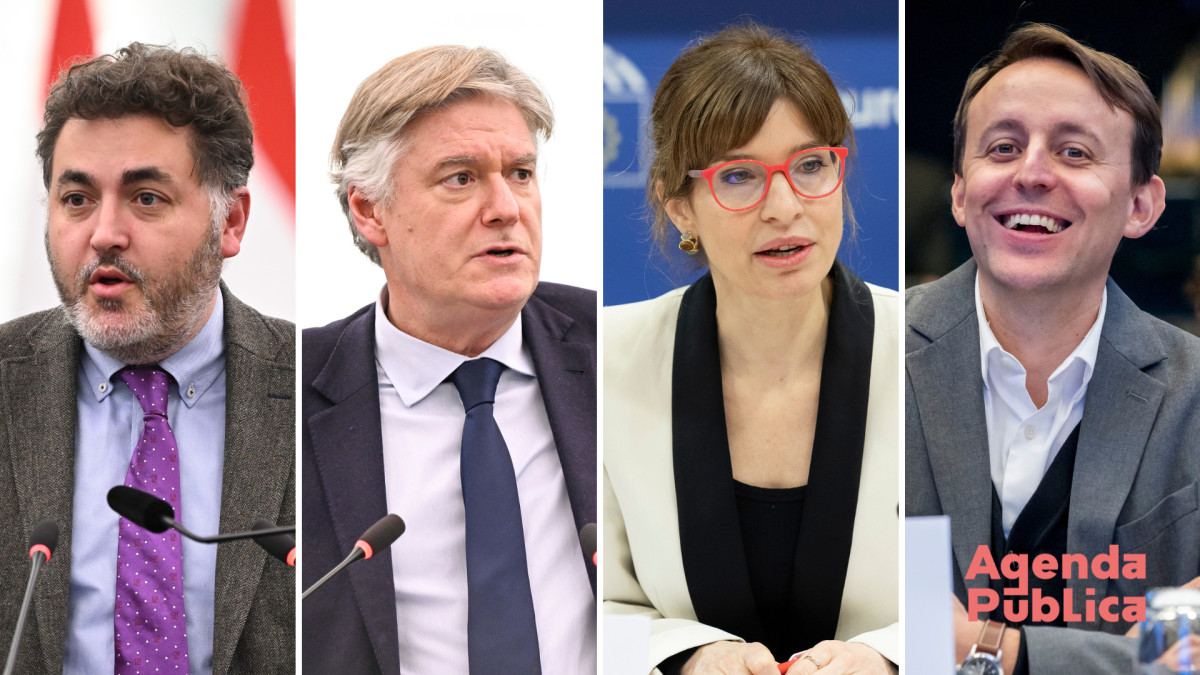
At this crossroads where NATO, international law, and European sovereignty intersect stand the viewpoints of four Members of the European Parliament, all contributing to the section. Hana Jalloul, Antonio López-Istúriz, Javi López, and Jonás Fernández respond to the situation with an understanding of Spanish politics as well as a comprehensive grasp of the European Community framework.
By denying the United States the use of Rota and Morón for attacks on Iran, is Spain asserting its independence, or is it risking the alliance’s credibility?
Jonás Fernández: Spain is simply exercising a prerogative recognized in the bilateral agreements with the United States that govern the use of these bases, which specify that any military operation outside the NATO or United Nations umbrella requires Spain’s formal authorization.
Spain is therefore acting in accordance with normal procedures under the cooperation framework signed with the United States.
Antonio López-Istúriz: Spain has every right to defend its sovereignty and to participate in decisions that affect its security and foreign policy. Yet, such legitimate autonomy must be exercised prudently and, above all, in coordination with our allies. The bases at Rota and Morón form part of a broader framework of strategic cooperation with the United States, and within our commitment to NATO.
“An ally’s credibility rests precisely on predictability and cooperation”
Therefore, any decision affecting their use should be handled with transparency and dialogue within the alliance, and we should avoid sending signals that could be interpreted as unreliability. An ally’s credibility is built on predictability and cooperation. Sánchez has acted as if guided by regimes not aligned with democratic history; he has made moves outside the Cortes Generales’ rulings, without informing His Majesty the King and without consulting with his European partners.
Hana Jalloul: That dichotomy does not accurately reflect the reality. Spain isn’t asserting greater independence; it is operating within the framework of the 1988 cooperation agreement with the United States, which grants Spain the authority to authorize movements at those bases, such as the routing of strategic bombers. This permission has occurred on prior occasions and is a standard aspect of the bilateral cooperation that governs U.S. bases on Spanish soil.
What we must emphasize is the illegality of the intervention. The strikes on Iran carried out by the United States and Israel violate international law and the UN Charter, lacking backing from the Security Council or even the U.S. Congress.
This position aligns with condemning the Iranian regime and its repression of Iranian citizens, particularly women, a stance we have repeatedly taken, and with designating Iran’s Revolutionary Guards as a terrorist organization.
Javi López: Spain remains a dependable, first-rate partner within NATO and the United Nations. What it is doing is affirming its steadfast commitment to international law and to peace by declining to allow its territory to be used for a war that is unjustified and illegal, lacking UN Security Council endorsement or proper alignment within the NATO framework.
Unlike the Aznar government in 2003, Pedro Sánchez’s government is rejecting participation in a war that would only intensify violence and destabilization in the region and threaten global peace.
What jeopardizes the alliance’s credibility are unilateral military interventions conducted with external third-party states outside the alliance, not actions by members who comply with international law.
Does the prospect of U.S. trade retaliation compel Spain to choose between economic interests and strategic autonomy?
H. J.: Spain’s stance on the claimed trade retaliation has also been reinforced by the European Commission. The unity between Spain and the Commission—our lead on trade policy—shows that Trump’s warnings are not a credible threat.
Trade matters fall exclusively under Community jurisdiction, not Member States, so this does not endanger Spain alone but the EU as a whole.
“This stance aligns with condemning the Iranian regime and its oppression of Iranian citizens, especially women”

In any event, it’s important to recall that this is not a novel situation. Since last summer’s agreement with the United States, when Ursula von der Leyen accepted tariffs at 15%, the Trump administration has threatened several countries for backing Denmark’s autonomy over Greenland. The EU’s economic interests depend precisely on that strategic autonomy and on acting as a united bloc in the face of such threats.
J. L.: Trump’s threat is not directed at Spain alone but at the entire European Union. His ignorance of how transatlantic trade works is not a new phenomenon, nor is his unpredictability and the potential fallout of his actions.
Frankly, there is nothing new under the sun. Trump has already dismantled the premises of the Turnberry Agreement following the Supreme Court ruling on his tariff measures, to which he responded with public talk of a new general 15% tariff.
The Trump administration is not a reliable partner. It reacts to setbacks—external or domestic—in a capricious and indiscriminate manner. Europe’s economic interests demand real strategic autonomy.
A. L. I.: We should not accept a false choice between strategic autonomy and economic prosperity. As a member of the European Union, Spain participates in a common market and a commercial policy designed to strengthen our bargaining power against major powers.
What is needed is to act with strategic acumen: defend our economic interests while maintaining a robust relationship with the United States, which remains a pivotal partner in security, trade, and shared democratic values.
Impulsive choices or short-term political gestures can have repercussions beyond diplomacy… We still remember Zapatero’s disregard for the flag and the lasting consequences of that act.
J. F.: Trade policy is a complete competence of the European Union, not of the individual Member States. Therefore, there is no room for targeted trade retaliation against a specific EU country.
We can also recall the Algeria case and its gas exports to Spain, where the North African country’s government threatened retaliation that it couldn’t actually carry out.
To what extent has public opposition to interventions in the Middle East shaped the government’s decision? Can political caution prevail over strategic aims?
J. L.: I believe that, more than public opposition to Middle East interventions—which does exist—the decisive factor is the public consensus on the need to respect international law and preserve peace.
“This government’s stance reflects the solid values and legitimate interests of Spanish society”
The government’s stance isn’t merely a fact—it’s ingrained in its DNA: defending multilateralism, engaging in dialogue, pursuing diplomacy, de‑escalation, and peace. All of this has been expressed within the European Union and across every multilateral arena. The entire record of this government and its president corroborates it. He’s articulated this stance before—on Ukraine, Gaza, and Greenland.
This decision by the government rests on the firm values and legitimate interests of Spanish society. An illegal war serves no one.
A. L. I.: It’s clear that in Spain the government has pushed to polarize society; Sánchez himself noted as much in his investiture speech.
Democratic governments are only true democracies if they respect the separation of powers. In that sense, the Cortes Generales embodies the expression of popular sovereignty and the main forum where public opinion is formed and represented. Sánchez frequently bypasses the Cortes. He makes decisions without presenting them to the Congress or the Senate and without facing questions from the press: these “institutional declarations” feel like a bad joke to journalists.
J. F.: I perceive a clear strategy in the Spanish government’s actions when, under the U.S. cooperation agreement, it chooses to reject using our bases for operations outside NATO and UN frameworks.
That strategy rests on a commitment to denounce any blatant violation of the UN Charter, whether in Russia’s actions in Ukraine, Israel’s actions in Palestine, or presently the U.S. and Israel’s actions against Iran, or Iran’s actions toward its regional neighbors.
H. J.: Any strategy we adopt cannot legitimate military intervention outside the bounds of international law, which unsettles regional stability and fails to foster de‑escalation or diplomatic dialogue. If that prompts public opposition, it’s because people care about international law, understand history, and value peace. We must be explicit in condemning the illegitimate use of force and violations of international norms.
The position of the Spanish government resonates with a broad majority of citizens, who regardless of ideology or party reject war and the unlawful use of violence. Two decades ago, Spaniards took to the streets to oppose the Iraq War, whose catastrophic consequences brought violence and instability to the entire Middle East and where it later turned out that there were no nuclear weapons.
We remember. And that is why Pedro Sánchez’s administration has chosen not to stand passively by and to defend firmly a return to UN-led mechanisms as the sole path to de‑escalation and peace in the region.
Is Sánchez’s stance a pledge to European strategic autonomy, or does it expose Spain to isolation within NATO?
A. L. I.: Europe must move towards greater strategic autonomy, especially in defense and security. Yet this autonomy is not incompatible with a strong NATO. In fact, both dimensions should reinforce one another.
The danger arises when some decisions are presented as domestic political gestures rather than as elements of a coordinated European strategy. Spain must seek to be a bridge-builder, not a source of doubt about its place in the alliance. Our country holds a critical geostrategic position and should use it to strengthen both transatlantic cooperation and Europe’s capacity to act.
J. F.: This military operation was launched without NATO’s involvement or approval.
“The only country isolating itself by launching military operations without NATO support is the United States”
Rejecting the use of military bases on our soil shouldn’t be read as NATO isolation, because the only country acting in isolation by waging wars without seeking NATO backing is the United States.
H. J.: The position expressed by President Sánchez signals responsibility, multilateralism, and peace. Spain has been, and remains, a steadfast NATO member, a fact that underscores its role within the Atlantic Alliance. Our commitment to peace and to international law is compatible with—and essential to—the importance we attach to NATO membership.
The Government and the PSOE have consistently supported building a European defense architecture grounded in upholding the UN Charter.
Evidence of that commitment includes Spain’s backing for Ukraine, or the recent deployment of a Spanish frigate to Cyprus as part of a joint European operation to bolster protection against attacks. We have condemned Iran’s attacks on various nations, and we continue to urge the EU to act coherently and decisively, avoiding double standards, as was the case with Gaza.
J. L.: Many European leaders have become complacent and overly subservient to the United States since Trump took office. That approach has produced disastrous political, economic, and security outcomes. Spain challenged that course from the start and argued that the EU should be a stronger pillar within NATO, capable of defending its values and interests autonomously. Today that stance has found full vindication.
The same logic applies to this illegal war. Spain was the first to denounce it, and its position has since been echoed by other European nations, and not only by European countries.
It reflects a readiness to wield our geopolitical potential autonomously, to defend our values and interests. The EU and many of its Member States are mistaken, in my view, about failing to recognize the profound consequences of joining this new fiasco fostered by Trump and Netanyahu.
