
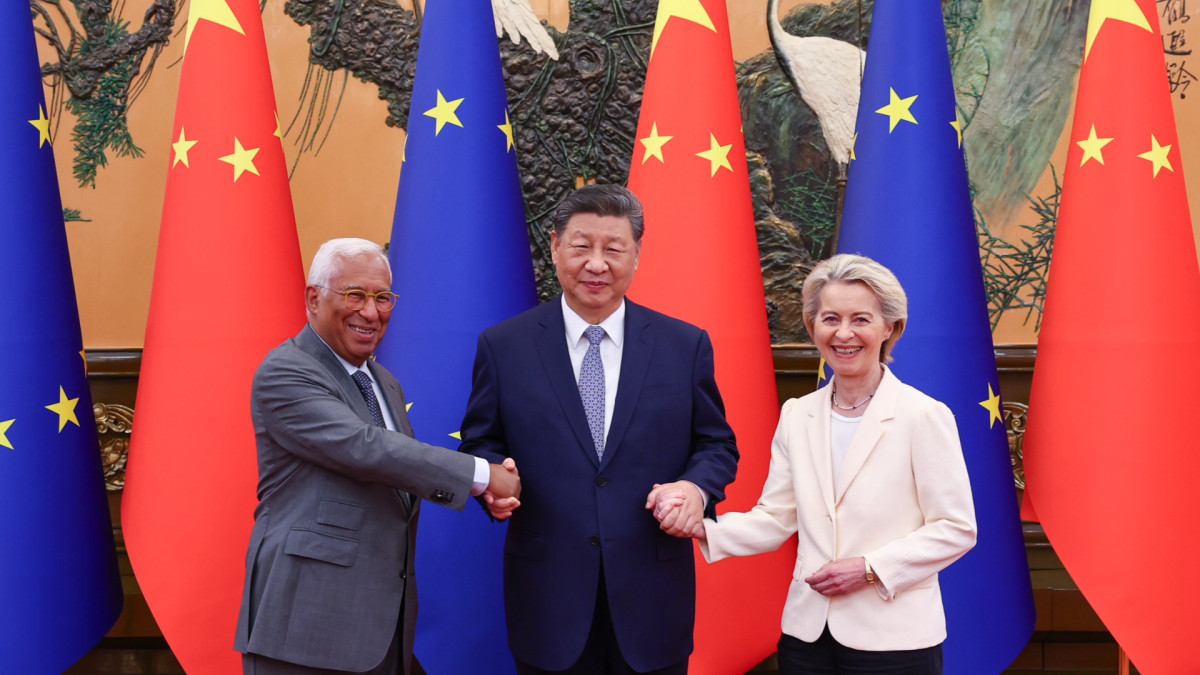
Last Friday, the European Commission held a special meeting of its commissioners devoted exclusively to China. The hope of the European Union’s executive is that the coming weeks will help the EU develop a new strategy to manage its trade relationship with the Asian giant, which is already a direct threat to European industry. The opportunity to elevate this debate to political urgency lies at the EU heads of state and government meeting in mid-June, when the European Council is scheduled to address the issue.
In 2019, the Juncker Commission drafted a new strategy for China that continues to shape the European agenda with Beijing seven years on. It described the Asian giant as “partner in cooperation, economic competitor and systemic rival”. European leaders, despite their many and varied sensitivities and relations with China, decided to unanimously bless that definition, which maintained a balance among all dimensions of the ties with the giant. In a relationship heavily marked by fears of retaliation that China could take, that move marked a turning point.
“The European leaders unanimously blessed that definition, which maintained a balance among all dimensions of the ties with the Asian giant”
But since then, the situation has worsened. In the Commission’s view, those three elements of the relationship with China have become unbalanced, especially since the pandemic. China remains an economic competitor, but with €800 billion a year in subsidies, according to the IMF. This policy is designed to prevent the yuan from appreciating and also a refusal by Beijing to foster domestic demand, diverting all subsidized production toward exports; it is not a fair competitor.
Over the past years, the Commission has steadily hardened its stance. Politically, the previous US administration under Joe Biden actively influenced Brussels to be tougher on Beijing and to take its threat seriously. But the European executive needed only a nudge from Washington to sound the alarm. Its president, Ursula von der Leyen, was already skeptical about China, and around her were aides and technicians who shared that view. That translated, during her first term, into the rollout of an unprecedented economic-security agenda for the EU. In spring 2023, Von der Leyen set out her first clear stance on the issue, her own “China doctrine”: she called on the EU not to decouple (decoupling), which was the trend in the US, but to de-risk. It has been a slow process of changing mindsets that is applied across all areas, aiming to protect supply chains and Made in Europe in proposals such as the Industrial Acceleration Act (IAA).
But all those measures are slow and require a time Europe does not have. It must begin by ensuring that its industry does not disappear in the coming years. “It’s much cheaper to protect industrial capacity now than to rebuild it later, once the industries have collapsed,” explain economists Sander Tordoir and Brad Setser, who have written a paper for the Centre for European Reform (CER) on the China shock 2.0 and Germany’s complacency in the face of a Chinese revolution that is targeting the heart of its business model: machinery, chemicals, pharmaceuticals and, of course, cars. So far, the EU has tried to shield these industries with tools from another era: tariffs levied for antidumping and foreign subsidies through a new regulation. They are very complex processes, requiring testing, in-depth product-by-product investigations and, above all, time.
And again: that is time Europe no longer has. Stéphane Séjourné, the European Commission’s executive vice president and head of enforcing the Foreign Subsidies Regulation, explained this week: at times, “an eight- or nine-month investigation does not allow us to save the sector”, the Frenchman told a group of European media outlets. Not only is it a matter of time, but also of effectiveness. Despite the trade barriers on Chinese electric cars, in 2025 their imports rose again by 26%, and Beijing offset any possible European market closure for its electric vehicles with a 155% increase in hybrids.
“The European Commission proposed using much more general and rapid tools, such as quotas and safeguards to protect entire sectors”
Last Friday, both Séjourné and Maroš Šefčovič, Commissioner for Trade and Economic Security, in addition to strengthening the risk-reduction agenda along the supply chain, proposed using much more general and rapid tools, such as quotas and safeguards to protect entire sectors. That strategy has two important “drawbacks”. The first is that they are applied broadly to all partners and, as seen with the steel and aluminum case, loyal trading partners feel they are unfairly bearing the brunt of the China standoff. The second is that Beijing will retaliate.
It is here that the hard-to-control panic element comes into play. Governments of many member states have many reservations about being harsh with Beijing because of the measures that China could take against its own exports, as in Germany’s case, or against Chinese direct investments. Spain had already shifted its stance on tariffs against Chinese electric vehicles during a visit by the Prime Minister to Beijing, and last week, when it emerged that France had sent a reflection document to the European Commission calling for tougher actions against commercial practices that align with China, and that in that document Spain, together with other countries, backed the request, the Ministry of Economy quickly tried to dissociate itself from the document. This is a highly sensitive matter.
The damage that China can cause does not come only through those two channels. Beijing has many ways to trigger major disruptions in the European industry’s supply chains, as already seen with the case of Nexperia chips after the Government of the Netherlands took control of the company, originally Dutch but purchased by a Chinese firm and with its operations now concentrated in southern China. But all of this is precisely driving the Commission’s Secretariat-General and the Directorate-General for Trade to act as soon as possible: this kind of practice will not disappear; it will increase. If there is a window of opportunity to break this dynamic, it is now, or so they think.
“China will only be willing to seek a negotiated solution to the trade imbalances if it sees a real risk of losing a large part of its access to the European market”
To that end, the EU’s executive shares an idea expressed by Tobias Gehrke, an analyst at the European Council on Foreign Relations (ECFR): the EU must be ready to provoke a certain level of economic and commercial deterrence. China will only be willing to seek a negotiated resolution to the trade imbalances, which Spanish President Pedro Sánchez has described as “unsustainable,” if it sees a real risk of losing a large part of its access to the European market, which is key to its exports. And that, of course, will not happen without some pain and tension. “China’s coercion and its systemic imbalances are two sides of the same coin. Trying to address the latter will inevitably provoke the former,” Gehrke explains.
