
Digitization has turned cyberspace into a territory of geopolitical contest where information threats and interference operations unfold. The initial view of the Internet as a space of democratic freedom has given way to a more complex reality, in which cyberspace today functions as an extension of physical territory, where power strategies crystallize on three interdependent layers — physical (infrastructures), logical (platforms) and informational (narratives). In this context, the Spanish linguistic space, with 635 million potential speakers, constitutes a strategic setting for disinformation campaigns that exploit transnational connections between Spanish-speaking communities.
“The Spanish linguistic space constitutes a strategic setting for disinformation campaigns that exploit transnational connections among Spanish-speaking communities”
The geopolitical shift accelerated by Donald Trump’s second presidency, the questioning of global governance and the growing multipolarity configure a tense environment for the Ibero-American space. Latin America faces migratory and climate crises, the expansion of transnational crime, and extreme political polarization, while powers such as China and Russia intensify their presence in the region. The Ibero-American Summits — particularly the XXX Summit, to be held in Madrid on November 4 and 5, 2026 — emerge as critical moments where these challenges converge.
This article is the first in a series of three that analyzes the risks and opportunities of the Spanish linguistic space from the perspective of disinformation. It focuses on the physical and logical layers, i.e., the geopolitical dimension of digital infrastructures and the American dominance of platforms. The next two address the disinformation strategies of state and non-state actors in the Ibero-American space —with special attention to Russian interference— and institutional responses, with recommendations to strengthen narrative resilience ahead of the Madrid Summit.
As for the methodology and the development process, the series is the result of a preliminary research process on disinformation as a geopolitical phenomenon. The research aims to increase social knowledge about disinformation threats in the Spanish and Ibero-American context and to promote preventive, analytical, and, of course, responsive measures.
“The series is the result of a preliminary research process on disinformation as a geopolitical phenomenon”
In an increasingly digital world, disinformation and cyberattacks have become one of the main threats to national and international security. Information manipulation campaigns affect both domestic politics and foreign relations, especially in the Ibero-American space. Spanish, besides being a cultural asset and, therefore, geopolitical, is a space vulnerable to interference campaigns, political polarization, and foreign influence operations. Therefore, the series first introduces a broad concept of disinformation within a methodological approach of critical geopolitics, supported by classical and algorithmic geopolitical cartography. Subsequently, it takes language as a specific focus for the analysis of disinformation. To give greater analytical solidity, data on trends and impact in Twitter (now X) are provided through collection via the Visibrain API.
The Redefinition of Power Dynamics Since the Emergence of Cyberspace
Internet was initially perceived as a realm of free communication more than a space of power. This view has radically changed. The United States consolidated a dominant position by controlling the main technological elements for the development of the Internet: physical networks, logical infrastructures, and application platforms. This hegemonic position allows it to function as a data-transfer node for the American continent and for connections with Europe, more focused on regulatory aspects, which has entailed a concession of its digital sovereignty.
“The United States consolidated a dominant position by controlling the main technological elements for the development of the Internet: physical networks, logical infrastructures, and application platforms”
The rise of social networks between 2010 and 2015 transformed information flows, “horizontalizing” and “transnationalizing” them. This phenomenon broke traditional information hierarchies and was interpreted as a “democratization of information.” Its open architecture allowed anyone to connect networks and launch services without centralized authorization. Multiactor governance (technical experts, the academic sector, companies and civil society) and the absence of coordinated regulation fueled the perception of a non-hierarchical environment.
This apparent freedom had tangible effects on social movements. The mass adoption of smartphones in 2010, together with the exponential use of Twitter (now X) and Facebook, coincided with the 2008 economic crisis and facilitated self-organization at multiple geographic scales. The Arab Spring (2010-2011), the Indignados movement in Spain (2011), Occupy Wall Street (2011) and, more recently, the Cuban protests of 2021 made evident the role of social networks in articulating transnational counter-powers.
However, this period of “freedom” seems to have reached a turning point. Disinformation campaigns and cyberattacks have become strategic tools of state and non-state actors, turning cyberspace into a hostile terrain. Despite partially diluting physical borders, informational behavior generates spatial patterns linked to linguistic, political and ideological connections and, therefore, also territorial. For this reason, Spanish — with 520 million native speakers and official in 20 countries — constitutes a space highly vulnerable to informational interference campaigns with transnational repercussions and specific consequences for the polarization of societies.
“Disinformation campaigns and cyberattacks have become strategic instruments of state and non-state actors, transforming cyberspace into hostile terrain”
The predominant focus in disinformation research has marginalized the linguistic dimension, limiting understanding of the phenomenon and the informational potential of Spanish. From a geopolitical perspective, the Spanish-speaking cyberspace is in a moment of contest due to the multiple interests that Latin America arouses for powers such as the United States or emerging actors promoting the redefinition of global alliances through initiatives like BRICS. Cyberspace is not a dimension isolated from conflict, but an additional layer where power relations among powers are projected and crystallized.
Unequal and Centralized Digital Infrastructures
The physical layer of cyberspace is often left out of the disinformation debate, but it conditions it. Submarine cables, data centers, and telecom networks determine where information flows, who can observe it or interrupt it, and under what jurisdiction it is stored. Cables carry more than 95% of international data traffic, and although they are managed mainly by private consortia, deciding which routes are built, who funds them, and under what rules equals fixing dependencies between States. They are also infrastructures exposed to sabotage and espionage. In authoritarian contexts, that control becomes a direct instrument of power, as could happen in Cuba.
“Submarine cables, data centers and telecom networks determine where information flows, who can observe it or interrupt it and under what jurisdiction it is stored”
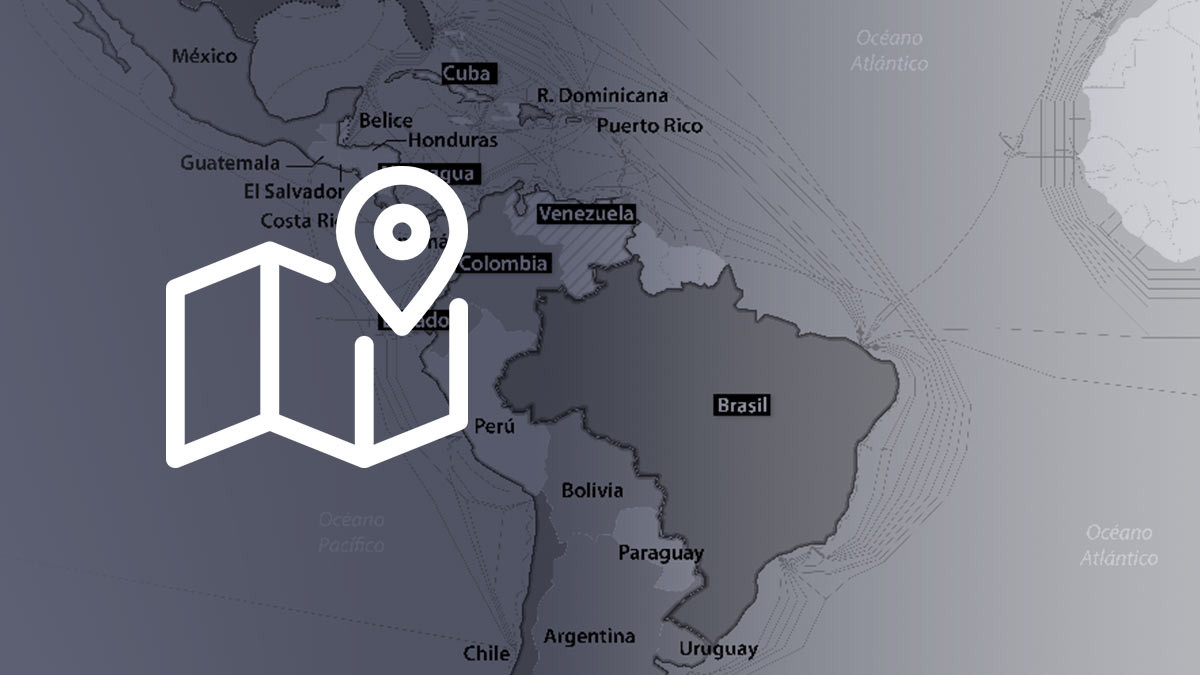
A system centered in Florida. The United States is the central node of this architecture on the continent. It accounts for 23% of global internet traffic, and of the nearly 68 submarine cables that the American continent had in 2020, about one third originated from its territory. The map in Figure 1 shows the result. The routes concentrate in the Atlantic and converge at the Americas’ Exchange Point (NAP) in Florida, from where they fan out toward the Caribbean, a densely interconnected space that acts as a bridge between the North and the South, while Panama channels systems along the Pacific coast. The exceptions highlight vulnerabilities. Cuba is almost disconnected from the United States due to the embargo, and in Central America El Salvador lacks its own landings and Honduras and Nicaragua barely have a few, while Colombia and Venezuela are well integrated into regional networks.
Pase sobre el mapa para hacer zoom. Figura 1. Geopolítica del ciberespacio en español e iberoamericano, un espacio informacional en riesgo y en disputa. Elaboración de Kartex.
From Operators to Platforms. The first generation of cables was driven by operator consortia, and Telefónica was for two decades the main vehicle of Spain’s presence. Its expansion across the region built a network that connected countries, governments and markets, and it turned it into a node of diplomatic, technological and cultural relations between Spain and Latin America. That influence has eroded. The deterioration of margins, regulatory instability and devaluations have led the company to shed Latin American assets, and its place is now occupied by Google, Meta and Microsoft, which control end-to-end the data chain, from platform to data center to cable. Since 2024, content and cloud service providers surpass traditional operators as the main demanders of capacity on the links between the United States and Latin America, with growth close to 50% annually and more than 90 Tbps carried that year. The network has modernized — 18 new fiber systems in the last decade and 157 Tbps of international capacity in 2023, with an average annual growth of 34% — but it has done so following the logic of those companies, which decide routes and capacities based on where they place their data centers. At least seven more cables are in development, and the Humboldt cable, with entry planned for 2028, will connect Chile with Asia-Pacific with participation of Desarrollo País and Google.
“Since 2024, content and cloud service providers surpass traditional operators as the main demanders of capacity on the links between the United States and Latin America”
Alternative routes and Spain’s role. Connections between Europe and America pass mainly through the United Kingdom and, to a lesser extent, through France and Spain. Telxius, Telefónica’s infrastructure subsidiary, developed with Microsoft and Meta the MAREA cable, which connects Virginia Beach with Sopela (Bizkaia) and which, when in service in 2018, was the Atlantic’s highest capacity cable (up to 200 Tbps), and operates BRUSA between the United States and Brazil. EllaLink (2021) opened the first direct connection between Europe (Sines, Portugal) and Latin America (Fortaleza, Brazil) without passing through the United States, and the BELLA II project, framed in the EU-CELAC Digital Alliance, seeks to strengthen these ties. In the Europe-Africa-America axis, Spain acts as a hinge. The Canary Islands are a landing zone for systems such as Canalink, Pencan-9, ACE or SAT-3/WASC, its direct connection with EllaLink has received funding from the Connecting Europe Facility (CEF Digital) and the ACE cable guarantees the link with Equatorial Guinea.
Asymmetries of computing and access. The imbalance is even greater in processing and storage of data. Of the nearly 10,000 data centers operating worldwide, Latin America and the Caribbean host 4.8%, compared to 38.5% in the United States; in hyperscale capacity, the United States accounts for around 49%, China around 15% and Latin America and Canada, together, around 4%. The result is a structural dependency, with higher latency, higher transit costs, lower resilience and data hosted outside national jurisdictions, subject to external regulatory frameworks. Regional investment in data centers is expected to double, from $5 billion in 2023 to around $10 billion in 2029. That growth will intensify competition for data flows, especially between the United States and China, and will require energy and water, because a data center consumes between 10 and 50 times more electricity than a commercial building and may require millions of liters of water per year for cooling. In access, the gap persists. The fixed connection reaches 77% of households in Brazil and 74% in Chile, but only 25-31% in Guatemala and Nicaragua, as shown in Figure 1; mobile broadband has reduced that distance only partially.
“The consequence is a structural dependency, with higher latency, higher transit costs, lower resilience, and data hosted outside national jurisdictions, subject to external regulatory frameworks”
Mobile networks and the Washington-Beijing pulse. The mobile ecosystem is concentrated in a few groups —América Móvil, Telefónica, Millicom and AT&T—, along with pioneering state operators such as Antel, which launched the region’s first 5G in Uruguay (2019), or Costa Rica’s ICE. Huawei, ZTE, Nokia and Ericsson supply much of the equipment. The United States has conditioned the Chinese advance in the region on national security grounds, but only Costa Rica has vetoed Chinese technology in its auctions, so Chinese and European manufacturers compete openly. The Atlantic worry is also present. In January 2023, NATO and the European Union created a joint working group to protect critical infrastructures.
Balance. The region has expanded cables, capacity and networks, but its digital map remains centralized and unequal, with bottlenecks at landings, backbones and local computing. Infrastructures are not neutral, because hierarchies and forms of sovereignty are defined in them. Latin America remains in a peripheral position, between US technological hegemony and China’s expansion, and the challenge is not only to expand connectivity, but to do so with criteria of sovereignty, sustainability and regional cooperation.
The US Dominance of Digital Platforms and Its Political Implications
With the arrival of the Trump Administration in 2025, the major social media platforms reoriented their strategies. Under strong political pressure and regulatory threats, they revised their approaches to disinformation and content moderation. Freedom of expression shifted from a balance of rights and responsibilities to a more deregulated framework. This relaxation of safeguards seeks to shape — and dominate — the spaces through which much of human communication passes.
“This relaxation of safeguards seeks to mold — and dominate — the spaces through which much of human communication passes”
Digital platforms thus consolidate as . Few states possess a technological ecosystem capable of projecting such influence; among them, the United States and China, expected to intensify their competition on the global stage and in the Spanish-speaking context.
Political mistrust over digital abuses. American tech companies maintain a relevant dominance in multiple fields —Microsoft, Google— and in social networks, with Facebook (3.049 billion users), YouTube (2.491), Instagram (2.000), WhatsApp (2.000) and X (415). Nonetheless, this dominance is increasingly questioned and generates political concerns in certain countries due to its impact on digital sovereignty. Moreover, social fragmentation in platform use is intensifying with the emergence of Chinese-origin competitors such as TikTok (1.562) or WeChat (1.336), and alternatives like Telegram (1.000).
Elon Musk, after acquiring and transforming Twitter into X, consolidated a model with a high risk of partisan manipulation, particularly due to the businessman’s political role in the campaign and —for a few months— in the Trump administration. A European DigiHumanism study detected the appearance of a bot campaign on X in support of Alternative für Deutschland (AfD), which allows anticipating similar trends in a deregulated framework. The Cambridge Analytica case — for the scandal of its microtargeting activities during electoral campaigns, including Donald Trump’s in 2016, and its subsequent operation in Spanish-speaking countries — had a large impact on societies and emphasized the importance of understanding how these platforms operate and their role in social processes. A few years earlier (2013-2015), Edward Snowden’s revelations about mass surveillance carried out by the US intelligence agencies profoundly affected societies.
Cases like these have strongly conditioned trust in American platforms, and the diversification of tools is becoming more pronounced, although the ecosystem remains dominated mainly by the United States and China. The space of the Spanish language remains strongly marked by the dominance of American platforms. Yet, in recent years there is a visible trend toward diversification, with increased use of Chinese platforms —TikTok, WeChat— and the growth of Telegram, of Russian origin, not associated with the Kremlin, though it has become one of the main networks through which Russian disinformation campaigns are carried out.
Governments such as Nicolás Maduro’s in Venezuela (2013-2026) — concerned about the widespread use of American networks among Venezuelans — promoted social networks like Telegram or WeChat to replace WhatsApp or Instagram, deeming them dangerous, criminalizing their use. The dominant dynamic points to strengthening control and the “frontierization” of cyberspace. Changes in digital policy — whether to gradually substitute American dominance or to deepen the relationship with the United States — will depend on the evolution of local governments.
“Changes in digital policy — whether to gradually substitute the American dominance or to deepen the relationship with the United States — will depend on the evolution of local governments”
Struggles and power strategies in the Ibero-American cyberspace. Despite technical limitations and disparities in infrastructure, Latin American countries maintain strong activity on social networks. According to GlobalWebIndex in 2019, Latin America has one of the highest social media consumption rates in the world, well over 200 minutes per day. Brazil and Colombia stand out with 225 and 216 minutes on average, followed by Argentina and Mexico. Unlike the downward trend in screen time in developed countries, the dynamic in Latin America is one of increasing consumption, making platforms important spaces for citizen information. The average Latin American user accessing social networks is around 86.6%.
Within these, the growth of TikTok stands out, with a global increase of 11.8% in 2023 compared with 2022, followed by Instagram (+3.2%) and Snapchat (+1.2%), to the detriment of Twitter (-2.6%) and Facebook (-0.7%). Globally, Facebook remains the dominant platform among the social platforms in the Ibero-American space, though its leadership margin is narrowing. In Brazil, projections indicated that Instagram would surpass it by 2025, reflecting a generational shift in usage preferences.
Twitter faces an estimated contraction of 2.1 million users under Elon Musk’s leadership, a situation that has favored migration to emerging platforms such as Koo or Bluesky. In contrast, TikTok was poised as the fastest-growing network in 2023, though it will have to face competitive pressure from Instagram and Kwai in the Brazilian market. Other platforms such as Odysee —created in 2020 as a decentralized alternative to YouTube— are emerging as new and dynamic platforms where pro-Russian or conspiratorial content spreads. American dominance of platforms is increasingly questioned, encouraging regional or national particularities that show a trend toward territorialization of cyberspace.
The Latin American cyberspace concentrates a dynamism and heterogeneity that are of interest to many actors, causing tensions and conflicts. On one hand, there are judicial actions such as platform blocks. In Spain, a judge was close to blocking Telegram due to a copyright infringement complaint. Although these actions are almost anecdotal, judicial systems can make complex blocking decisions with clear informational consequences in political and social systems. Nevertheless, it is the actions of governments that have the most direct consequences for informational control, especially if that control aims to limit democratic freedoms.
“The Latin American cyberspace concentrates a dynamism and heterogeneity that are of interest to many actors, causing tensions and conflicts”
Thus, as seen on the map (Figure 1), different Ibero-American governments have applied some form of temporary or perpetual blocking to certain social media platforms. Bolivarian orbit countries (ALBA Red) have used platform blocks to contain protests that emerged with support from social networks.
In response to massive protests in July 2021, Cuban authorities resorted to a cyberspace control strategy that included restricting internet connectivity, blocking social networks, communication platforms and VPN systems, as well as selective interruption of activists’ and dissidents’ mobile and fixed connections. Although platforms played a key role in the onset and sustenance of the demonstrations, government repression significantly limited later organizing attempts.
The legal framework tightened. Decree-Law 35, in force since August 2021, granted providers broad censorship obligations without judicial oversight, while the new Cuban Penal Code approved in May 2022 introduced harsher penalties for crimes committed in digital environments. These measures led to
Platforms Elsewhere, Data Forwarded
The disclosure of internal documents from “the Company” — the Russian political consulting network heir to Yevgeny Prigozhin’s structure, analyzed in the second article of this series — illustrates the paradox of this architecture. The Russian operations documented in Latin America in 2024 did not require their own infrastructure, because they relied on American platforms. According to those documents and the accompanying investigations, the network ran Facebook accounts, paid between 100 and 650 dollars per post on Instagram meme pages in Argentina, used the comments of the hundred largest Bolivian public pages as a barometer of its campaigns, and paid with cryptocurrencies for hosting and domain registrations of its websites. The adversary does not contest American technological hegemony, but exploits it, especially where Spanish moderation is weaker.
The Bolivian case adds a less visible dimension of digital sovereignty. Among the August and September 2024 deliverables, the network’s reports show that the Bolivian Presidency Ministry provided its own analyses of the country’s social networks and key political agenda topics. Digital sovereignty is not lost only through the location of cables and data centers. It also erodes when a government hands over knowledge about its own public sphere to a foreign actor.
A Digital Alliance Without Informational Sovereignty
The Spanish Pro Tempore Secretariat has placed the “Ibero-American Digital Alliance” — digital transformation and artificial intelligence serving people, reducing gaps and protecting children and the vulnerable — among the Madrid Summit priorities, and has convened the Ibero-American Digital Forum on November 3 with governments, private sector, multilateral banks, international organizations and universities. It is an opportunity to treat infrastructures and platforms as the material base of the Spanish information space.
A digital alliance that is limited to connectivity and artificial intelligence, without incorporating information integrity, platform transparency and protection of public data, would leave intact the vulnerability described in this article, that of a linguistic space of hundreds of millions of speakers whose cables, data centers and social networks are largely decided outside the region. The official priorities of the Summit do not mention disinformation. The architecture described in these pages explains why it should appear among them.
