
Industry-wide bargaining could erode the very flexibility that gig workers most desire.
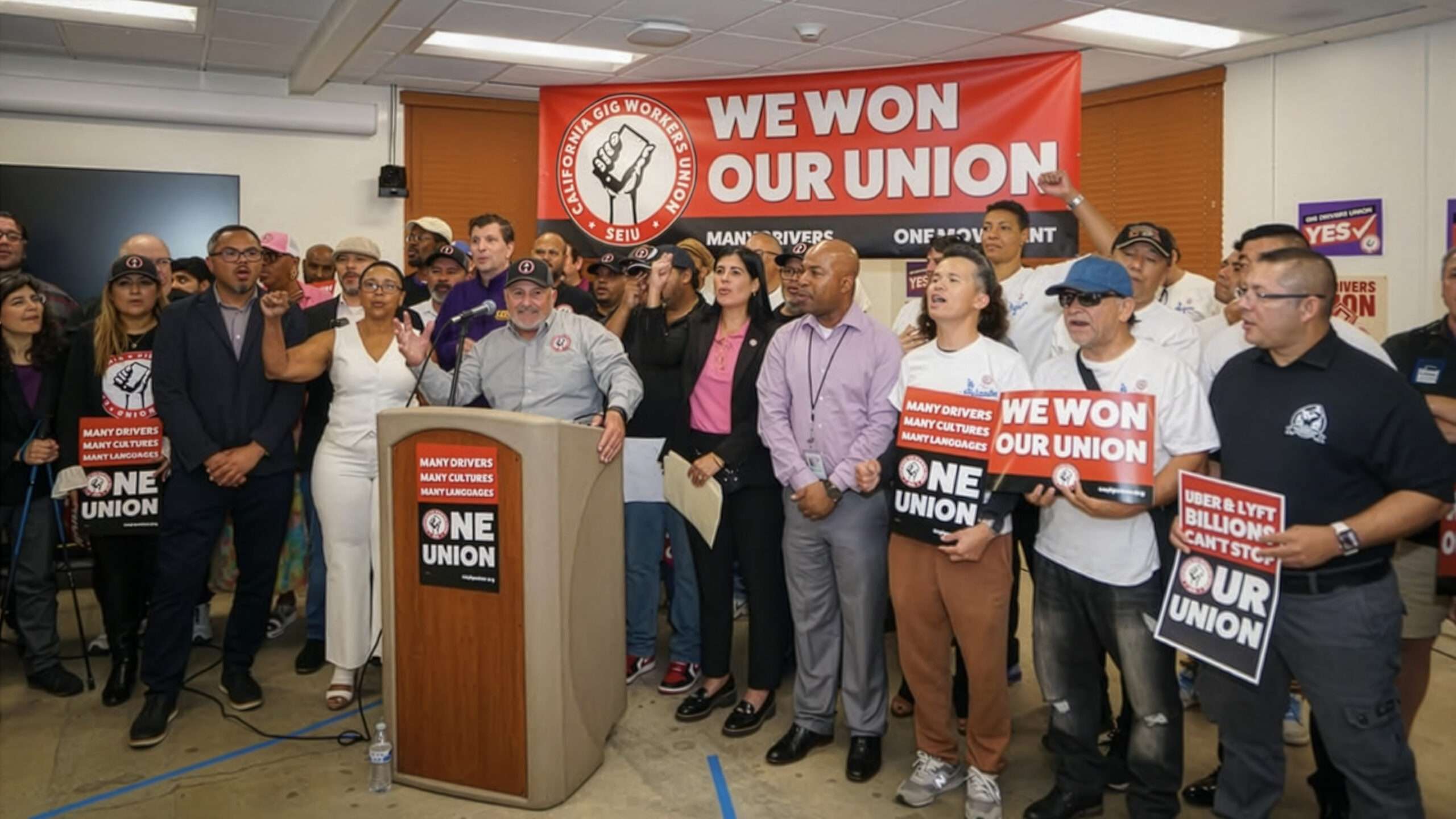
In September, California joined a small group of states by recognizing a statewide union representing rideshare drivers. Thanks to a newly enacted statute, the California Gig Workers Union will bargain directly with Uber and Lyft for all rideshare drivers across the state, and the resulting contract will establish uniform standards for the industry within California.
California is among a handful of blue states that have enacted sectoral bargaining laws for the gig economy. In 2024, Massachusetts became the first state to pass a sectoral bargaining law for rideshare drivers. California enacted its version in 2025, followed by Illinois joining the parade in 2026. Rather than requiring unions to negotiate with individual companies, these laws allow sector-wide negotiations, which could yield standardized terms that squeeze adaptability for both companies and workers.
Perhaps the most troubling aspect is that this sectoral approach could expand beyond the gig economy. Advocates and policy thinkers on the left are increasingly pushing for sector-wide bargaining to become the norm in contemporary American labor relations.
The California statute requires a union seeking recognition to show support from 10 percent of active gig drivers to obtain a directory containing the contact details of other active drivers statewide. The gig platforms are obliged to supply this data to the Public Employment Relations Board of California every quarter. When a union reaches 30 percent backing from active drivers, it earns certification unless a rival union also reaches 30 percent backing.
The law defines “active drivers” as those who have completed at least the median number of trips in a six-month window. Additionally, drivers with fewer than 20 rides are excluded. In effect, the 10 percent and 30 percent benchmarks apply to a subset of drivers far smaller than the total pool of drivers.
The California Gig Workers Union has gained recognition and will begin negotiations with Lyft and Uber. In Massachusetts, the statewide drivers union has already started bargaining with the ride-hailing companies for several months.
To date, sectoral models have stayed within the gig economy. The legal basis is that gig workers operate as independent contractors, not “covered” employees under the National Labor Relations Act (NLRA). Consequently, sectoral arrangements in the gig sphere are arguably not preempted by federal law. On this premise, these sector-wide structures might not extend to conventional “covered” workers in other fields.
Yet there are signs that some progressive law professors and policy thinkers would like to broaden the approach. Harvard’s Center for Labor and a Just Economy (HCLJE) has publicized a model sectoral bargaining statute that could be applied to other NLRA non-covered sectors, including agriculture and domestic work.
Although this seems limited to niches beyond the NLRA’s current reach, Benjamin Sachs, the co-director of HCLJE and a Harvard law professor, has championed novel legal theories to dodge NLRA preemption. One proposal from Sachs is that a future, union-friendly National Labor Relations Board could “decline to assert jurisdiction” over certain categories of employers under the NLRA, which in theory could empower states to extend sectoral bargaining to a wide range of industries.
Ultimately, sectoral bargaining laws present a set of drawbacks. For one, they curb worker choice and are likely to impose more uniform standards across industries. In the gig context, this could translate into tighter scheduling rules, diminishing the very flexibility that gig workers prize.
In Germany, a long-standing sectoral bargaining model has shown signs of reducing market dynamism. German workers are typically less productive than their American counterparts, and while not all economic challenges can be traced to sectoral bargaining, the country’s broader regulatory framework has contributed to a certain rigidity in the economy.
That context helps explain some recent reforms. Reforms to inject more flexibility into Germany’s sectoral framework have aided a partial rebound, and in France, under President Emmanuel Macron, there have been efforts to reform the sectoral bargaining system and push more decision-making to the company level rather than the sector level.
As the California Gig Workers Union’s certification demonstrates, sectoral bargaining is spreading within the gig economy. And the broader endgame could extend beyond gig work. The United States could follow Germany’s path before we realize it.
