
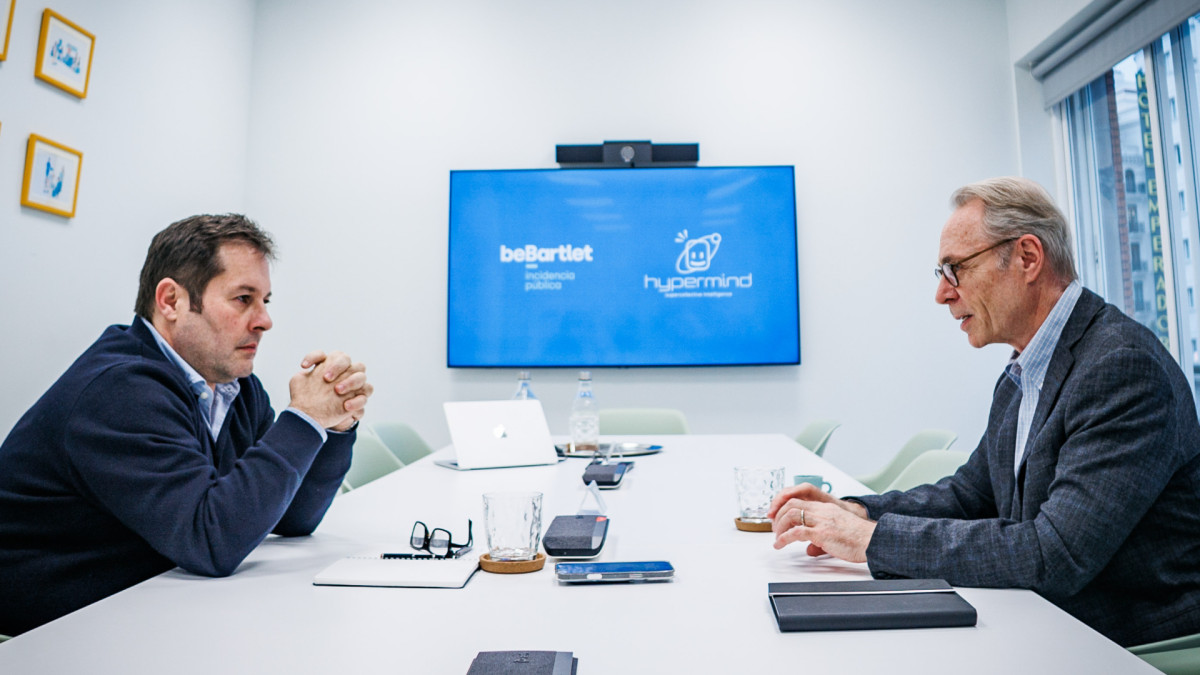
Prediction markets arrive in Spain. Hypermind, the leading European tool for collective intelligence, and beBartlet, the Spanish public affairs consultancy, announced yesterday at the Mobile World Congress a partnership to use this tool exclusively in the field of strategic consulting across Europe. This technology, used by European governments to make better decisions, enables organizations, companies, or media outlets to aggregate intelligence to anticipate scenarios and make smarter decisions.
In this conversation between Marc López Plana, editor and director of Agenda Pública, with Emile Servan-Schreiber, founder of Hypermind, it is also concluded that the media industry has been committing a multimillion-dollar strategic error for decades: making its readers smarter and then doing absolutely nothing with that intelligence. Servan-Schreiber, a researcher with a PhD in cognitive science and a member of a historic European journalist dynasty, creators of L’Express and Les Echos, has the formula to fix it. After 25 years refining platforms for collective prediction, his diagnosis for the sector is blunt and revealing: “if you create something valuable and you do not use that value, it is a waste”.
The arrival of prediction markets to Spain through the consultancy beBartlet opens a door to monetizing aggregated knowledge. Rather than limiting itself to offering static advertising, media can transform its readers into predictive analysts, extracting high-value insights for companies and markets. Servan-Schreiber makes his stance clear: “I believe the future of journalism will depend on gamifying the news”. When a user needs to stay informed in order to bet or compete, engagement surges and the media regains its absolute relevance in the value chain.
But this new business model faces an imminent challenge: artificial intelligence is already here. Although recently it seemed impossible, today technology is advancing at a dizzying pace: “A year ago it wasn’t feasible, but now AI can make predictions as well as a diverse crowd of intelligent humans”. If machines are a hundred times faster and cheaper, what role remains for the human reader in the prediction economy? An in-depth conversation to understand how the fusion of AI, social gamification, and the press will define the economic model of the next decade.
Servan-Schreiber has a long career in the world of artificial intelligence. Photo: Agenda Pública / Tania Sieira
He has spent 25 years driving the main European project for prediction markets. How did it begin?
I started when I worked as a journalist. My family is from Germany. My father created L’Express, my grandfather created Les Echos, and my uncle created L’Expansion. It is a family of journalists. But I was never a journalist: I was a scientist. I studied the brain — cognitive science —, and did a PhD in cognitive science at Carnegie Mellon. I began my career as an artificial intelligence engineer in the nineties, during the so-called “AI winter.” At that time, everyone thought we were clowns.
Then, over time, I became a journalist to seek new ideas in a scientific magazine. I came across an article proposing this idea: instead of using AI to track the Internet and see what’s happening — thirteen years ago the technology wasn’t there to do what we do today —, instead of using AI agents to search for information on the web, perhaps we could use brains connected to the web to generate collective intelligence, especially about the future, which is the hardest problem.
“I thought about creating platforms where people bet against each other to make predictions about the future, and the collective intelligence would be greater than that of any individual”
That was the first time you could massively connect many human brains and see what that network of brains could do. Before the web, this was impossible. As a scientist and as someone who has studied the brain, I knew that all intelligence is based on collective interactions of many smaller agents that aren’t as smart. Neurons, for example: there are 80 billion neurons in your brain. When it became possible to tap the network of human brains created by the web, I thought: “This is fantastic.”
Then I thought of creating platforms where people bet against each other to make predictions about the future, and the collective intelligence would be greater than that of any individual. As a scientist, I was interested in that possibility. As a journalist, I was interested in another thing: we spend time offering analyses and news and making people smarter. That is your craft: to make people smarter. But you don’t do anything with it. Maybe they receive a letter to the editor or something, but little else.
So we give them information through the media and they return to us, through this prediction platform, the use of tomorrow.
Isn’t it enough that people can be smarter?
No, because if you create something valuable and you do not use that value, it is a waste. You make people smarter, and what do you get? A bit of money and perhaps a bit of influence. But you do not obtain the possibility to use that intelligence at your disposal to make yourself smarter, or for your organization or your newspaper to be more effective.
Imagine you are aware of everything your readers know and all the analysis they are capable of doing. How much value would it bring to your media organization to be able to leverage it? There was a famous Hewlett-Packard CEO in the nineties, at the start of the knowledge-management revolution within organizations. He said: “If HP knew what HP knows.” There is a lot of knowledge out there, but you do not have a way to aggregate it and make it useful.
That was the idea: we give the news and they return predictions about what will happen next. What will happen with Trump’s Peace Board? How many countries will join? That will be tomorrow’s news, so we can have it today.
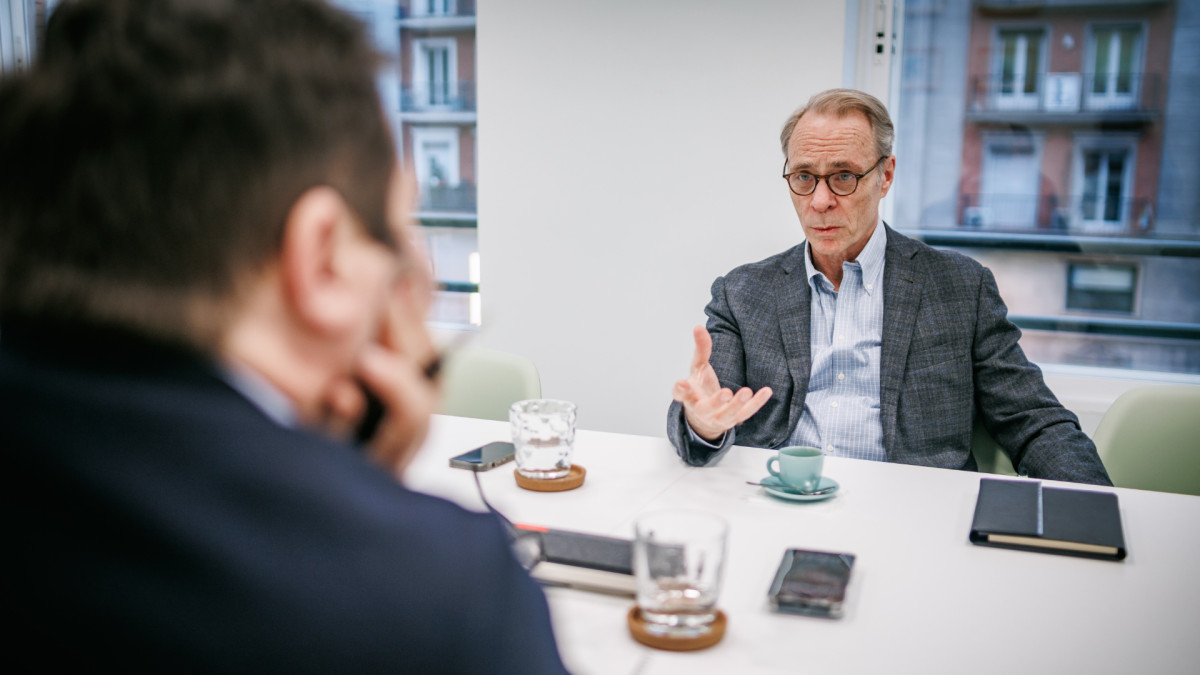
López Plana is interested in the comparison between prediction markets and surveys. Photo: Agenda Pública / Tania Sieira
Perhaps some readers aren’t familiar with prediction markets and might think they are similar. What is the difference between prediction markets and surveys or polls?
It is completely different. It’s important to realize that surveys and polls were invented less than 100 years ago: in 1936, by Gallup. Before that, do you think people didn’t make predictions about elections?
No…
Betting is probably the second oldest profession in the world. We have records of fifteen presidential elections before Gallup invented surveys, in which people bet on Wall Street about who would be the next president. Essentially, they were running prediction markets in the street rather than on the Internet.
The scientific record of those elections before surveys shows that the favorites in betting markets won fourteen out of fifteen times. It was quite accurate. In fact, when surveys arrived, people thought: “Finally, something scientific to predict elections.” Yet history shows that surveys did not do better in accuracy than betting markets before they existed.
Not only that: since surveys were invented, betting markets became less efficient because they were contaminated by bad surveys. As we’ve seen in many elections, people look at a poll and say: “This is what will happen, so I’m going to bet accordingly.” Then, when Donald Trump is elected instead of Hillary Clinton, everyone is surprised. Also, we have newspaper records, for example the New York Post, from before polls. What did they publish? Instead of polls, the odds that Roosevelt would win. Five to one that Roosevelt wins, and then it rises compared to the previous week. They treated betting markets exactly the same way polls are used today as content.
The second difference is the foundation. Polls are based on a representative sample of the population. If you want to say Spaniards prefer this candidate or that one, you need to ensure you represent every Spaniard with a probability of voting. Representativeness is the central principle.
“Everyone has biases: if you are left or right, you may not necessarily have the same perspective or consume the same information. But here you are not asked to express a preference”
In betting markets, representativeness does not matter. What matters is knowledge. That’s why we seek to recruit people who know politics, are interested, and absorb new information all the time to act accordingly. No one is perfect. Everyone has biases: if you are left or right, you may not necessarily have the same perspective or consume the same information. But here you are not asked to express a preference: you are asked to express a prediction. We do not appeal to your emotions. In fact, we observe that betting dampens the brain region linked to emotion, while the area associated with rational thinking is more activated. You are asked for a forecast of what will actually happen on the ground. You must empathize with reality, not with ideology.
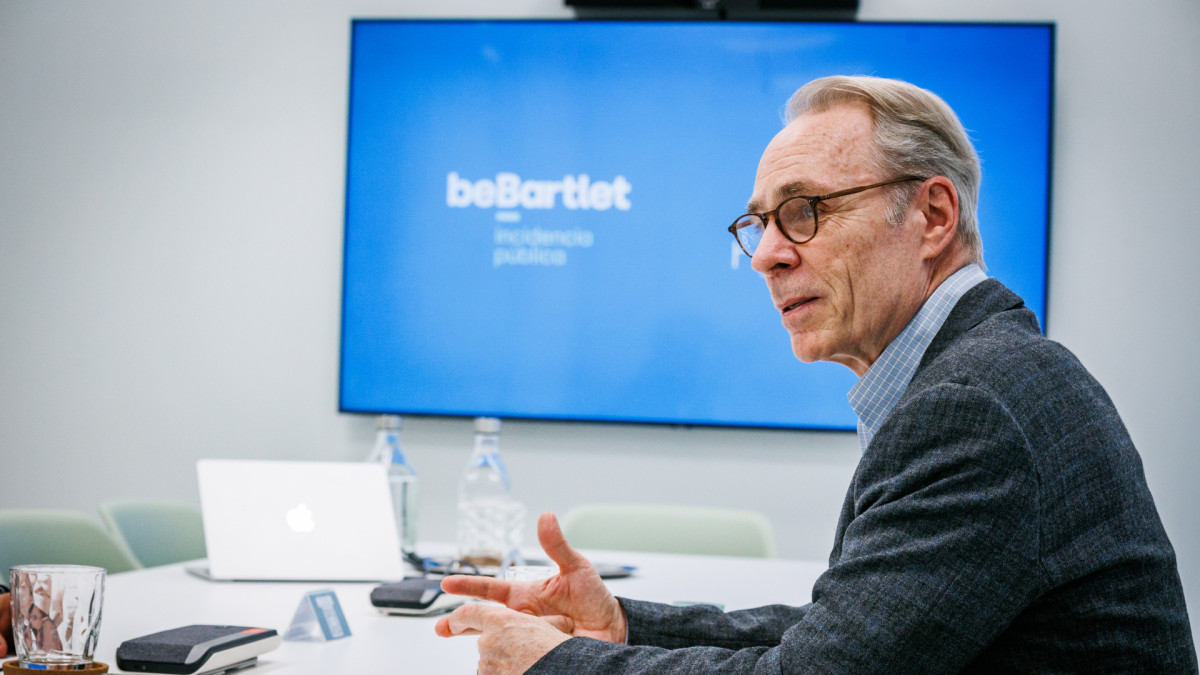
The Hypermind CEO explains how prediction markets work. Photo: Agenda Pública / Tania Sieira
What incentive do people have to participate in a prediction market?
There are four types of incentives, depending on what you want to achieve.
One: rewards. The money you could win or the prizes you could obtain.
Two: recognition. For example, inside Google, when there is a prediction market, not about politics but about the number of Gmail failures, people don’t care about the money: they’re well paid. They care about recognition, such as a T-shirt that says: “I am the best forecaster at Google.” It’s a form of social recognition within the company.
Three: relationships. When you bet against others, you get to know each other. It’s a social activity: you enjoy a community of predictors who compete to see who is the best. You bargain about the correct price for Trump to win the next election, or for Sánchez to stay in power, whatever it may be.
“Each polling firm has its own formula, and that formula is as secret as the Coca‑Cola recipe. You cannot fully trust it”
Four: relevance. If I read an article in about the European automotive market and electric vehicles, and I’m truly interested in that industry, I have ideas about what could happen, what should happen, or what will likely happen. Prediction platforms give me a channel to express it. That relevance, whether for work or personal interest, consists of being able to express my ideas there. If not, I could only discuss them with my friends.
What real influence could prediction markets have?
In politics they can have as much influence as polls, perhaps more, because polls are a weak technology. That’s why there exist aggregators: because no single poll is reliable enough. Moreover, it is not transparent. Each pollster has its own formula, and that formula is as secret as the Coca‑Cola recipe. You cannot fully trust it, because we know that some polls favor the right, others the left, and yet they influence.
For example, the New York Times reported that most Americans did not like what Trump did in his first year. Do you believe it? It would not be the same if it came from Fox News. In the last election, the prediction market, two weeks earlier, began to favor Trump, surprisingly, because polls showed a tie for three weeks. No one could differentiate.
There was some manipulation that worked. It gave Trump a psychological edge that could have made the difference in a very tight election, which he won by a few votes. Prediction markets can influence in this way.
However, that is not the influence I’m most interested in. I’m drawn to how prediction markets can quantify the future so that people, especially companies and policymakers, have a better sense of risks. Politicians often decide based on ideology rather than reality. In response, prediction markets offer a gamified way to consult what people on the ground think will happen. I find it a powerful way to choose policies to achieve concrete objectives.

Servan-Schreiber bets on open and reliable technologies. Photo: Agenda Pública / Tania Sieira
Prediction markets and artificial intelligence: do we perhaps no longer need people to make predictions?
Let me explain. We have just created a purely artificial forecasting machine based on AI: The Forecasting Machine. It is very interesting. A year ago it wasn’t feasible, but now AI can make predictions as well as a diverse crowd of intelligent humans. In six months or a year, AI will be better; in two years, significantly better.
The main advantage is that AI does not need rewards. It does not care about making a prediction for tomorrow or for a hundred years from now: it takes all predictions seriously. It is faster, about a hundred times faster than humans, and cheaper — much cheaper. So why do we still need human forecasters? For reasons and applications that differ. If you want to do horizon scanning around your company, AI can do it. But if you want to involve people, because humans still live on the planet and you need to organize them into movements, you need human forecasters.
“Ukrainian analysts raise questions that worry them, and we create a prediction-market platform with the Swedish defense ministry to invite Europeans to respond”
Getting people to think about the future is a way to make them smarter today. You cannot be smart about the present if you do not think about tomorrow: environment, global peace, inequality, or social organization. The best way is to gamify the effort, because thinking about the future is very hard. Most people do not spend much time thinking about the future, and that is a problem for them and for the community.
Right now we have a predictions project about the war in Ukraine called Glimt.nu. It is part of Swedish government aid to Ukraine. The idea is to contribute not with tanks or weapons, but with intelligence.
Ukrainian analysts raise questions that worry them, and we created a prediction-market platform with the Swedish Ministry of Defense to invite Europeans, now many Swedes and French, and hopefully some Spaniards as well, to respond.
The questions include the economy of the war, Russian assets in Brussels, Russian inflation, flows of oil through the shadow fleet. Also military questions: how many missiles will hit Kyiv, which city will fall next… And political questions: whether there will be a new US aid package, what will happen with Russian assets, or who will be elected in Poland or Hungary.
The idea is that the wisdom of a multitude of European citizens, all interested in Ukraine, can contribute analysis from their perspectives. Those diverse perspectives combine and are delivered to Ukrainian analysts. It is not about asking the AI: it is about involving Europeans to stay informed and engaged.
You have mentioned intelligence agencies. How could prediction markets change the way they work? It seems like a big change…
They were the first natural clients. In the United States there is an agency called IARPA, Intelligence Advanced Research Projects Agency. About fifteen years ago they started a multi-year project to test whether crowd predictions could be useful for geopolitics.
Instead of Ukrainians, the CIA posed a hundred questions a year to anyone interested, including readers of the New York Times, Foreign Policy, and other enthusiasts.
They compared forecasts from 10,000 diverse enthusiasts with the predictions of intelligence analysts: the same accuracy, but much cheaper. Within that crowd, around 2% were exceptional: about 30% better than analysts, and they charged only two hundred dollars a year. Incredible.
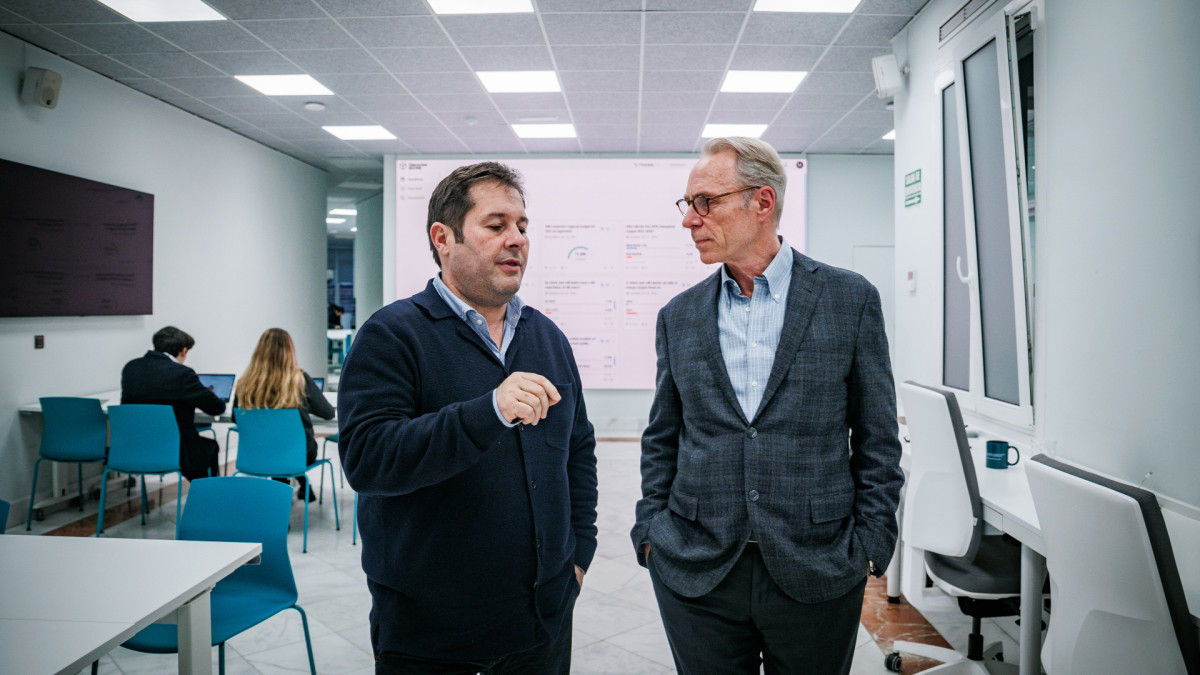
Hypermind has already collaborated with international intelligence agencies and now lands in Spain through beBartlet. Photo: Agenda Pública / Tania Sieira
Is the CIA worried about this?
No, it is complementary. If it is cheaper, you give them a badge that says “recognized super forecaster” (prestigious super-forecaster). They put it on LinkedIn and they become more valuable. You create forecasting competitions and recognize talent.
These superforecasters have experience in many domains: geopolitics, sports, economics, business. They know how to break down a problem analytically and recombine it. We know how they think thanks to the Good Judgment Project. We can even teach AI to think like a super forecaster, although humans can still be better for one or two more years.
“No one would read a financial newspaper if there were no stock market: it would be boring. If you want to operate in the market, you need to read the newspaper to inform yourself”
The CIA can use superforecasters. Organizations like RAND Corporation use this community for U.S. government projects. In France we do similar work with governments, and even with regional governments in Spain. Prediction markets can be applied in many ways: it’s not secret.
How do you see the relationship between prediction markets and journalism?
No one would read a financial newspaper if there were no stock market: it would be boring. If you want to operate in the market, you need to read the newspaper to inform yourself. The market exists, so the newspaper exists.
I think the future of journalism will depend on gamifying the news. For example, Polymarket partners with The Wall Street Journal: people need the news to predict market results.
The business model of Polymarket makes money from the players: it is a betting platform. Another model we use allows the audience of a publication to play, creating a community. Companies can buy access to insights from that community instead of merely advertising.
Is this about engagement?
Exactly. The audience is an intelligence asset. If we can add it, we can monetize it. There are many companies that would pay for those insights. Instead of just placing ads, you gain real predictive intelligence.
Thank you very much.

Natalie Foster
I’m a political writer focused on making complex issues clear, accessible, and worth engaging with. From local dynamics to national debates, I aim to connect facts with context so readers can form their own informed views. I believe strong journalism should challenge, question, and open space for thoughtful discussion rather than amplify noise.