
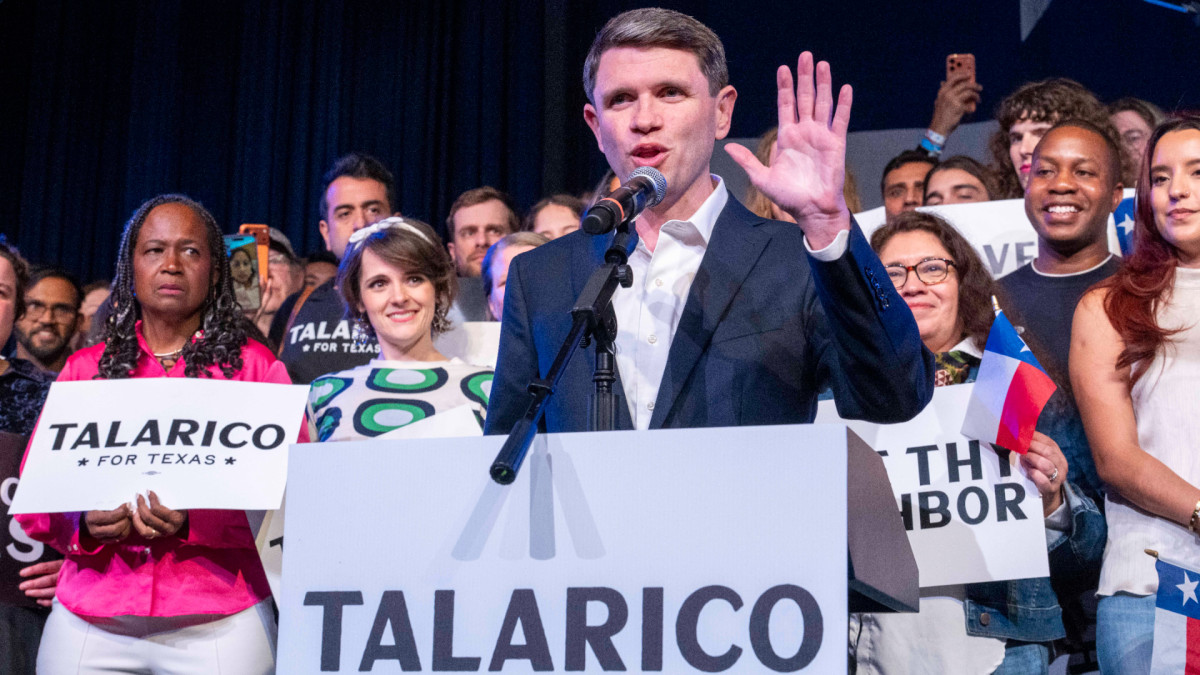
Until less than a month ago, in the U.S. (and in much of the world) the prevailing idea had been that publicly practicing religion equaled political support for the right (and probably for the far right).That began to change on March 4. The victory of a young seminarian in the Democratic primaries to determine the candidacy for the Senate in Texas broke the mold. One can be progressive and devout. That is James Talarico’s path.
“I knew that Trump and the MAGA movement dominate the frame of religion. But instead of writing it off as a lost cause and looking for another way to fit in, he decided to challenge it”
The prejudice against faith was deeply rooted by the broad support that Donald Trump enjoys among believers. As Antoni Gutiérrez-Rubí had written recently, his staunchest supporters are practitioners and the president has sought to win them over by surrounding himself with pastors and by creating bodies such as the White House Office of Faith. But Talarico has not let that intimidate him. Far from hiding his beliefs and his past in the Presbyterian Church, he positioned them as a central pillar of his message. He did not try to rearrange the board to have chances of triumph in the South. He played his own pieces and adapted to the game. As a result, the Democratic primary saw more participation than the Republican one for the first time this century.
How did he achieve it? Why does his novel proposal appeal to believers without abandoning progressivism? I share below, five key points of his success:
1. Contend the frame
Talarico did not give up. He knew that Trump and the MAGA movement dominate the frame of religion. But instead of writing it off as a lost cause and seeking another way to fit in, he chose to challenge it. And he did so by accusing his opponents of not knowing how to interpret the Scriptures.
It became very clear in the interview Ezra Klein conducted with him in January of this year. When asked about J. D. Vance, he drew an evident contrast with the faith defended by the MAGA movement. He defined it as a “nationalist Christianity” that forgets and distorts Christ’s teachings, therefore every Christian has an obligation to rebel and oppose.
In the famous book Don’t Think of an Elephant, George Lakoff warns politicians not to repeat their rival’s frames to avoid positioning them. That is what Democrats had done until now with religion: avoid it. But there is a caveat: do not enter the frame unless you believe you can steal it to change it and master it. That is what Talarico has done.
2. Progressive with a moderate tone
Talarico uses his faith to pack the progressive ideas in a way that can be accepted in a religious-leaning state. After all, according to a 2025 Pew Research Center study, Texas ranks in the top ten states in the country where residents say religion is “very important” to their lives.
“Talarico does not directly say that immigrants have the same rights as any other human being and that, therefore, they should be respected”
That is why, for example, he does not directly say that immigrants have the same rights as any other human being and that, therefore, they should be respected. He argues that Christ based his life on two commandments: “Love God and love your neighbor, because you do not love God if you do not love your neighbor”. And, in this line of reasoning, he reminds us that a neighbor is someone who does not think like you, who does not look like you, or who does not vote like you. In this way, he escapes the woke labeling that the far right loves so much and that is so effective among conservative groups, yet his message advocates for minorities with the same vigor.
3. Us against the elites
Talarico isn’t just progressive on social issues; he is also progressive economically. He has managed to translate to a conservative, more rural audience the message of affordability and the fight against the elites that Zohran Mamdani, Alexandria Ocasio-Cortez, or Bernie Sanders defend elsewhere.
“It’s time to start turning over the tables”. That is one of the candidate’s most repeated slogans, a biblical reference to when Jesus drove out the merchants who were conducting business in the temple. It succinctly captures his idea that the system has become corrupted and deep structural changes are necessary. He argues that the current division in the U.S. is not left-right, but between the have-nots and the haves, who take advantage of their wealth to divide the rest of the population and keep themselves benefiting.
“Pointing to economic elites as an abstract enemy allows Talarico to avoid constant confrontation with Trump”
With this, Talarico achieves three things: The first, position himself as a member of the oppressed majority. The second, to finish eradicating the ideological battles that could harm him in a conservative state like Texas. He does not want the vote to be about traditional party cleavages, which he reconfigures by leaning on the faith board. Finally, pointing to economic elites as an abstract enemy allows him to avoid constant confrontation with Trump. He does not refrain from criticizing him and his administration, but in a state that the president won with 56% of the vote in 2024, portraying him as a direct rival could burn bridges with many key voters.
4. Connection with the Latino electorate
Talarico’s rhetoric has made him popular in the traditional strongholds of the Republican Party. However, in the primary he faced Jasmine Crockett, a well-known African American congresswoman with a more traditional but highly mobilizing progressive message, which positioned her in the Democrats’ traditional strongholds, the big cities such as Dallas or Houston.
The only way to counteract that disadvantage was to attract Latino voters, an electorate also permeable to religious rhetoric and which in the last two years had begun to tilt toward the Republicans. The young seminarian managed to carve a space among them with his pious stance toward immigrants, with his economic demands, and with the help of Carlos Eduardo Espina, a Texan news influencer with more than twenty million followers on social media who became an adviser to his campaign.
5. Oratory and virality
In recent years, aggressive and fear-based rhetoric has gained popularity and propelled the radical right. But two campaigns have started to slow that in the U.S.: Zohran Mamdani’s and Talarico’s. The Texan has a style and cadence that recall Barack Obama, positioning hope and a longing for change with a calm voice.
“Talarico will head into the race as the candidate with the least chances in a state where Democrats have not won a presidential, gubernatorial, or Senate election in more than thirty years”
His campaign has managed to position clips of his speeches on social media with great effectiveness. Several of them have more than 100,000 likes on Instagram. That has allowed him to attract the attention of influencers and podcasters, whom he has granted interviews to reach as many voters as possible. For example, his discussion with Joe Rogan has more than a million views. As a consequence, his fundraising power rose to the point where he could pay for a spot in this year’s Super Bowl.
Texas Senate elections will take place in November, within the framework of the midterms of 2026. Despite the excitement he has generated, Talarico will start as the candidate with the fewest chances in a state where Democrats have not won a presidential, gubernatorial, or Senate election in more than thirty years. But, whatever happens, symbolically he has already won. He has demonstrated that his opponents’ religious narrative has weaknesses and can be fought on their own ground. Faith not only moves mountains, it can also mobilize the progressive vote.
