
“We depend on the energy sector and we regulate it as well”. This is the example Carme Artigas uses to defend that Europe can set its own rules in the face of the big tech companies, despite relying on their models and infrastructures. In this conversation with Agenda Pública during the La Toja Forum, the expert calls on the European Union to decide which part of the AI value chain it wants to control, with particular attention to energy and industrial data.
Artigas served as Secretary of State for Digitalization and Artificial Intelligence between 2020 and 2023, a period during which she participated in the negotiations of the European AI Regulation. Subsequently, she co-chaired the UN advisory body on this technology. She is currently a researcher at Harvard’s Belfer Center and an operating partner of Nazca Capital, where she chairs its technology committee.
In the face of the US-Chinese technological race, Artigas advocates for international governance that can establish common safety standards and independently supervise AI models. She also warns about the concentration of power in the major tech companies and its implications for fundamental rights.
“Artificial intelligence neither harms nor improves democracy,” she argues. In her view, the key is how institutions should adapt to govern the new forms of power that this technology generates. Also, we have time to address other issues such as the risks of manipulation of public opinion and the exposure of young people to language models, especially when they use them to seek help for mental health problems.
Artigas and Esteban converse during one of the breaks in the forum sessions. Photo: Agenda Pública / Yanka Soto
Who controls today the technological power of artificial intelligence?
Artificial intelligence is more than a technology. It is an infrastructure that spans from physical and energy infrastructure to computing capabilities, chip design, model development and also data. Each of these layers has new players.
What is changing in technology is the balance of power between countries, because some have critical raw materials, such as rare earths, or unique production capabilities, such as chip production. But also for the first time there are private players who can challenge those governments’ ability to control the technology.
That is something we are already understanding, from a political standpoint, defines the new global competition. Basically, we see two major poles, the United States and China, competing for AI supremacy because, at bottom, the aim is economic and military supremacy.
When we talk about European technological sovereignty, what we are saying is what role Europe has in that context. And here the solution is not to reproduce this entire stack in a single way, because that is impossible. We come from thirty or forty years of collaboration and global value chains, and they cannot be replaced. Neither can the United States produce it all.
What Europe must do is make a strategic bet on which part of this value chain it wants to control. I believe Europe’s strong bet is control of the energy infrastructure and control of that industrial data.
In the heat of great-power competition, is global technological governance still realistic?
Not only is it necessary, it is more necessary than ever. We must also not confuse the fact that these are dual-use technologies with the need to regulate civilian and military uses in the same way.
“Europe’s strong bet is the control of the energy infrastructure and the control of that industrial data”
Moreover, we are seeing that the very technology companies that traditionally opposed regulation are now understanding that without regulation you cannot develop an industry with the trust and security necessary for its adoption. And, in the end, everyone wants this to be adopted because that is where the business is.
I think they are realizing that it is an absolutely transversal technology that no single company or country on its own will be able to regulate. In fact, at the meeting between Xi Jinping and Trump they agreed to exchange information about security incidents, but for a long time we have been seeing that this goes beyond bilateralism between two countries.
“They are realizing that it is an absolutely transversal technology that no single company or country on its own will be able to regulate”
We need to incorporate elements of international governance that already exist in other industries, such as arms control or nuclear energy control. Therefore, we do not have to invent anything new: the institutions already exist. If the industry truly agrees that regulation must prevail, what it must do is not try to regulate itself, but open its companies and development centers so that third-party independent evaluators can assess these models and decide under what conditions they can be deployed or not.
International security issues have always existed. They also exist in the world of cybersecurity. Therefore, it is not a new problem either.
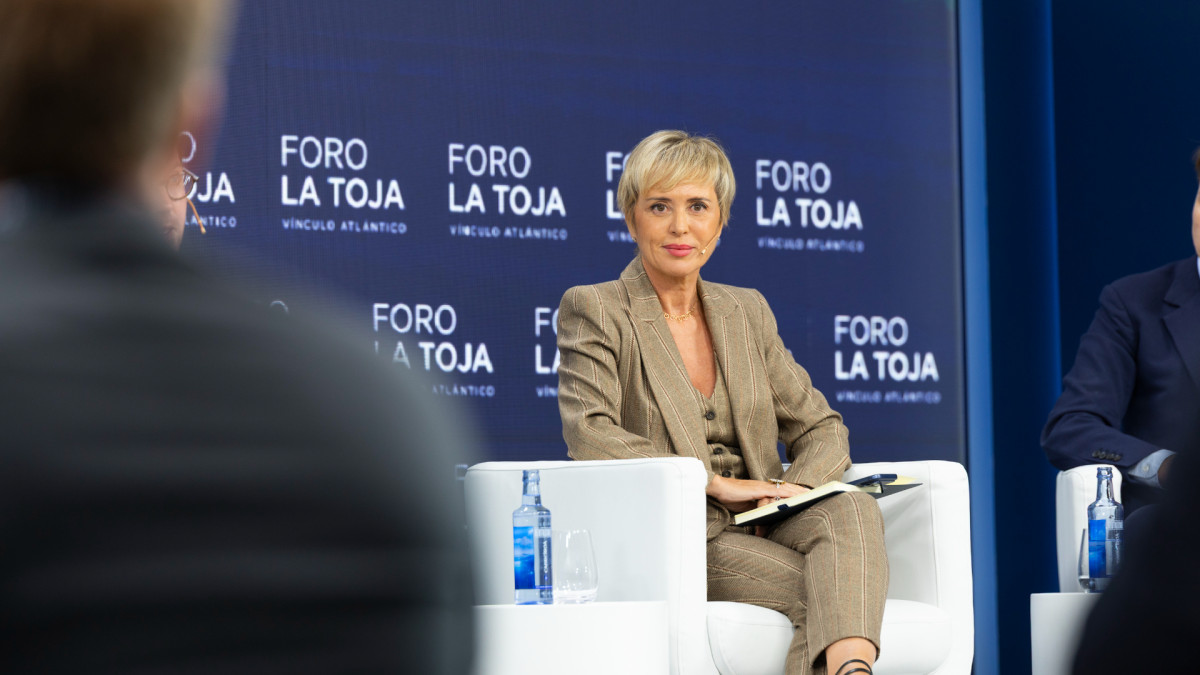
Carme Artigas, during her intervention at the La Toja Forum. Photo: Agenda Pública / Yanka Soto
There is an evident tension: we want to curb the power of big tech, but at the same time we need their capital, their models, and their infrastructure to compete in AI. How can Europe regulate companies we depend on, in a sense?
We depend on the energy sector and we regulate it as well. I always stress that the key in a revolution is governance. Governance means defining the instruments and systems we can set in motion to ensure there is no abuse of power, that access to fundamental resources exists, and that there is control over physical harms, mental harms, and harms to fundamental rights. This is how we have regulated all technologies.
The issue is that this one has a much more pervasive presence. And what we must do —the European Union has always done this— is set the rules of the game in our territory. We cannot intrude into others’ territory. At the market level or in terms of fundamental rights, there are things that are acceptable elsewhere and not acceptable in our European context. For example, in terms of freedoms or the use of these technologies by public authorities to control the population. We do not accept this even if it is technically feasible.
Therefore, we have the right to define the rules by which we want to be governed. But there are things that must be agreed internationally. Security standards must be agreed. You can compete for market share, you can compete to be the most innovative, but you cannot compete for fundamental rights. We cannot enter a race toward the lowest common denominator where we fail to ensure compliance with international law, human rights, or the United Nations Charter.
“You can compete for market share, you can compete to be the most innovative, but you cannot compete for fundamental rights”
Competition is good, but we cannot compete for people’s safety. We must work together to define a common risk matrix that we share and, above all, a safety standard and an interoperability standard. It also won’t work if there are three regions with three different technical standards.
Ultimately, this is a technology that can bring enormous benefits to humanity, and there is no reason not to be able to do it right from the start. Because if you don’t earn the trust of people or industries, they will not adopt it.
A few years ago I argued that AI could help citizens better monitor governments and large corporations. Today we also see that governments and companies can use it to learn about, persuade, or monitor the citizenry more effectively. Has the paradigm shifted?
Artificial intelligence neither harms nor improves democracy. What happens is that democracy is based on guaranteeing fundamental rights, ensuring citizen participation and citizen agency, and controlling the excess of power.
What is happening is that AI creates new axes of power. What we need to see is how we renew democratic institutions to be able to place limits on that new kind of power exerted by AI.
There are examples for everything. There are examples where artificial intelligence is helping to make processes much more open and collaborative. One example is Taiwan, where they use AI or tools like Polis to achieve greater citizen participation in the decision-making of public policies.
And then, obviously, there is that new kind of power. We are not only talking about freedom of expression and the excessive weight of algorithms on social networks, but, above all, about the intermediation in how you form your own opinion. I think the great right at stake is not freedom of expression, but the freedom to form an independent opinion, because beliefs and the creation of opinion are being mediated.
“The great right at stake is not freedom of expression, but the freedom to form an independent opinion, because beliefs and the creation of opinion are being mediated”
The European AI proposal itself regards manipulating thought through AI tools as a prohibited use. We are already seeing this at the level of information influence. Imagine when they could implant a chip and directly manipulate your mind.
But there are uses we already know how to control and regulate. The same goes for monopolies. I always give the same example: a vertical monopoly would be the owner of the highway who is also the owner of the toll, the truck, and the apples it transports. We know how to regulate that. The problem is that, in the tech realm, the concentration of power goes even further: the owners of the large technology companies also control digital platforms and digital information media, they are buying traditional media outlets, and they also participate in the military industry.
If this is not a monopoly, what will it be? It is a more horizontal monopoly and, therefore, it must be regulated. There is no need for artificial intelligence to come to explain how cartels or monopolies are regulated, because that already exists. It is a matter of applying it.
“There is no need for artificial intelligence to come to explain how cartels or monopolies are regulated, because that already exists”
I think we are going to see a trend toward setting limits with mechanisms that already exist. The issue is to understand them and apply them. And they do not want to apply them because of the geopolitical battle which, above all, these two powers, the United States and China, have decided that this must be won in a year and a half.

Artigas advocates regulating AI, a sector she considers a horizontal monopoly. Photo: Agenda Pública / Yanka Soto
What limits should a democracy place on the use of artificial intelligence, especially when privacy and mental health are at stake?
We need to start controlling what kind of information those systems can provide. I am deeply concerned about how young people use those social networks, especially as we are seeing more girls than boys consulting psychological and mental health issues on a social network, in this case a language model, ChatGPT.
We must begin educating that when you are telling your problem to a social network or a language model, no matter how much it seems you are talking to a person, you are handing over your privacy to a company. And a company is not a NGO. A company will monetize that information.
“No matter how much you think you are speaking to a person, you are handing over your privacy to a company”
And how will it monetize it? It will use it to sell you things or, if there is a bad actor, to extort you. Therefore, we must be very aware and demand that, just as if I tell those models “help me design a homemade bomb,” they will reply “I can’t answer that question,” when someone says “I’m depressed, what would you recommend I do?”, they should say: “I can’t answer that question. Call this number, call this expert”.
Speaking of these safeguards, of these limits, also implies this: for which uses these technologies are suitable and for which not.
I am a believer in the positive value of technology. We must focus more on how we use this technology for the common good, for the major problems of humanity, and focus less on the temptation of control and economic power.
“We must focus more on how we use this technology for the common good, for the great problems of humanity”
It is also why I am absolutely against that personalization of AI, AI friends, AI boyfriends and girlfriends, because behind that there is an interest in social control.
Within ten years, which decision about AI could seem to us today the most irresponsible?
I think we cannot let AI develop without constraints, without defining prohibited and inappropriate uses of AI. Not everything technically possible should be done. We must establish safety requirements and also ensure that governments and public authorities use AI without turning it into a tool for social control.
Thank you very much.
In partnership with