
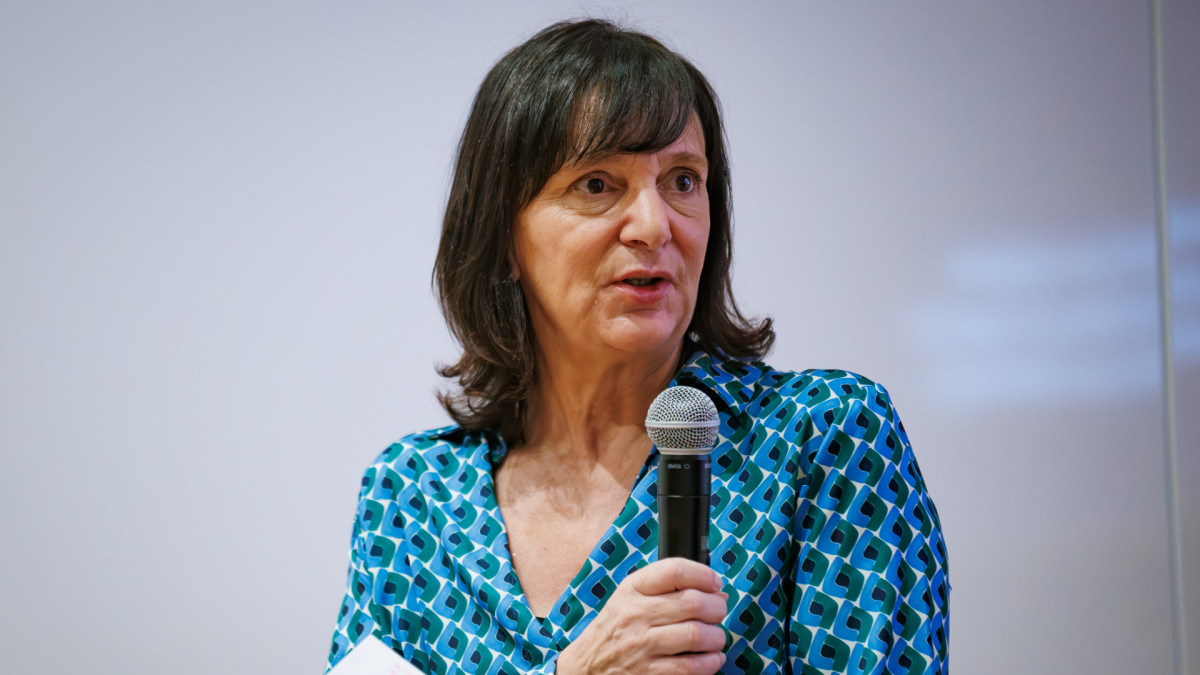
For Carolina Bescansa, the latest elections and the rivalries among public officials prove insufficient to explain the problems of Spanish politics. The sociologist, university professor, and cofounder of Podemos locates the crisis of public discourse in a deeper transformation of representative democracies, begun more than two decades ago, when the personal spectacle began to push public policies out of the center of the debate. Since then, competition for audiences and the expansion of digital platforms have accelerated a process that, in her view, has substantially altered the functioning of politics.
During the conversation organized by Agenda Pública in Madrid on November 20, Bescansa identified the rise of Silvio Berlusconi in Italian politics as one of the decisive moments in that transformation. The entrepreneur and conservative leader turned his public persona and his relationship with the media into central elements of his project, inaugurating, from her perspective, a way of understanding democratic competition that would gradually extend to other European and American democracies.
“One of the issues we are witnessing is the substitution of politics by political communication,” she warned. Bescansa thus established a distinction between the activity of governing and making decisions about collective matters and the construction of messages aimed at capturing attention. Both dimensions are part of democracy, although they respond to different dynamics. When success is measured chiefly by communicative effectiveness, parties risk dedicating an increasing portion of their efforts to discursive competition, relegating the explanation of their proposals on the economy or public services.
“One of the issues we are witnessing is the substitution of politics by political communication”
Her analysis also extended to the media, which operate under growing audience competition and in a context of precarious work that hinders journalistic labor. In an environment where attention is perpetually contested, attracting readers and viewers becomes increasingly difficult, which favors the circulation of striking statements and content for immediate consumption, to the detriment of deeper discussions about public policies.
Bescansa argues that the difficulties of political conversation largely stem from the economic and communicative incentives that condition its functioning. This perspective brought into the discussion a reflection on the need to address the structural factors that foster confrontation and constrain possibilities of understanding. In her diagnosis, competition between the media and digital platforms plays a decisive role in shaping the public debate, to the point of influencing how institutional leaders relate to the citizenry.
The cofounder of Podemos shares conversational space with other former political leaders. Photo: Agenda Pública / Tania Sieira
Can immediate communication block major political accords?
The predominance of immediate communication also reshapes decision-making times. The need to respond to any event imposes a pace difficult to reconcile with the reflection and negotiation processes that public policies require. This difference in tempo can end up subordinating government decisions to the demands of a perpetual conversation, where any sign of doubt or willingness to concede risks being interpreted as a weakness.
“The need to react to any event imposes a speed difficult to reconcile with the processes of reflection and negotiation that public policies require”
To illustrate this, Bescansa drew on a question she often poses to her students. Would the 1978 Constitution have been possible if Twitter had existed? The question invites reflection on the conditions that make complex agreements possible, from discretion in negotiations to the ability to revise initial positions. In a climate dominated by instant reaction, any concession can be portrayed as a defeat before the parties have finished negotiating.
The former deputy also wanted to introduce a reflection on the role of consensus in democracy. The existence of opposing interests and different political projects is part of pluralism, and some decisions must be resolved by the majority principle. From her perspective, the essential task is to revive a discussion centered on the content of proposals, where different options on housing, productive models, or tax systems can be confronted with arguments. Disagreement about public policies is, in fact, an essential part of democratic functioning.
Her concern extended to the major technology platforms and the risks associated with artificial intelligence. Much of public discourse, she recalled, flows through information distribution channels controlled by private firms. The difficulty in distinguishing truth from falsehood, alongside the concentration of tech power and the insufficiency of democratic control mechanisms, poses challenges that exceed the traditional left-right divide.
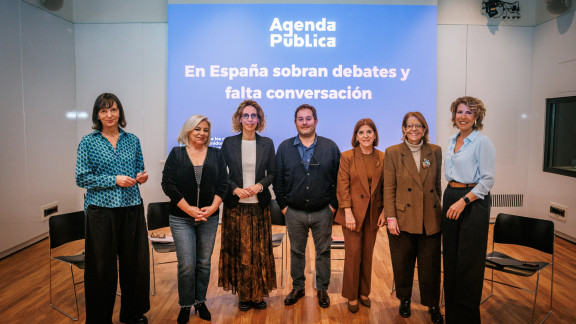
The voices who participated in the meeting, alongside the editor and director of ‘Agenda Pública’, Marc López Plana. Photo: Agenda Pública / Tania Sieira
A perspective against inequality
When addressing economic and social problems, Bescansa called for a policy once again oriented toward reducing inequalities. She defended the importance of making visible the different alternatives that public debate should be open to, so that citizens can understand the available options and assess their consequences. The transformation of the productive model, public health and education services, or the ecological transition admit different solutions, though not infinite, and it is up to politics to explain them clearly to facilitate an informed choice.
“The transformation of the productive model, public health and education services, or the ecological transition admit different solutions, though not infinite”
Her aspiration was condensed at the end of the gathering into a phrase: “Restore politics, because politics is about this”. With it she argued for the need to bring back to the center of the conversation the decisions that affect people’s lives, reclaiming the prominence of collective affairs against the logic of immediate communication.
Democracies had never had so many channels to speak with their citizens, yet they face increasing difficulties in discussing the policies they need. Bescansa’s reflection points to that very contradiction and to the importance of reclaiming spaces where public conversation once again revolves around the decisions that determine how we want to govern ourselves.
