
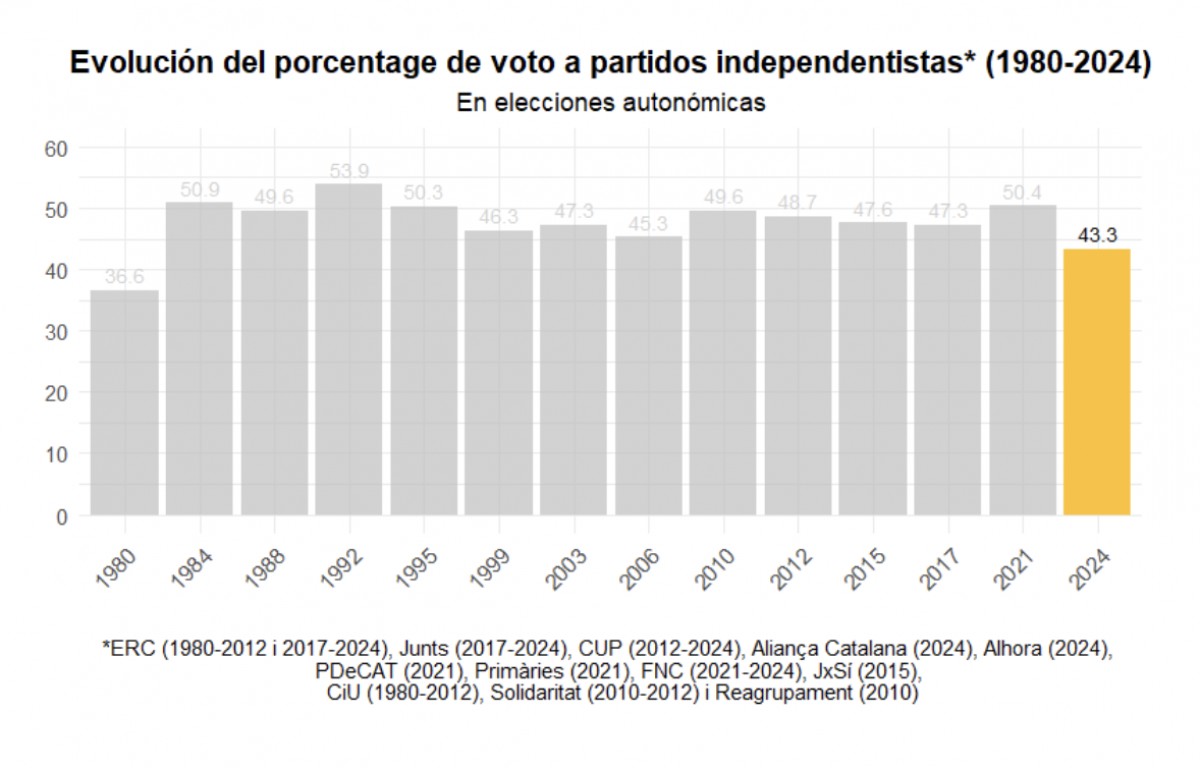
The 2024 elections to the Parliament of Catalonia were historic. Not only for the Socialist victory, which although never achieved alone, had already occurred in votes in 1999 and 2003, nor for Vox’s result or the emergence of Aliança Catalana, nor even for the divergence in turnout patterns between the coast and the Barcelona Metropolitan Area (AMB) compared to inland Catalonia. The May 2024 elections were historic because they certified a change of political stage in Catalonia that had been taking shape at the electoral level since 2021 but which in public opinion had been brewing since 2019, as the quarterly surveys of the Centre d’Estudis d’Opinió have shown us in recent years. A change of stage that can already be observed at the electoral level as Catalan nationalism/independence obtained its second-worst historical result in votes and seats, only surpassed by 1980, the first autonomous elections, and that broke the historical trend of absolute majorities by this bloc, especially when compared with the years of greatest mobilization and polarization on the national axis, which was the period from 2010 to 2021.
Figure 1: Evolution of the electoral results.
After the global economic crisis of 2008, an intense phase of politicization of Catalan society opened, taking into account the demonstrations against the cut to the Statute in 2010, the social eruption of May 15, the demonstrations for the unity of Spain, the unilateral referendum on independence in 2017, or the demonstrations for the release of the independence leaders prosecuted by the procés in 2019. A phase that sums up the two major cycles of contestation that transformed the Catalan bipartite political system (PSC/CiU) and opened the path to other political options until that moment marginal.
The twenty-fifth movement that brought Ada Colau to the Barcelona mayoralty and allowed Xavier Domènech to win two general elections, or the growth of the independence movement which became the leading force amid the contempt for Catalan demands and claims exercised by the PP’s absolute majority in the State. This allowed ERC to go from 7% of the votes in 2010 to 21% in 2021 and to reach the Presidency of the Generalitat for the first time. Or CUP, which entered the Parliament for the first time in 2012 and reached 10 seats in 2015. In short, these were the two great utopias available into which a large part of Catalan society poured itself, mobilizing it socially and politically.
Today, those available utopias have been exhausted at the same pace as the Catalan society tired precisely of the intense political conflict that has not led to a clear improvement in its day-to-day life or in its material conditions. It is this unmet material reverse that, as we will see, now returns to dominate the agenda.
Figure 2: Result of Catalan nationalism (1980-2024).
The asymmetrical mobilization we mentioned briefly in the previous section shows it. For the first time in the history of elections to the Parliament of Catalonia there was an inversion of voter turnout. Although inland areas continue to participate more than the coast and the AMB, the increase compared to 2021, the least participatory of Catalonia’s autonomous elections, was larger in areas where abstention traditionally prevailed, while in areas where it did not, the rise was smaller and in some counties and zones it fell relative to 2021. This shift in trend is important to understand why the Catalan nationalist result occurred and to understand the Socialist victory. According to published analyses, from 2017 to today, 2024, the independence movement would have lost more than 400,000 votes to abstention, while the Socialists would have gained the same amount of votes from other parties and from abstention.
But what explains this electoral result? How can we understand the change that has occurred in Catalonia in recent years and which culminated in the 2024 regional elections, inaugurating a new political era? The two post-electoral surveys published recently give us some of the interpretive keys of the result and confirm that in a large part of public opinion in Catalonia there has been a change of mindset that certifies the shift of stage reflected in the electoral result. Let’s analyze some data from these post-electoral barometers.
“Catalonia was voting on whether to turn the page on the territorial conflict or not: whether to move toward another stage or continue arguing about the territorial axis”
The first to be released has been the CIS, and it draws perfectly what was the question that dominated the electoral campaign and that voters had to resolve with their vote. When the public is asked what were the main issues of debate in the Catalan elections campaign, we observe that more than 50% of the issues cited were tied to the territorial question. The two main topics were the Amnesty Law and Catalonia’s independence, which were far above other problems such as immigration, the environment, inter-party disputes, housing or the economy. Catalonia was voting on whether to turn the page on the territorial conflict or not: whether to move toward another stage or continue debating the territorial axis. It wasn’t about the country model or the economic situation. It wasn’t even about independence yes or no. The question was whether to advance or to keep in the same position.
This dichotomy about turning the page or not was reflected in the figures and leadership of Salvador Illa and Carles Puigdemont. Both represented one option or the other in the question of whether to turn the page or not.
“We have entered a much more identitarian phase of the territorial conflict, where a Catalan and Spanish demos that is more ethnically defined is projected, and therefore the nation is defined less in civic terms”
In fact, this is evident when we analyze the reasons for voting for the different political options. If we look at those who decided the vote more on the stance of nationalism of the parties, the mirror game stands out: the electorates of Junts (48.1%) and Aliança (41.4%) in the pro-independence camp are the ones who say they decided to vote for their respective parties because of their nationalism (compared with 32% for ERC or 32.4% for CUP), as with the PP (56.4%) or Vox (28.9%). Indicating that we are entering a much more identitarian phase of the territorial conflict, where a more ethnically framed Catalan and Spanish demos is projected and thus the nation is defined less in civic terms. Against this drift, it has been the Socialists who have risen, concentrating most of the useful vote (more than 40% of the reasons to vote for the PSC if you add “to cast a useful vote” and “to prevent another party or bloc from winning”).
This shift in the slope of Catalan politics becomes even clearer with the analysis of the CEO quarterly barometer. The first thing we observe is the confirmation that the main problem of Catalans is no longer the territorial conflict, and we find political dissatisfaction (16%), housing access (11%), and in third place the territorial conflict at 9%, not far from problems such as immigration, public safety, or health which stand at 8%. The evolution of the different problems also shows how the territorial axis or the Catalonia-Spain relations have begun to decline for a couple of years, only peaking in October 2022, and how other problems have surpassed it or come very close. Even among pro-independence or pro-unionist electorates, the territorial conflict is not the first problem. Both Junts and ERC voters have political dissatisfaction as their first problem. The same for PSC or PP voters. Comuns and CUP place housing access as their top concern, and Vox and Aliança Catalana identify immigration. In fact, it is not even the second problem for socialists, republicans, CUP supporters, Comuns voters, or ultras of Aliança Catalana. This indicates a shift in Catalan society’s priorities.
“The main problem of Catalans is no longer the territorial conflict, and we find political dissatisfaction (16%), housing access (11%), and in third place the territorial conflict at 9%, close to issues like immigration, public safety or health at 8%”
So much so that Catalans ask the upcoming Government of the Generalitat to make reducing social inequalities its top priority: 4 out of 10 voters ask this of the future government. 22% to boost economic growth, 14% a focus on order and public safety, and 10% to address drought and climate change. Only 9% want the next Catalan government to prioritize the territorial conflict. By electorates it remains so. Independentist voters also push social and economic issues as top priorities for the new Catalan executive. Only in Junts is the territorial issue in the third position in the priority order and for ERC or CUP it is the fifth. The change is evident.
If this information about political priorities and the main concerns of the citizenry were not enough, the CEO’s barometer section on territorial preferences offers a series of data confirming this shift in stage. The first is that the position opposed to independence records its highest result in the historical series since 2015 with 53% of Catalans against it. Only 4 in 10 are in favor. The figure is the lowest since 2015. The gap between the two options is 13 points, the widest in the historical series. This datum is confirmed by the preferred territorial model chosen by Catalan citizens. For the first time since 2015, the autonomous model is the first option with 34%, breaking the technical tie that had existed since October 2023 between an independent Catalonia and a Catalonia as an autonomous Community of Spain. Independence stalls at 31% and autonomism attains its highest score, consolidating the upward trend.
“Catalonia seems to have changed its chip and, without new utopias available, moves toward a phase of “cold times,” as Ackerman would say: marked by political dissatisfaction and disillusionment, which indeed are perceived as some of the main problems in Catalonia”
Catalonia appears to have changed its mindset and, without new utopias available, is moving toward a phase of “cold times” that Ackerman would describe: marked by political dissatisfaction and disillusionment, which are indeed recognized as some of the main problems in Catalonia. A review of the various indicators linked to public opinion shows how there has been a shift in political priorities among Catalan citizens. A change that is best explained by the May 12, 2024 electoral result. Catalans have set aside concerns about the procés, showing more material priorities tied to housing but also concerns more about attitudes and values, such as political dissatisfaction, and they ask the new Catalan government to focus on fighting inequalities and on the economy. The material agenda overtakes the territorial agenda in Catalonia in 2024 after the last elections decided whether Catalans would turn the page on the procés or not.
However, a few caveats are worth noting before finishing this analysis. The first is that these trends may be altered depending on whether a government is formed in Catalonia or if elections are repeated, which could entail an even greater polarization than the Illa–Puigdemont clash. Public opinion is increasingly volatile, as scholars such as Oriol Bartomeus have studied. What now appears to be a clear shift in trend may simply be a matter of the moment. This is why Puigdemont could still play the card of returning to Catalonia, triggering a political and social earthquake with unpredictable consequences. Without resolving the situation of the independentist leaders, it is more likely that national polarization could rise again.
Another important point to highlight is that although the main problems and the priorities of Catalans have changed, the conflict remains unresolved. Catalonia still wants to decide its political future in a binding referendum. Three-quarters of the Catalan citizenry affirm this in successive surveys. The fundamental causes that started the polarization years in Catalonia remain unresolved: there has been neither recognition of the singular Catalan fact nor have the Catalans spoken out about their future. This makes it necessary to restore democratic legitimacy and for the new Catalan Government to seek a renewed fit for Catalonia within the State. Even if it is not the top priority of Catalans, solving the conflict remains key to achieving political stability in Catalonia and in Spain in these turbulent times we are living.
