
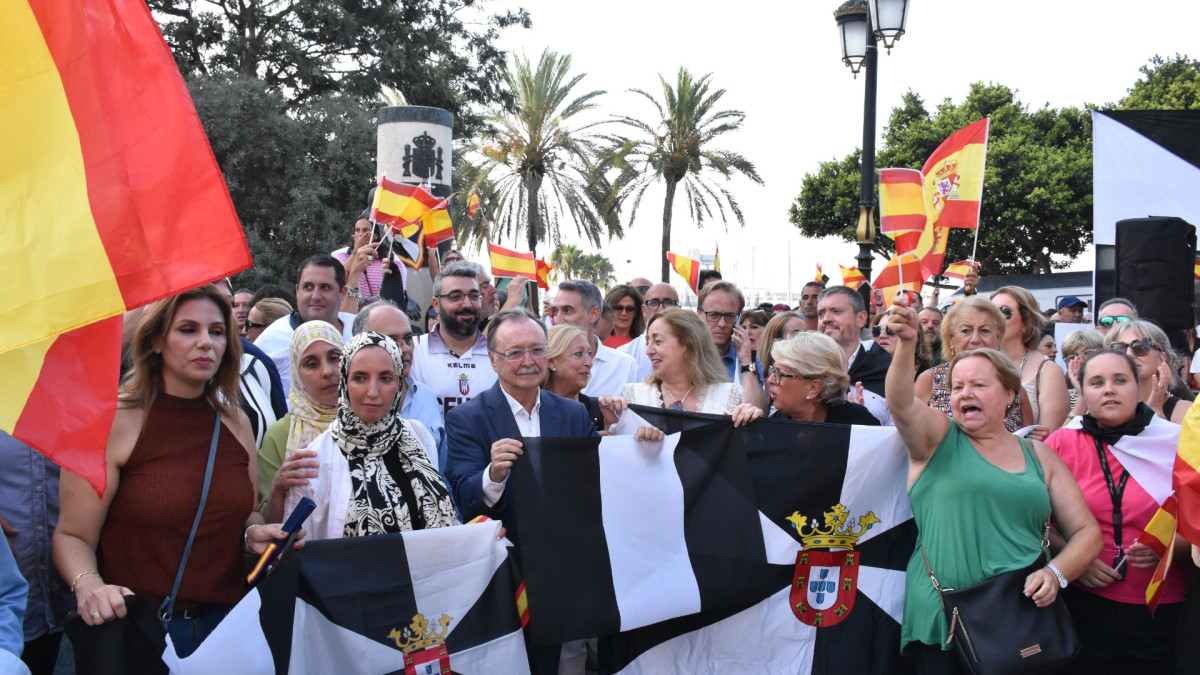
Ceuta’s arrival of around 70,000 people in just a few days, most of them young Moroccans, has been the largest irregular crossing in the shortest period of time in this part of the southern European border. Dozens of people died trying to reach it. The magnitude of what happened invites seeking a single explanation, but none by itself is sufficient. Ceuta has experienced a migration crisis, no doubt, but also a multifactorial political and geopolitical crisis in which multiple actors with different interests were involved and whose degrees of responsibility are still difficult to determine.
“The sentence is debatable, but its scope is precise: it did not open the border nor prevent the return of those who entered irregularly”
The immediate trigger seems relatively clear. A recent Spanish Supreme Court ruling had established that the exceptional procedure of immediate border rejection provided for Ceuta and Melilla could not be applied to those intercepted at sea when attempting to enter by swimming. The ruling is debatable, but its scope is precise: it did not open the border nor prevent the return of those who entered irregularly. It obliged the application of the ordinary return procedure, with the safeguards provided in the law, instead of the immediate rejection used for those who try to overcome the border’s physical containment elements.
In the social networks, however, this judicial decision became something entirely different: the message that the border was open and that those arriving by sea could not be returned. This misleading information circulated at an enormous speed and generated the expectation of an exceptional opportunity to enter Europe, but this alone does not explain how a digitally spread expectation could become a movement of such magnitude. It is also unclear what benefit criminal networks, to which a leading role has been attributed, could obtain from crossings carried out largely autonomously, on foot or by swimming and without paying for clandestine transport.
A Singular Space
Ceuta is a Spanish city located on the northern coast of Africa, separated from the rest of Spain by the Strait of Gibraltar and surrounded by Moroccan territory. Its land perimeter is protected by a high-security fence, complemented by surveillance systems and maritime barriers at its ends. It is an exterior border of Spain and of the European Union, but it is also a border over which Morocco maintains a territorial claim.
The city forms part of the Schengen area, though under a specific regime. Connections from Ceuta to continental Spain are subject to identity and documentation checks. Entering Ceuta irregularly does not equate to entering the European continent without controls nor to gaining freedom of movement for the rest of Schengen. During this crisis there were no movements toward the Peninsula or toward other member states.
This precision matters because Schengen was quickly used as a political argument. Italy reintroduced controls on travellers from Spain, while various European leaders suggested that Spain’s action could jeopardize the area of free movement.
The majority of those who reached Ceuta returned spontaneously to Morocco. They were not the subject of a massive state-organized return operation. Facing the impossibility of continuing toward the Peninsula and after finding themselves in an overwhelmed city, without housing or prospects, tens of thousands of people decided to return on their own using the passage Spain opened in the fence. Morocco accepted their reentry. From a certain moment onward, its security forces also acted to prevent the flow of entry from continuing.
“The image of tens of thousands of Moroccans advancing toward a city whose Spanish sovereignty Rabat does not recognize evokes for Spain echoes of other times”
The initial inhibition by its security forces was visible and decisive for the crossings to reach that dimension, something that some analysts on the ground have interpreted as a planned operation and, for others, as a complete loss of control. Between both there are other possibilities and many nuances. The temporal coincidence adds an inevitable symbolic dimension. The events began on July 30, the Moroccan Throne Day, while Mohammed VI celebrated in Tetouan, about 40 kilometers from Ceuta, the anniversary of his accession to the throne. The image of tens of thousands of Moroccans advancing toward a city whose Spanish sovereignty Rabat does not recognize evokes for Spain echoes of other times. This episode takes on a hue that goes beyond migratory management and enters the realm of geopolitics, particularly in a Mediterranean that is seeing the rule of the sea shaken in its eastern zone, in the Strait of Hormuz. In Ceuta and the Strait of Gibraltar, matters of sovereignty, security and balance converge, in addition to migratory concerns between two countries whose border cooperation is as close as it is asymmetric.
The Spanish Paradox
Returning to migration and entering the European Union arena, it is worth noting that Spain occupies a singular position in the current European debate. Its government defends a narrative on immigration that is different from the dominant one in numerous member states: it acknowledges its economic and demographic contribution and has approved an extraordinary regularization for people who already resided and worked in the country. But Spain is also, and has been under governments of different political hues, one of the strictest countries on southern border control. The Spanish government invested substantial political capital in the approval of the European Pact on Migration and Asylum. Its internal narrative does not imply an open-border policy, but a combination of external control and realistic management of the migrant population already integrated into the economy and society.
In this narrative divergence lies the critique by some European countries of the recent regularization. The regularization did not play any proven role in the Ceuta events. It applies to people who could demonstrate prior presence in Spain and does not offer a path to regularization for those who arrived during the crisis. Presenting it as a “pull factor” transfers to the episode a preexisting political controversy. Moreover, some of the countries that criticize the Spanish decision have adopted mechanisms that are different but functionally comparable.
A Test for the European Union
“Some governments questioned Spain and linked the crisis to its regularization or to the functioning of Schengen, even though no movement toward other member states had occurred”
The first European reaction was conditioned by national narratives about immigration. Some governments questioned Spain and linked the crisis to its regularization or to the functioning of Schengen, even though no movement toward other member states had occurred. The interior ministers’ videoconference on August 4 corrected that dynamic: states expressed their solidarity with Spain, recognized the speed of its response, and defended a common European action. By then, the immediate dimension of the crisis had been contained.
Ceuta shows to what extent a border can be altered by a combination that includes the aspirations of thousands of people, in this case young Moroccans, the changing actions of the authorities and a bilateral relationship laden with history, all fed by media that facilitate the speed and scale with which these events have occurred. It is not necessary to reduce that complexity to a single factor or to a conspiracy to acknowledge its geostrategic dimension, nor to ignore its migratory implications by noting that they do not exhaust themselves in those terms.
The European response must begin precisely from that multifactorial and multi-actor character. In both migratory and geopolitical spheres, the Union needs better mechanisms for anticipation and coordination, along with effective procedures compatible with the rule of law and a truly shared responsibility for its external borders. In both realms—domestic and foreign policy—ever more intricate, they must reduce their vulnerabilities and sustain internal solidarity to preserve the main achievements of integration and the values that underpin them.
© This article was originally published in International Politics and Society.
