
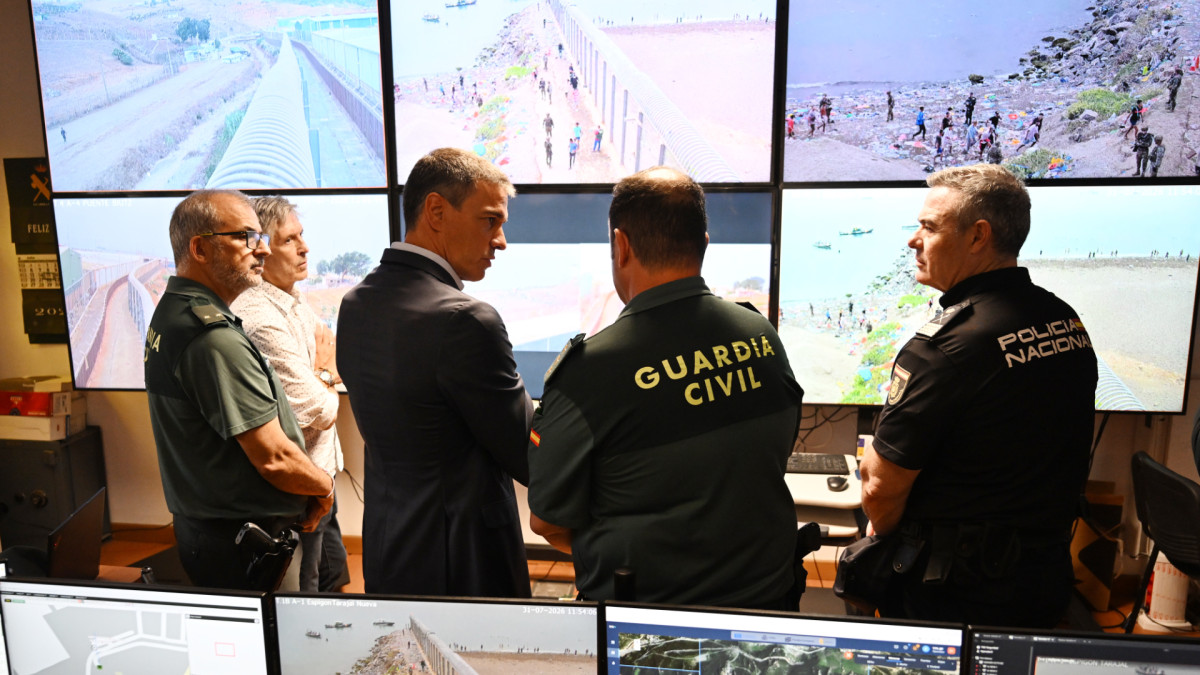
Almost a month after the Prime Minister described the mass influx of tens of thousands of people into Ceuta as a “violation” and an “attack” on Spain’s territorial integrity, the Government has activated the mechanisms of the National Security System. Up to now, the National Security Council had not been convened, there is also no record of the Situation Committee having been convened, nor had the situation been declared a matter of national security interest. The decision comes late and inevitably implies both a correction of the ‘inaction’ during the preceding weeks and an amendment, even to those who proclaimed that the crisis was “resolved”.
The Government has been managing the situation for twenty-six days through three partial interministerial coordination meetings, one presidential visit and various ministerial visits to the autonomous city, appearances to the media rather than to Parliament —only on the 25th did the Defense Minister appear— and sectoral announcements. Therefore, activating the National Security Council and creating a single command do not fix the accumulated problems, but they do show that the crisis required from the start a clearer framework of political leadership. The main question is why these instruments were not used earlier; the answer is strictly political.
The Law 36/2015 on National Security exists precisely to address grave, cross-cutting, urgent situations that overwhelm the ordinary management of a single ministry or administration. In Ceuta all those conditions were present from the first days. There was a border issue, public safety concerns, immigration, humanitarian attention, minors, public health, the bilateral relationship with Morocco, local economic impact, and political communication. It was also a situation in an autonomous city with limited competences, scarce resources, and growing social pressure. It was not a crisis reducible to Interior alone, nor to External Affairs alone, nor solely to Migration. Nor was it a matter that could be managed by a drip-feed of ministers or by interministerial meetings without a sufficiently visible command architecture.
The situation of national security interest helps organize the response when several levels of government, different ministerial departments, and diverse public resources are involved—such as those now to be put in place: security, health, economic resources, etc.
“The crisis occurred in an autonomous city with limited competences, scarce resources and growing social pressure”
In turn, the creation of a single command led by the Minister of Territorial Policy confirms this need. It also responds to a demand, a plea for help, repeatedly voiced by the president of the City of Ceuta, Juan Jesús Vivas. Its approval weeks later places the Government in a critical position: if the single command is useful by the end of August, it is hard to explain why it was not useful at the beginning of the July crisis; the gap between reality and the narrative leaves little room for rhetorical acrobatics.
A premature summons of the National Security Council in the early days of the crisis would have enabled, facilitated and driven multiple opportunities for better management. First, it would have allowed sharing a consolidated picture of the situation. That is one of the central functions of any crisis-management system: to know what is happening, what is known for certain, what is unknown, which actors are involved, and what evolution to expect. In a crisis like Ceuta’s, information from the Security Forces and Corps, the CNI, the Government Delegate, the City, social services, Health, or Foreign Affairs should have been integrated into a single political decision-making framework. When that integration does not occur or occurs imperfectly, each body tends to protect its own area, its narrative, and its timeline. There is no doubt that there are elements that show a struggle between ministries.
“An early convocation of the National Security Council in the early days of the crisis would have allowed, facilitated and driven multiple opportunities for better management”
It would also have promoted, consequently, better coordination among administrations. The National Security Council, in its capacity as the Government’s Delegated Commission for National Security, is designed to assist the Prime Minister in directing this public policy. It also has the support of the Situation Committee, the body provided for crisis management across the National Security System. That committee can centralize information, analyze scenarios, propose measures, facilitate preventive coordination and elevate recommendations. Exactly what seemed necessary in Ceuta.
Communication coordination is another weak point, not from the standpoint of the Government’s policy, but from crisis management itself. The situation demanded a coherent political voice toward Ceuta, toward Spanish society as a whole, and toward third parties, including Morocco and the European Union. When the president spoke of territorial integrity, the institutional response should have matched that gravity.
The prompt activation of national-security mechanisms would also have allowed better aligning policy and administration. In crises of this nature, the traditional temptation is to let each ministry manage its own part. That division can work in normal times. In a territorially concentrated crisis, with simultaneous effects and a strong gray-area governance component, that compartmentalization multiplies costs.
There is another missed opportunity: the production of lessons for strategic crisis management. If the royal decree maintains the national-security-interest status until December 31, the government itself acknowledges that we are not facing an episode to be resolved in the coming days. Therefore the National Security Council and its related bodies should not be limited to coordinating the immediate. They should also serve to observe patterns, identify failures, assess warnings, review information flow and prepare future responses.
Finally, the institutional culture of national security is built by using its instruments. It is not enough to approve strategies, create bodies, and draft procedures. These mechanisms become solid only when activated in real crises, when coordination routines are practiced, and when the Administration learns to operate in an integrated manner. If every crisis is managed first through the political logic of wear, ministerial competition, or opportunistic communication, national security is reduced to dead bureaucratic language. The delayed activation of the mechanisms provided by law sends an ambiguous message and, ultimately, weakness: the State has tools, but it hesitates to use them until the political cost of not acting becomes too high.
“If every crisis is managed first through the political logic of wear, ministerial competition, or opportunistic communication, national security becomes reduced to dead bureaucratic language”
Ceuta needed a presence of the State, but it also needed a State method. Society required capability and unity of state action. The method is expressed through coordination, direction, anticipation, and learning. In this crisis, what has been missing from the start is a management framework sufficiently recognizable for a crisis of such magnitude and gravity. There is an attempt to project national security as a guarantor of protecting Spaniards’ everyday life, and that is precisely what Ceuta residents have suffered since late July: their normality shattered.
Almost a month later, what should have been done at the outset is raised. That is the amendment to the management of these weeks. And also the institutional lesson, the political lesson, which ought not to be wasted. Yet, looking at previous crises of all kinds that have occurred in recent years, I am pessimistic about the possible lessons to be learned.
