
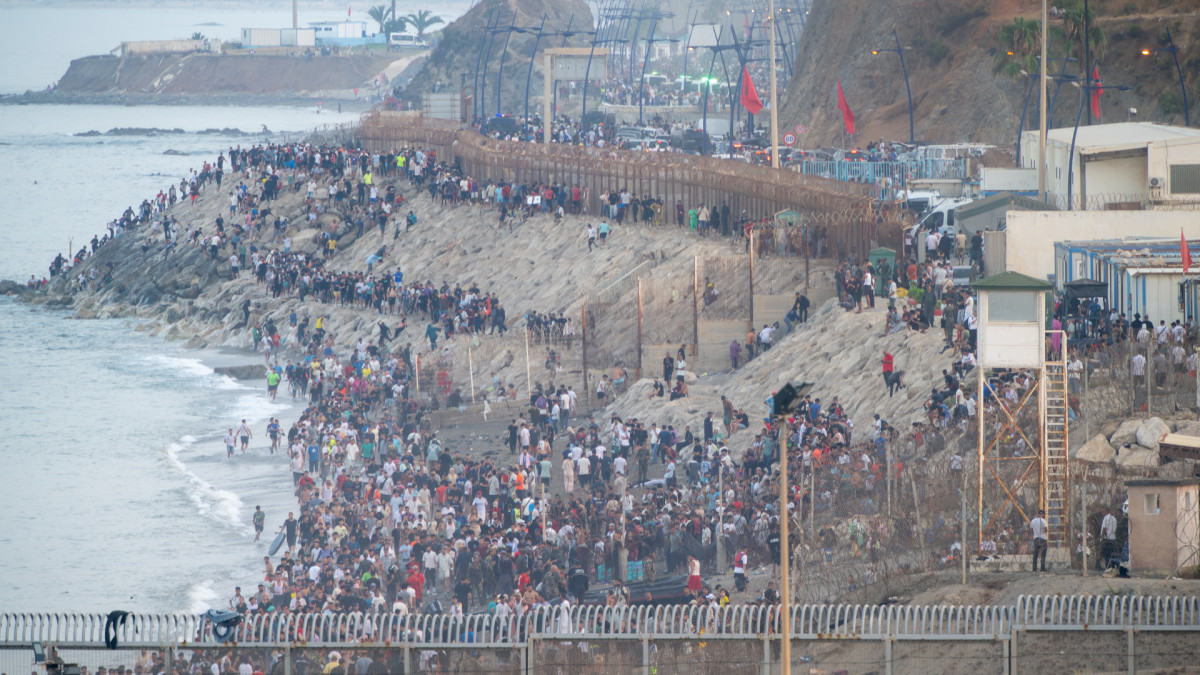
The present text offers a critical, dialogic reading of the article “The Ceuta Crisis Morocco Didn’t Need,” published by the editor and director Agenda Pública, Marc López Plana. Far from intending to challenge the data presented or to diminish the analytical effort of its author, this reflection interrogates the epistemological angle from which the phenomenon is observed: a perspective focused exclusively on the rationality of the State and on deducing its strategic intentions, which ends up blurring the human subject who experienced and endured the crisis and, at the same time, omits its structural intersection with the dispute over Western Sahara and the parliamentary evolution of the Spanish nationality law.
This reflection does not arise from a distant observation. The undersigned followed the Ceuta migrant crisis from its early stages, publishing several analytical studies as events unfolded. Having accompanied the process from its origin does not grant any privilege, but it does impose an intellectual duty: to remember that what is today dissected in geopolitical terms was, above all, exposed human vulnerability, and that the primordial question in Ceuta did not lie solely in “who coordinated the flow?”, but in “who crossed, under what conditions and toward what legal horizon?”
“What is being dissected today in geopolitical terms was, above all, exposed human vulnerability”
López Plana frames his column around a premise about the exercise of power: did Morocco control the Ceuta crisis or lose mastery over it? However, between the opening and closing of his argument, tens of thousands of people pass through the text as an undifferentiated mass, reduced to statistical magnitude, vector of pressure, or empirical evidence. Their faces, biographies and the deep causes of their displacement fade away.
It is an analysis that sharpens its gaze on the State, internal balances, the succession question, naval incursions and the paradoxes of sports diplomacy. Nevertheless, the human being remains absent as a subject of rights, appearing only as an instrumental variable: a parameter to measure the intensity of the crisis or infer the will of the elites. This omission is not only an ethical dilemma but an epistemological limit: is it possible to fully understand a human and border crisis without considering the subjectivity and the rights of those who cross it? To this is added a second, geopolitically consequential omission: the disconnect between the Ceuta events and the Western Sahara dossier, despite both processes converging in time and in their juridical significance.
The subject and the object of the discourse: From what place is the crisis narrated?
All political analysis responds to a place of enunciation. The López Plana article is situated in the optics of state power: it observes the institutional architecture, weighs power correlations, and infers strategic calculations. Under this lens, the tens of thousands who crossed the border lose their status as social agents to become mere objects of analysis, devoid of their own voice.
“Under this lens, the tens of thousands who crossed the border lose their status as social agents, becoming mere objects of analysis, devoid of their own voice”
From critical theory of law and migrations, one can formulate a methodological objection: can a displacement of such magnitude be interpreted without attending to the agency of the migrants themselves? When the analytical discourse characterizes human mobility exclusively as an “instrument of pressure,” it pre-asserts the state thesis and closes off other sociological or economic explanations. Likewise, when debating the “loss of control,” the approach is restricted to the state’s territorial dominion over its borders, omitting the loss of control of the individual over their own existence and life project. Reducing the complexity of what happened to the question of “which body in Rabat made the decision” implies confounding the administrative trigger with the structural causes that push thousands to risk their integrity.
The polysemy of the ‘crisis’: Who bears the real cost?
The term crisis possesses a relational nature that requires specifying its addressee. The article competently examines two dimensions: the crisis of sovereignty and border management for Spain and the reputational crisis for Morocco at a symbolic moment marked by Throne Day and the presence of FIFA president Gianni Infantino.
However, a third dimension remains in the shadows: the existential crisis of those who left their homes, invested their scarce resources in intermediary networks, and faced a border without legal guarantees. When analysis privileges exclusively the perspective of Chanceries and institutions, the human drama risks becoming a strategic game among elites, where people become abstract figures. A rigorously intellectual approach requires asking not only which State affected its international image, but who bore the irreversible cost with their own life and dignity.
The civic-military simultaneity: an unresolved analytical aporia
In his argumentation, López Plana draws an analytic distinction between the massive crossing of civilians —suggested as a possible overflow— and the incursions of Moroccan military vessels into Spanish waters, labeled as “another story” for lack of conclusive evidence of coordination.
From logical rigor, this separation raises an open paradox. If both phenomena converge in the same space and time, the hypothesis of mere coincidence proves insufficient to explain the sequence of events. Conversely, if there was any degree of institutional articulation, a legal question about the instrumentalization of civilian populations in inter-state coercive dynamics becomes unavoidable. And if, as the author argues, there was a lack of coordination between state apparatuses, the phenomenon would reveal an internal fracture in security governance. In either scenario, the analysis remains incomplete if it does not interrogate the legal and institutional responsibility regarding the lives put at risk.
A hidden legislative variable: the nationality law, the Senate and the dissolution of the Cortes
The central thesis of López Plana states that Morocco “didn’t need a crisis” given the good state of its relations with Madrid after the 2022 diplomatic turn and the joint bid for the 2030 World Cup. However, this premise overlooks a determinant factor in the bilateral agenda: the parliamentary processing of the bill granting Spanish nationality to Sahrawis born in Western Sahara before September 29, 1977.
The parliamentary chronology is revealing for understanding the underlying tension. Initiated in March 2024 and blocked for months, the initiative was unblocked in June 2026 through a parliamentary agreement, received the favorable report of the Justice Committee of the Congress on July 23, 2026 — barely a week before the massive Ceuta episode — and reached the Plenum on September 10, 2026. Far from being a peripheral element, this sequence shows that the legislative advance in Madrid and the border tension in Ceuta operated as interconnected moves on the same diplomatic board. For Rabat, the reactivation of a historic legal link between Spain and the Saharawi population challenged the narrative of a definitive closure of the dossier.
“The legislative progress in Madrid and the border tension in Ceuta operated as interconnected moves on the same diplomatic board”
A partir de este nexo temporal, el análisis político debe atender a dos desenlaces institucionales posteriores: en primer lugar, las maniobras en el Senado orientadas a neutralizar el alcance material de la norma; y, en segundo lugar, la decisión del presidente del Gobierno, Pedro Sánchez, de disolver las Cortes Generales y convocar elecciones anticipadas para el 29 de noviembre de 2026. Conforme al derecho parlamentario español, la disolución de las cámaras conlleva la caducidad automática de todas las iniciativas legislativas en trámite. De este modo, la proposición de ley sobre nacionalidad quedó sepultada por la vía procedimental, ofreciendo a Rabat una distensión de facto sin que el Ejecutivo español tuviera que asumir el coste político de rechazarla explícitamente en sede parlamentaria. Ignorar esta concatenación entre dictamen legislativo, crisis fronteriza y disolución parlamentaria impide captar el verdadero trasfondo de la negociación bilateral.
Hacia una geopolítica con rostro humano
This critical reading does not seek to invalidate Marc López Plana’s contribution nor oversimplify the complex architecture of Hispano-Moroccan relations. Its purpose is to invite an expansion of the gaze: to remember that geopolitics does not unfold in an abstract vacuum, nor does it exhaust itself in the calculation of state reasons.
When academic and journalistic discourse is limited to scrutinizing the governments’ intentions or the internal dynamics of elites, it risks normalizing the invisibility of the most vulnerable subjects. In Ceuta, not only was the effectiveness of border control or the strength of a diplomatic alliance measured; the primacy of human dignity and the coherence of Europe’s legal and historical commitments were put to the test.
“Academic and journalistic discourse risks normalizing the invisibility of the most vulnerable subjects”
The intellectual challenge of our time lies precisely in building a critical thinking that does not sacrifice the human being on the altar of raison d’État, remembering that no geopolitical stability will be truly solid if it is built on the silence of people and the expiry of their rights.
