
María Zambrano used to say, who developed in exile a deep philosophical thought on, among other things, the notion of homeland and belonging, that “the true homeland has no borders: it is the place where the heart can finally rest”.
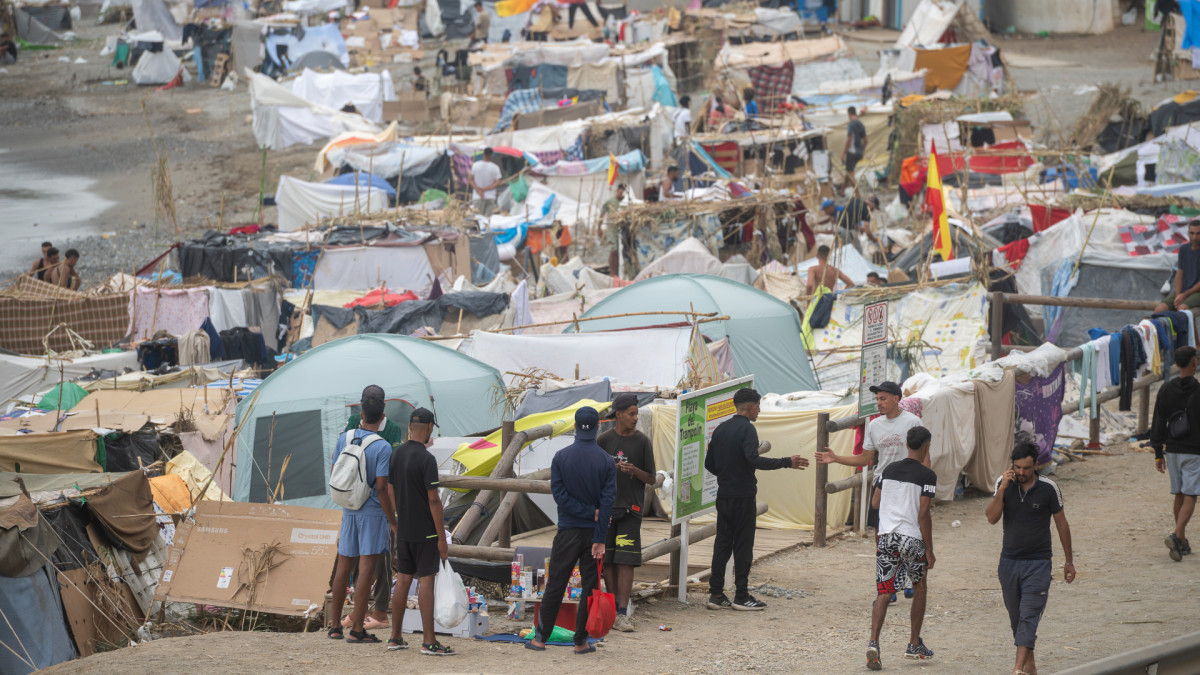
I don’t know what María would think about border patriotism that has been raised in recent weeks in speeches and reflections of every kind, but I can imagine it. Nor is naïveté appropriate, and less so from a constitutional reflection. There is no doubt that the homeland is linked to the notion of the State, and this is formed around the territory, the population that inhabits it, sovereignty, government, and the legal order, so that when the territory receives foreign populations in an uncontrolled and large number, as happened in Ceuta at the end of July, a sense of fragility of some of the key elements of the legal homeland may emerge. For me, it is not territorial integrity that is most fragile, but sovereignty, because this crisis has exposed the degree of dependence of Spain and the rest of European border countries on third countries that act as a barrier to containing migratory movements. Our sovereignty yields to the pressures of Morocco, whether by action or by omission, with a worrying ease.
But being patriotic at a border cannot be reduced to demanding border control or a strengthening of sovereignty. There are two other key elements that are being overlooked.
“This crisis has revealed the degree of dependence of Spain and the rest of the European border countries on third countries”
The first is that it is necessary to reinforce the conduct of government (not only that of the Government). The response has been so far slow and insufficient. I am not going to dwell on the reaction to the entry and its circumstances. Much has already been said and much more will be said about the issue. I refer, by alluding to my article on the entry into force of PEMA, to the fact that since June 12 Spain should have developed and foreseen the concrete and practical modalities of applying triage, as a tool for implementing the European Migration and Asylum System. That which has been called the “filiation,” which is nothing other than the individualized identification and the determination of the vulnerability conditions of the newcomers (regular or irregular), with the subsequent aim of assessing who among them is likely to receive international protection and who is not, and, in the absence of a valid entry title, must be returned. Said more precisely, Regulation (EU) 2024/1356 obliges triage for those who irregularly cross an external border, demanding, with the identification, health, safety, and vulnerability checks and the detection, by specialized personnel, of situations that require special protection. To make this effective, structures, trained personnel, interpreters, and mechanisms capable of identifying individual needs are required, even in mass arrival situations. And those resources should have been available before the crisis occurred. In other words, the government’s action failed, but not where the focus is being placed.
Indeed, the arrival was of such a magnitude that surely any existing means would have been overwhelmed. The Interior Minister has estimated before Congress that about 72,000 people entered irregularly into the city on July 30 and 31. Most returned to Morocco within the first 24 hours and, according to his data, around 5,000 remain in Ceuta. Too many for infrastructures that do not exist. By August 7, a week after the entries, the Ombudsman warned that hundreds of people, “many of them underage,” were still waiting for a response and called for something as elemental as talking to them, listening to them, and applying the law. Three weeks after the entries, the authorities were still seeking spaces to concentrate people to be processed under filiation and to perform triage. Starting triage a month later is starting a month late.
The second is that the homeland must also be conceived as identity, especially as constitutional identity. A democracy is also a political community that recognizes itself in certain rules about how power may be exercised, and the Spanish Constitution places, in Article 10.1, the dignity of the person—not the Spanish person—and the inviolable rights that are inherent to them as the foundation of the political order and social peace.
“A democracy is also a political community that recognizes itself in certain rules about how power may be exercised”
This does not mean erasing the legal difference between nationals and foreigners that the Constitution itself acknowledges in its Article 13 CE. The State may control its borders, establish entry and residence conditions, and agree on the return of those who lack a title to stay on its territory. There is no doubt about that, and the Constitutional Court has been explaining, since STC 107/1984, that the Constitution does not attribute identical legal status to Spaniards and foreigners. But it has also stated that there exist rights that, by their connection to human dignity, belong to every person regardless of nationality, and neither immigration law nor exceptional situations can place anyone outside the Constitution (STC 136/2007). In the 21st century, without a Constitution there is no homeland either.
And the Constitution speaks of solidarity among the nationalities and regions that make up Spain (Arts. 2 and 138 CE), which should require a different behavior from some autonomous communities regarding the problem that affects—merely for geographical reasons—the Autonomous City of Ceuta (the same that formerly affected the Canary Islands); it says that children will enjoy the protection provided by international agreements that safeguard their rights (Art. 39.4 CE), which includes, by reference to those agreements, a guarantee of the right to be heard and not to be returned without due process, whether they are Moroccan or Sudanese; it says that all persons (including foreigners) have the right to obtain effective protection by the judges and courts in the exercise of their rights and legitimate interests, without in any case suffering from defenselessness (art. 24.1 CE), a right that presupposes that any administrative act, such as return or expulsion, must be adopted with safeguards and following a procedure that can subsequently be judicially controlled, which is why the Supreme Court rejected in July that someone who swam into Spanish waters could be returned without a procedure; and we could continue commenting on other principles and rights.
Preparation for a migratory crisis or for a crisis of guaranteeing territorial integrity (we are still debating the typology of the crisis) cannot consist solely of having police capacity to control a border. It must include administrative capacity to identify people, health and social capacity to detect vulnerabilities, legal capacity to guarantee assistance and information, and protective capacity to immediately take charge of minors, and the capacity to distinguish, on an individual basis, between who should access international protection, who needs other forms of protection, and who can be subjected to a return procedure. Let us not forget that it was not soldiers who entered Ceuta in July. It was unarmed men, women, boys and girls.
“Preparation for a migratory crisis or for a crisis of guaranteeing territorial integrity cannot consist solely of having police capacity to control a border”
This brings us back to patriotism. The flag raised against migrants and the violence against foreign persons are not patriotic behaviors. Because defending Spain cannot be reduced to defending Spanish territory against those who come from outside. Defending Spain also means defending the rule of law that exists within those borders.
We do not protect the rights of migrants because they are Spanish. We protect them precisely because we are. Because the police that identifies them is our police; the Administration that decides their status is our Administration; the laws that regulate those procedures are our laws; and the Constitution that limits the exercise of that power is our Constitution. The Ceuta border delineates Spanish territory and, at the same time, constitutes an external border of the European Union. But it does not delimit the validity of rights. On the contrary: the more intense the public power and the smaller the ability of a person to defend themselves against it, the greater the importance of the guarantees that limit it. Perhaps that is why the border is one of the best places to measure the quality of a rule-of-law state. And perhaps being patriotic also means demanding that, precisely where Spain begins, the rules we have decided define what Spain is should begin to be fully applied.
