
Spain is going through a distinctive moment of international visibility. Its stance on Gaza, Iran and European strategic autonomy has placed the Spanish government at the center of a global conversation defined by threats, realignments and a rising sense of uncertainty about the role of the United States. Bronwen Maddox, director and chief executive of Chatham House, is watching the unfolding events with great attention and broadens the scope of the discussion: Europe can no longer pretend that the old order remains intact.
At Chatham House’s London headquarters, the organization’s chief executive lays out a demanding scenario for European democracies. Populist pressures, fragility in industry, technological dependence and doubts about Washington are converging at once. In her view, the ascent of forces like the AfD stems from social tensions that traditional parties have failed to address.
The head of the British think tank also highlights the external challenges. While Russia pushes Europe to rethink its security architecture, China threatens entire industrial sectors. The United States, even beyond the era of Trump, no longer offers the same assurances. “Europe has a strong imperative to bring its economy and defense into alignment” is the heart of her argument.
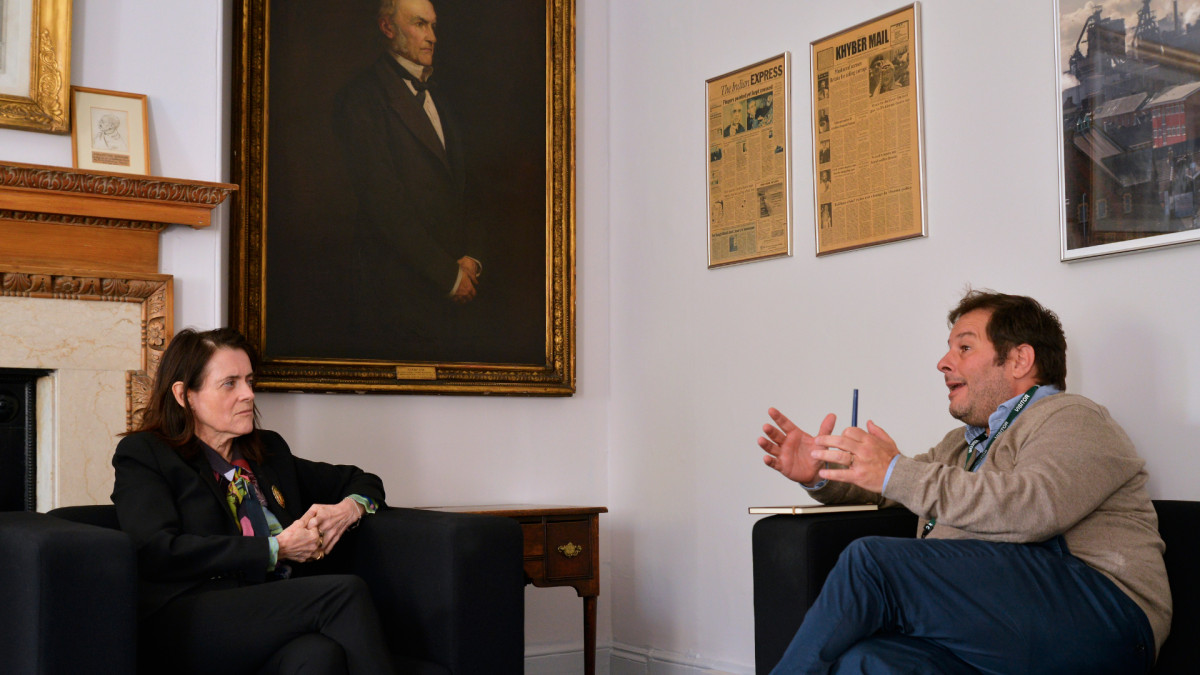
Founded in 1920, Chatham House is also known as the Royal Institute of International Affairs. Photo: Agenda Pública / Mark York
I would like to ask you first about Spain, because it is in a good moment —I don’t quite know how to put it— in terms of international exposure. What is your view of what Spain and the Spanish government are doing on the global stage?
Spain is making its mark by putting forward a set of views. It dissents from the action against Iran. It disagrees with what is happening in Gaza. And it is making that stance unmistakably clear. There is a possibility of retaliation from the United States; President Trump has spoken of expelling Spain from NATO. Yet we will have to observe how seriously those threats are actually carried out.
“This is the kind of moment that requires governments to define themselves and to define where their countries stand”
It is always difficult for any leader to gauge whether people back home care about these positions and how those words will land abroad. But this is the moment for leaders to declare their stance. Mark Carney, in Canada, has done something similar by stating that, in the face of all these challenges, this is where his country stands. It takes courage for a leader to be so explicit. It depends, of course, on understanding what voters at home want, but this is precisely the kind of moment that compels governments to define themselves and to declare where their countries stand.
Do you think European elites are well prepared to understand and survive this global situation?
They should be prepared. Donald Trump did not come from nowhere. He emerged from political forces that had been building slowly in the United States and that echo in other countries. Many European nations confront the same pressures: migration, the sense of hollowed-out manufacturing, and cultural conflicts that may be more pronounced on the other side of the Atlantic but resonate in Europe as well. Trump embodied those dynamics. He has his own temperament, but he represents forces that also surface in European societies.
Nearly every European leader must contend with budgetary constraints: how to meet citizens’ expectations for health, education and pensions with insufficient funds. Manufacturing jobs are vanishing; tech firms are ubiquitous and control vast wealth, yet taxing them is exceedingly complex. Without taxation, a state’s capabilities are compromised. And still they must go back to voters and say: this is very tough; please vote for me again. All democracies are facing this dilemma at the moment. Jean-Claude Juncker captured it well years ago when he said: “We know exactly what to do; we just don’t know how to win re-election after implementing it.”
“Who the elites are is a big question. They are different in every country, and I am not sure they have remained the same”
So elites must understand these pressures on nations. Now, who counts as the elites is itself a significant question. They vary from country to country, and I’m not sure they have stayed the same. There has been much anger among many populations—especially in the UK since the 2008 financial crisis—toward elites, whether bankers or political leaders, who steered countries into this mess. Ordinary people suffered, and yet it does not seem that those who made those decisions were held accountable.
So I am not sure that elites—if I may use that term—have fully come to terms with that. But they should have. They have had ample time to examine why people are so angry.
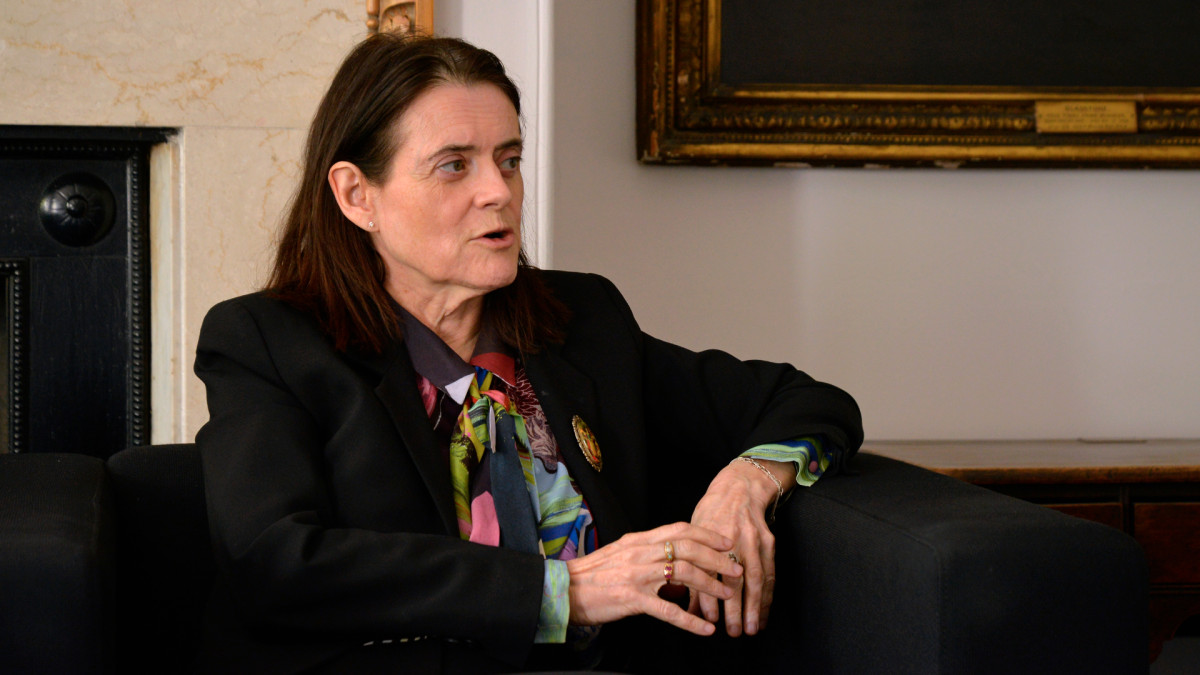
López Plana asks about the capacity of European elites to understand the new global scenario. Photo: Agenda Pública / Mark York
Because, if they do not, what happens? What could occur if European elites fail to grasp the real situation? In the latest polls, AfD appears to be leading.
That is the consequence: parties on both right and left offering simpler, more radical solutions continue to gain momentum. We are witnessing this in the United Kingdom, notably on the left with the Green Party, which has broadened its agenda beyond environmental issues to address the economy and Gaza, drawing substantial youth support.
All of this is happening. If AfD were to come to power in Germany, it would transform the functioning of the European Union. No one should become complacent or assume the status quo will endure. The populist forces are addressing a challenge that every party now must confront, including centrists: how to provide people with a sense of hope and growth without offering flawless, simplistic quick fixes.
Is it possible to build more Europe right now with that angry population in our societies? Because it does not seem easy to have a stronger and more unified European Union.
Yes, it is challenging. Yet external pressure can be a powerful catalyst. There is Russia, a threat to the entire EU—even if Spain sits farther away, the risk reaches the whole bloc—along with the quiet cyber warfare, disinformation campaigns and everything else tied to it. There is also the tangible danger of the ongoing conflict in Ukraine, and then there is Washington’s stance of stepping back from guaranteeing European defense, effectively leaving the responsibility to Europe itself, with all the uncertainty that entails.
There is China as well, pursuing an aggressive strategy of selling goods worldwide while showing little appetite to buy. That combination poses a substantial risk to European firms and industries. All of these factors give the European Union a powerful incentive to get its economic and defense affairs in order.
Let me ask you about the upcoming U.S. midterm elections. In Europe, Von der Leyen appears to be waiting to see whether Trump might lose. But could we end up with a more dangerous Trump after those elections?
That’s an intriguing point. He will be furious—extremely angry. The question is whether he will be constrained by the U.S. Constitution, and that remains unknown. Suppose he loses the House and perhaps the Senate as well. What then? It’s hard to say. If he loses both chambers, there could be efforts to impeach him, which would make him even angrier.
He has demonstrated a willingness to govern as president through executive orders—“the Sharpie pen” approach. He has already signed more in a single year than in his entire first term: well over 220. It is difficult for any check—Congress or the courts—to keep pace, though they can start to push back. That is precisely what Democratic lawmakers would attempt to do immediately. They would also feel less afraid.
“Trump has shown that he is willing to try to be president simply by Sharpie pen, through executive orders”
It remains striking how quiet Congress has been so far. This is an election year, yet they seem wary of the influence of tech money aimed against them. They fear that voters who back Trump will feel licensed to attack them. There is a pervasive sense of fear, which struck me strongly a couple of weeks ago in Washington.
He will be angry. I don’t know how much he can accomplish if he loses all that influence. The more important question is what you assume today. Do you wait for the Democrats to rebound? That is risky. Any country or company dealing with the United States should assume that much of what Trump has done will endure. He possesses a highly distinctive personality—vindictive and prone to personal attacks.
But if his approach endures: that the next president keeps the tariffs—likely—; that there might be more conciliatory rhetoric on Europe and defense, even though NATO will still be under a shadow.
Maddox answers questions about the US midterm elections and Trump’s room for manoeuvre before a hostile Congress. Photo: Agenda Pública / Mark York
Is Iran Trump’s real error?
Indeed, he has made other missteps, and some of the tariffs could prove problematic. Yet Iran stands out as the most immediate misjudgment. It seems unlikely he can disengage from that confrontation. It is a protracted conflict that Iran has an incentive to prolong. It has provoked a global reaction, and the world wants him to de-escalate, but he cannot. It represents a major miscalculation.
His bigger misstep, however, is failing to craft a coherent strategy toward China. There is only one thing a U.S. president must get right now: how to handle China. Instead, the picture is muddled. Some in his administration warn that China is the principal threat, while Trump suggests Nvidia could sell its second-rate chips to China and issues contradictory signals about Taiwan.
“The United States has never had a rival like China: in technology, economy, military power and ideology”
The takeaway China may derive from Iran is that the United States might not defend Taiwan, or might not be able to defend it. That interpretation aligns with the late-year National Security Strategy. Why tie your interests to geography? It seems narrow. That strategy reads as a retreat from China.
But the United States has never faced a rival of China’s scale in technology, economy, military might and ideology. And the one thing a president truly must get right is precisely that. If we’re looking for a technical error right now, Iran stands out as that mistake.
And what about Europe’s policy toward China?
Europe must make several choices now. It will need to deploy existing laws to shield its industries; otherwise, manufacturing in Europe could wane. At the same time, as Mario Draghi has argued, Europe should make the single market work more efficiently and ensure its capital markets function better so that European companies can stay European and avoid being acquired by China or the United States.
We have already seen the impact on the automotive sector and on solar panels. There are twenty other industries at stake. Pharmaceuticals is next. Competing with China is almost impossible when they have access to hospital data, can run tests in days rather than months, and can license new products instantly. A European firm confided that whatever molecule we produce, they can synthesize it better.
“It is urgent for Europe to decide whether Chinese competition is unfair because of subsidies and whether it should protect its industries”
It is urgent for Europe to determine whether Chinese competition is unfair due to subsidies and whether protective measures are warranted. It must decide within weeks or months. China is propping up many companies at a loss with state-backed banks. That cannot continue forever, but its current strategy is to flood the world with goods, posing a significant threat to Europe.
What is the status of the UK–Europe relationship? Are we likely to see notable progress in the coming years?
There are small talks about minor improvements, and there will likely be some, but they are exhausting for both sides. Even modest compromises—such as European students paying UK fees instead of international rates—are politically delicate. There will be some gains, but nothing transformative.
Economic and business pressure on the government is mounting, and so is pressure from travelers annoyed by lengthy security measures—fingerprints and all that—during holidays. The pressure will likely push toward a new general election in the UK. I would be surprised if one of the major parties—Labour, the Liberal Democrats or the Greens—did not advocate rejoining or joining the customs union.
There is a strong economic case for returning, and many allies advocate it. But European nations have numerous other priorities as well. Relations with France are perpetually challenging, whether on defense or on fisheries.
The discussion covers the United Kingdom–European Union relationship post-Brexit. Photo: Agenda Pública / Mark York
Not only for you, but also for other EU countries.
Indeed, it is an intriguing topic. I recently spoke at the Delphi Economic Forum in Greece, where many countries argued that negotiating with France presents a hurdle. If I were advising Keir Starmer’s team, I would urge more time spent in Brussels and less on bilateral outreach. That is the way back.
Public support exists, albeit not yet overwhelming. The political push is trending in that direction. Another key point is that migration figures have fallen significantly, reducing the sensitivity around the issue.
Are you concerned about the role of the major powers inside the EU—France and Germany—who seem unable to cooperate effectively?
This is a particularly interesting observation. I travel frequently to countries outside the UK, France and Germany because other European nations have markedly different experiences. Spain, Ireland, Greece—and Poland in a different light—are saying: we’ve faced our own crises, and now we are faring relatively well. We can offer lessons to the UK, France and Germany.
The Greeks, in particular, are keen to teach Germany how to grow, given the long lessons they received from Angela Merkel over the years. Europe is undergoing change. Countries are finding their own solutions. Yet France and Germany face domestic struggles and find it hard to coordinate with each other.
From the perspective of the European Union and its economic landscape, it seems the South is performing better than the North and central Europe, with Germany and France lagging. A weak Germany presents a problem for the whole continent.
Germany is pivotal to European defense. It is heavily investing in its own industry and remains central to Europe’s defense and identity. Germany is not hostile to the United States, but Europe must define itself with more independence from Washington than in the past.
Germany is essential to whatever happens with Ukraine, and its voice carries weight on enlargement as well.
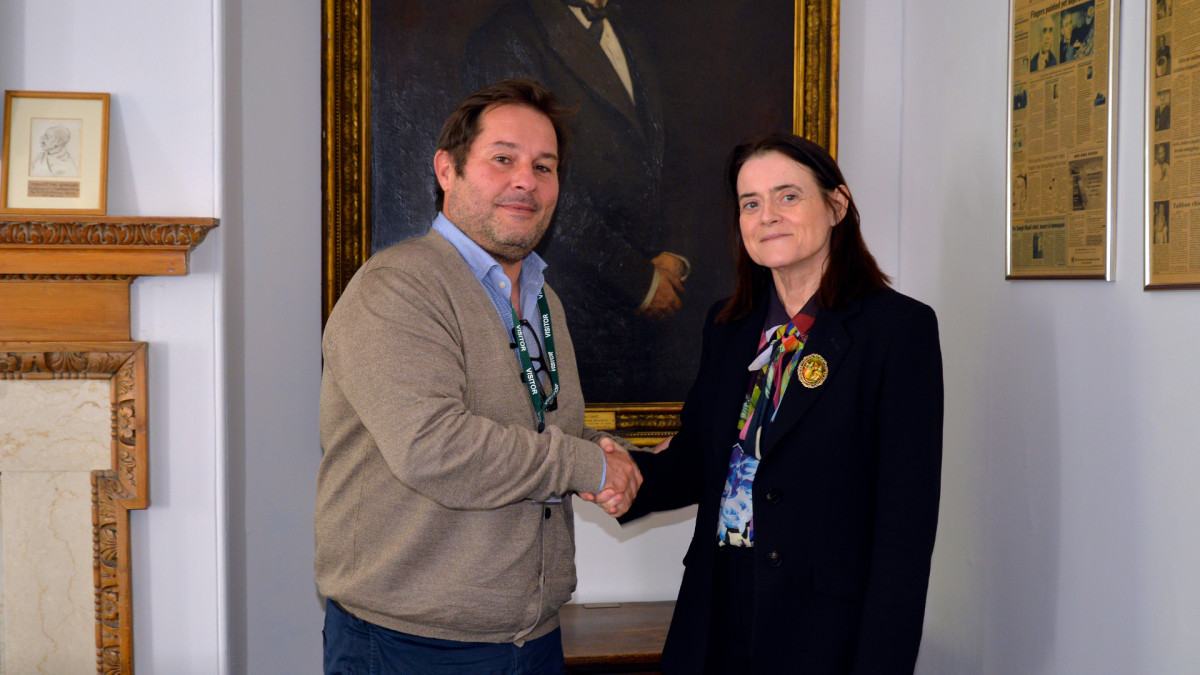
López Plana asks about the role of France and Germany in a Europe seeking greater autonomy and cohesion. Photo: Agenda Pública / Mark York
Enlargement and, at the same time, greater unity in Europe?
It is inherently challenging. The more members you admit, the higher the risk of encountering divergent voices. The Hungarian election result is encouraging, but you cannot rely on that alone. Other scenarios may emerge. Even Moldova is saying, “Let us in—no exemptions, admit us immediately.”
Enlargement is an inherently difficult question for the EU.
Speaking of enlargement, Ukraine is part of the conversation. But can Ukraine join the European Union without a clear resolution to the Russian invasion?
Everyone is looking toward Ukraine’s potential accession. There is talk of observer status—participating in meetings without voting rights and without inclusion in the Common Agricultural Policy. It is difficult to advance without a solid resolution. Any entry into the EU would entail a defense umbrella, and we will hear more about that in the future.
Thus, it is hard to imagine Ukraine joining quickly, even though many supporters want it to prevail in the conflict.
One potential consequence of the midterm elections, if Trump loses, could be something like: “I’m done with Europe and Ukraine; take responsibility yourselves. My focus is on the Pacific.” Is that plausible?
It is more likely that he would respond in an incoherent way to a challenge. He may be angry, but that does not automatically translate into a broad withdrawal. The message in Europe has already landed: you will have to pay more for your defense.
“We are not in a live war with Russia, even if Ukraine is. But it would be foolish to rely on Trump defending Europe”
It is the duty of politicians to persuade voters to accept compromises between welfare, health, pensions and defense. It is extremely difficult to convince people to fear Russia but not excessively. We are not in a prospective war with Russia, even if Ukraine is. Yet it would be reckless to depend on Trump defending Europe. If Russia takes provocative steps—such as seizing a Swedish island—it could trigger NATO’s involvement. That remains a pressing concern.
In public debate, we see, on one side, platforms and tech giants pouring money into U.S. elections and creating friction within the European Union. On the other, think tanks like Chatham House strive to cultivate a critical mass of global thinking. My question is: how can one compete with tech firms that shape public opinion in ways very different from think tanks?
The key lies in seeking alternatives. For a year now, Europeans have been exploring substitutes for American technology: determining what is essential and what is not. At present, systems like Microsoft Windows are hard to substitute, but this is precisely the kind of mental exercise people are undertaking.
In social media, alternatives exist depending on corporate conduct. Taxation is essential too, because these firms operate across borders. What has changed is that the U.S. government often intervenes on their side, tying tariffs or political pressure to tech regulation.
That confluence of forces is new and potent. But nations are still urgently seeking viable alternatives.
Thank you very much.
