
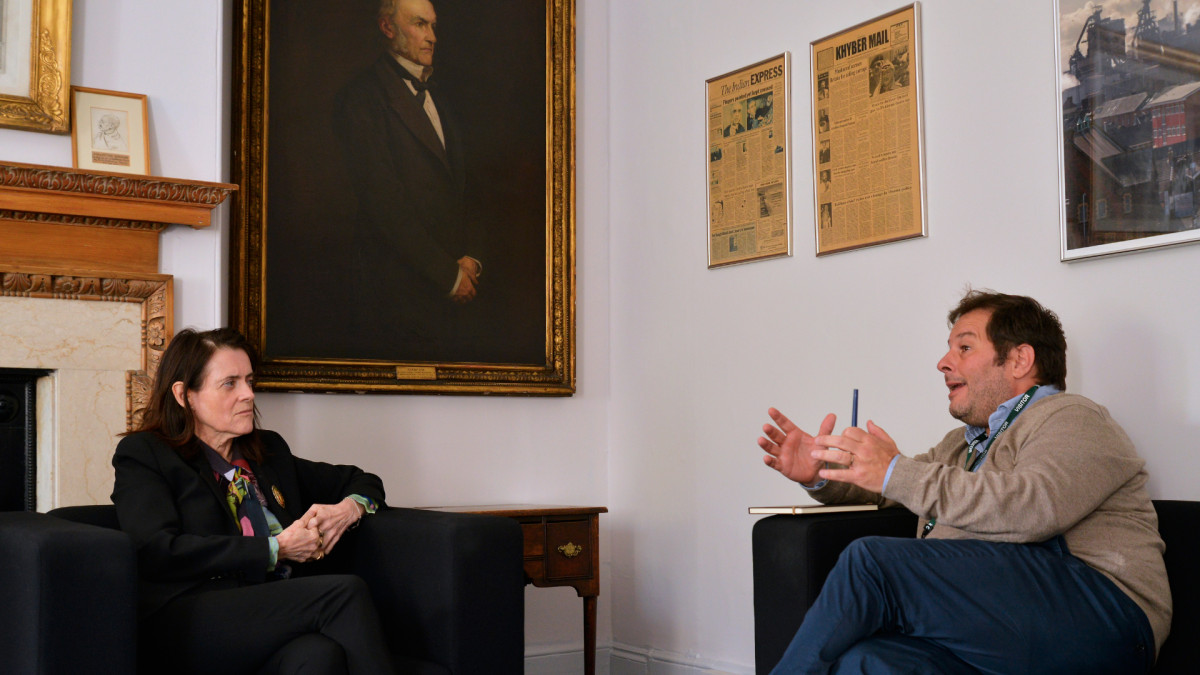
Spain is living through a unique moment of international exposure. Its positions on Gaza, Iran, or European strategic autonomy have placed the Spanish Government in a global conversation shaped by threats, realignments, and a growing uncertainty about the role of the United States. Bronwen Maddox, director and chief executive of Chatham House, watches the present with attention and elevates the debate to a broader scale: Europe can no longer act as if the old order were intact.
In Chatham House’s London headquarters, its chief executive outlines a demanding scenario for European democracies. Populist pressure, industrial fragility, technological dependence, and doubts about Washington converge at the same moment. For her, the rise of forces such as the AfD is the result of social tensions that traditional parties have failed to address.
The head of the British think tank also points to the external challenge. While Russia compels a rethink of the European security model, China threatens whole sectors of industry. For its part, the United States, even beyond Trump, no longer offers the same certainties. “Europe has a huge incentive to get its act together in economy and defense”, she maintains.
Founded in 1920, Chatham House is also known as the Royal Institute of International Affairs. Photo: Agenda Pública / Mark York
I’d like to ask you, first and foremost, about Spain, because it is at a moment —I’m not sure how to say it— of strong international exposure. What is your view of what Spain and the Spanish Government are doing in the global scene?
Spain is making an imprint and signaling that it holds a set of positions. We disagree with actions toward Iran. We disagree with what is happening in Gaza. And it is making that clear. There is the possibility of retaliation from the United States; President Trump has spoken of expelling Spain from NATO. But it remains to be seen how far those threats would be carried out.
“This is the kind of moment that requires governments to define themselves and to declare where their countries stand”
It is always difficult for any leader to know whether people back home care about these words and how they will be received on the international stage. But this is the moment for leaders to declare: this is our position. Mark Carney, in Canada, has done something similar by indicating that in the face of all these challenges, this is his country’s position. It takes courage for a leader to speak with such clarity. Of course, it depends on understanding what voters back home want, but this is the kind of moment that requires governments to define themselves and to declare where their countries stand.
Do you think European elites are well prepared to understand and endure this global situation?
They should be prepared. Donald Trump did not appear out of nowhere. He emerged from political forces that had been brewing for a long time in the United States, and which have echoes in other countries. Many European countries face the same pressures: migration, the sense of losing manufacturing jobs, or cultural wars that may be sharper in the United States but also resonate in Europe. Trump reflected all of those forces. He has his own character, but he represents dynamics that also appear in European countries.
Almost all European leaders have to grapple with budgetary pressures: how to fund health care, education, and pensions with insufficient money. Manufacturing jobs are disappearing; technology companies are everywhere and have a lot of money, but taxing them is very difficult. Without taxes, there is no state. And yet, you have to stand before voters and say: it is very hard; now vote for me again. All democratic countries are facing this problem at the moment. Jean-Claude Juncker expressed it very well years ago when he said, “We know exactly what to do; what we don’t know is how to win the elections again after doing it.”
“Who the elites are is a big question. They are different in every country, and I’m not sure they have remained the same”
So, elites should understand the pressures on their countries. Now, who the elites are is a big question. They differ from country to country, and I’m not sure they have stayed the same. There was a lot of anger among many populations —certainly in the United Kingdom since the 2008 financial crisis— toward the elites, whether the banks or political elites, who led their countries into this problem. Ordinary people suffered, yet those who made the decisions did not seem to be punished in any way, nor did they suffer themselves.
So I’m not sure elites —if I may use that term— have fully come to terms with that. But they should. They have had ample time to reflect on why people are so angry.
López Plana is interested in Europe’s elites’ ability to grasp the new global scenario. Photo: Agenda Pública / Mark York
Because, if not, what will happen? What could occur if European elites fail to grasp the real situation? In the latest polls, the AfD is leading.
This is the consequence: right- and left-wing parties that offer much simpler and more radical solutions rise, rise, and rise. We are seeing it in the United Kingdom, especially on the left with the Green Party, which is no longer primarily an environmental party. It is campaigning on the economy and on Gaza, and is winning a huge young vote.
We are seeing all of this. If the AfD were to come to power in Germany, it would completely change the way the European Union operates. No one should fall into complacency or assume that the status quo continues. What those populist parties are addressing is a challenge that all parties must face now, including centrists: how to give people a sense of hope and growth, even if the answers are not perfect, simple, and quick.
Is it possible to build more Europe now, with that angry population in our societies? Because it seems that making a more powerful and unified European Union is not easy.
Yes, it is difficult. But external pressures help a lot. On one hand, there is Russia, a threat to the entire EU —though Spain is farther away, it is a threat to the whole Union—, and the silent cyber warfare, disinformation, everything that is happening there. There is a great physical threat, the unresolved conflict in Ukraine, and then the United States saying: we will not guarantee European defense and you are left to it, with the uncertainty about what may come next.
Then there is China, with a very aggressive policy of selling all its products to the world and not being particularly interested in buying much. That poses a huge threat to European businesses and industry. All of these are reasons why the European Union has a strong incentive to get its act together in economy and defense.
Let me ask you about the forthcoming United States midterm elections. It seems that in Europe, von der Leyen, for instance, is waiting for the moment Trump might lose them. But couldn’t we have, perhaps, a more dangerous Trump after losing those elections?
That’s an interesting point. He will be angry. Very, very angry. The question will be whether he is constrained by the United States Constitution or not, something we don’t know yet. Suppose he loses the House and there seem to be more Senate seats in play each week. What then? It’s hard to say. If he lost both chambers, they would try to impeach him, and that would make him extremely angry.
“Trump has shown he is willing to try to be president simply by Trump-level action—Sharpie marker orders” (Note: the original blockquote in Spanish included a caption translating to “Trump has shown he is willing to try to become president simply by Sharpie marker, through executive orders”)
He has shown that he is willing to try to become president simply by Sharpie marker, through executive orders. He has signed more in a year than in his entire first term: over 220. It is very difficult for any check—whether Congress or the courts—to keep pace with that, though they can begin to. That is exactly what Democrats in Congress would start doing right away. Besides, they would feel less fear.
The Congress remains strikingly quiet at the moment. This is an election year, but they are very afraid that tech money will come at them. They fear that people who feel aligned with Trump will feel authorized to attack them. There is a lot of fear there, and that struck me a couple of weeks ago in Washington.
He will be angry. I don’t know how much he can do if he loses all that. The most important question is what is assumed right now. Is it expected that the Democrats will return? That would be risky. Any country or company dealing with the United States should assume that much of what Trump has done will endure. He has a very particular personality, vindictive and marked by personal attacks.
But let us assume he stays: that the next president keeps the tariffs—likely—and there may be more conciliatory language about Europe and defense, although the question about NATO will continue to linger.
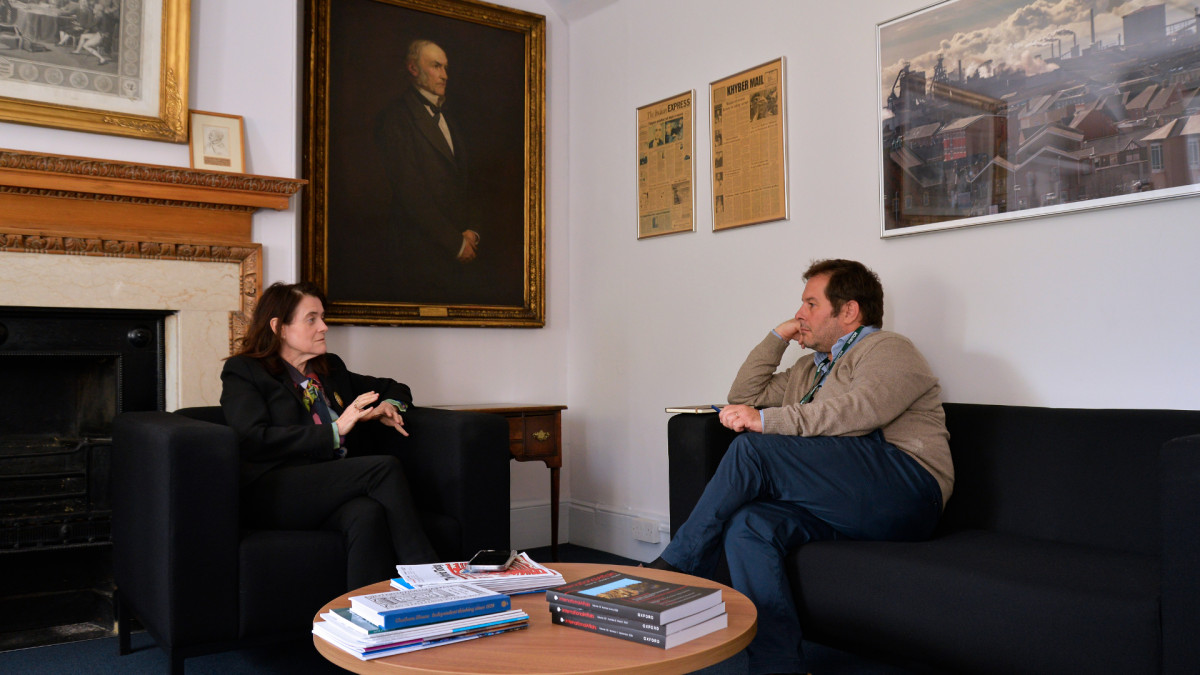
Maddox responds on the U.S. midterm elections and Trump’s room for maneuver with a hostile Congress. Photo: Agenda Pública / Mark York
Is Iran the real Trump mistake?
Yes, he has made other mistakes, and some of the tariffs may turn out to be one. But Iran is the most immediate mistake. It does not seem he can get out of it. It is a war that may have no end, because Iran has incentives to keep it alive. It has affected everyone, and the world is angry with him and wants him to end it, but he cannot. It is a big mistake.
His biggest error is not finding a coherent way to deal with China. There is only one thing a U.S. president, at this moment, must do well: how to handle China. And here we have a very confusing picture. There are people in his Administration who say China is the great threat, while Trump says Nvidia can sell its second-rate chips to China and sends mixed messages about Taiwan.
“The United States has never had an adversary like China—in technology, economy, the military, and ideology. And the one thing a president has to do really well is that”
Probably, the message China takes from Iran is that the United States would not defend, perhaps could not defend, Taiwan. That could be read as the National Security Strategy released late last year. Why define its interest by geographic length? It seems narrow. That strategy could be read as a retreat in the face of China. But the United States has never had an adversary like China—in technology, economy, the military, and ideology. And the one thing a president has to do really well is that. He has not done it. If you’re looking for a technical error right now, Iran is it.
And what about European policy toward China?
Europe must make some choices now. It will have to take measures, using existing legislation, to protect its industries; otherwise, it won’t have any manufacturing. At the same time, as Mario Draghi has written, Europe needs the single market to function much better and its capital markets to function better, to provide more capital to companies so that they remain European and are not bought by China or the United States.
Right now we have seen what happened with the automobile industry and solar panels. There are twenty other industries. The next is pharmaceuticals. It is almost impossible to compete with China. They have access to hospital data, they can test things in days or weeks, not months or years. They can grant licenses instantly. Any molecule we make, they can make it better, one European company told me.
“Europe must decide urgently whether Chinese competition is unfair due to subsidies and whether it should protect its industries”
Europe must decide urgently whether Chinese competition is unfair due to subsidies and whether it should protect its industries. It must make those decisions in weeks or months. China is keeping many companies afloat with losses, backed by state banks. That cannot last forever, but its current policy is to flood the world with products, and that poses a huge threat to Europe.
What about the relationship between the United Kingdom and Europe? Will we see interesting developments in this relationship in the coming years?
There are small discussions underway about minor improvements, and there will probably be some, but they are exhausting for both sides. Even small compromises —such as European students paying British tuition fees instead of international rates— are politically sensitive. There will be some improvements, but not major changes.
The pressure on the government comes from business as well as travelers who wonder why they are waiting two hours to go on summer holidays because of fingerprints and all that. The pressure is mounting. Perhaps we will have to wait for the next general election in the United Kingdom. I would be surprised if one of the parties —Labour, Liberal Democrats, or Greens— did not campaign for rejoining or entering the customs union.
There is a solid economic argument to return, and many allies for it. But European countries also have many other priorities. Relations with France are always difficult, be it on defense or on fishing.
The conversation addresses the UK-EU relationship after Brexit. Photo: Agenda Pública / Mark York
Not only for you, but also for other EU countries.
Yes, it is interesting. I recently attended the Delphi Economic Forum in Greece, where many countries said negotiating with France is an obstacle. If I had to give Keir Starmer’s team a piece of advice, it would be to spend more time in Brussels and less on bilateral relationships. That is the way back.
There is public support, though not yet overwhelming. Pressure is moving in that direction. Another key point is that migration figures are falling significantly, which reduces sensitivity around the issue.
Are you concerned about the role of the major EU powers —France and Germany— which seem unable to work together?
This is very interesting. One reason I travel a lot to countries outside the United Kingdom, France, and Germany is that other European countries have very different narratives. Spain, Ireland, Greece — and in a different sense Poland — are saying: we have had our own crises, we are doing fairly well now. Now we can teach the United Kingdom, France, and Germany a few lessons.
The Greeks have a particular interest in teaching Germany about growth, after all the lessons they received from Angela Merkel for years. Europe is changing. Countries are finding their own solutions. But it is a problem that France and Germany are having internal difficulties and, in addition, difficulties in working together.
In terms of the European Union and its economic situation, it seems the south is performing better than the north or the center of Europe, far better than Germany and France. Having Germany in a weak economic situation is a problem.
It is a problem for the rest of Europe. Germany is key to European defense. It is investing heavily in its own industry and is central to Europe’s defense and to Europe’s self-image. Germany is not antagonistic toward the United States, but it is essential for Europe to define itself with more distance from the United States than in the past.
Germany is central to what happens with Ukraine, and its voice is essential in enlargement.
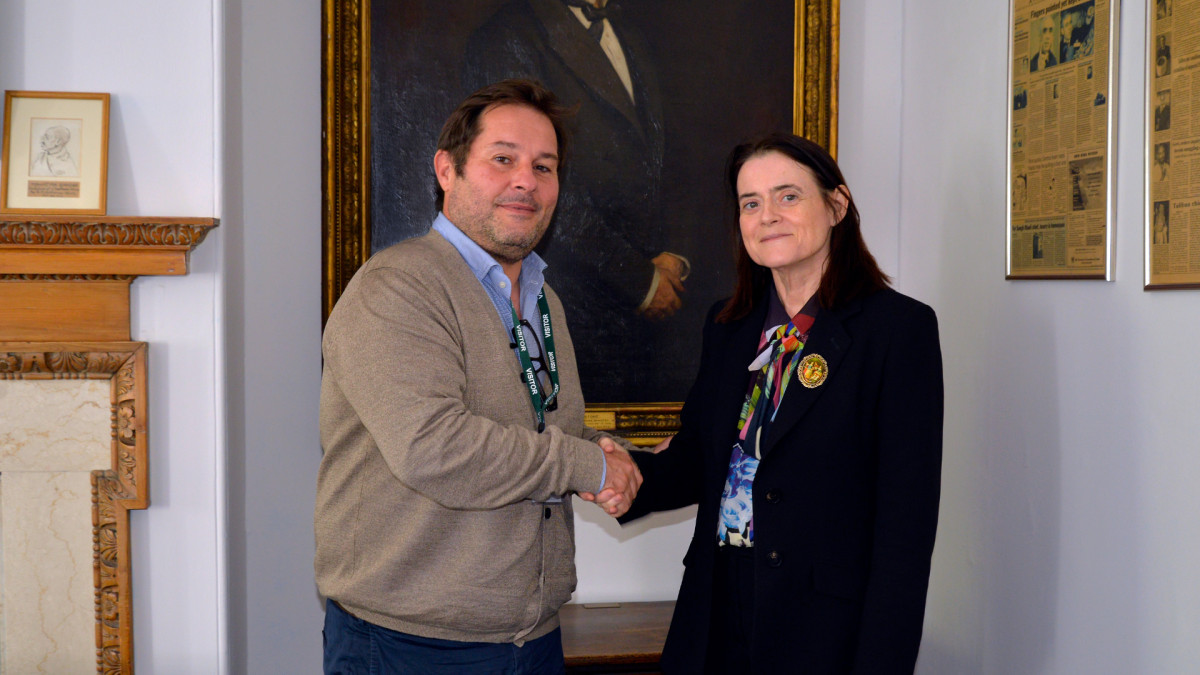
López Plana asks about France and Germany’s role in a Europe seeking more autonomy and cohesion. Photo: Agenda Pública / Mark York
Expansion and, at the same time, more unity in Europe?
It is always difficult. The more members you add, the greater the risk of divergent voices. It is a relief to have Hungary’s electoral result, but you cannot rely on that. Other cases could arise. Moldova itself is saying: let us in, we are perfect, no exceptions, let us unite immediately.
Enlargement is an extremely difficult issue for the EU.
When we talk about enlargement, we can talk about Ukraine. But is it possible to have Ukraine in the European Union without a clear resolution on the invasion?
Everyone is looking at that accession. There is talk of an observer status: being at meetings but without voting rights and without being included in the Common Agricultural Policy. It is difficult without a proper solution. Any entry into the EU implies a defense umbrella. We will hear more about this in the future.
So it is hard to imagine Ukraine joining quickly, although many want the conflict to end.
One consequence of the midterm elections, if Trump loses, could be something like: “I’m tired of Europe and Ukraine, you all take responsibility. My interests are in the Pacific.” Is that possible?
It is more likely that he will not respond coherently to a challenge. He may be angry, but that does not necessarily translate into a systematic withdrawal. The message has already reached Europe: they will have to pay more for their defense.
“We are not in a direct war with Russia, though Ukraine is. But it would be unwise to rely on Trump to defend Europe”
It is the job of politicians to persuade voters to accept trade-offs between welfare, healthcare, pensions, and defense. It is very hard to make voters fear Russia, but not too much. We are not in a direct war with Russia, though Ukraine is. But it would be unwise to rely on Trump to defend Europe. If Russia does something provocative —such as taking a Swedish island— it could trigger NATO. That is one of the current concerns.
In public debate we have, on the one hand, platforms and tech companies investing heavily in U.S. elections and stirring up trouble in the European Union. On the other hand, we have think tanks like Chatham House trying to build a critical mass of thought about the world and the global situation. My question is: how do you compete with tech companies that can shape the environment and public opinion in a way very different from think tanks?
The key is to seek alternatives. For the past year, Europeans have been looking for alternatives to U.S. technology: which technology is essential and which is not. At the moment, systems like Microsoft operating systems are hard to replace, but that is exactly the kind of thought experiment people are doing now.
There are alternatives on social networks, depending on how the companies behave. Tax policy is also essential, because these companies operate across borders. What is different now is that the U.S. Government often intervenes on its side, tying tariffs or political pressure to tech regulation.
That combination of forces is new and powerful. But countries are still urgently seeking alternatives.
Thank you very much.
