
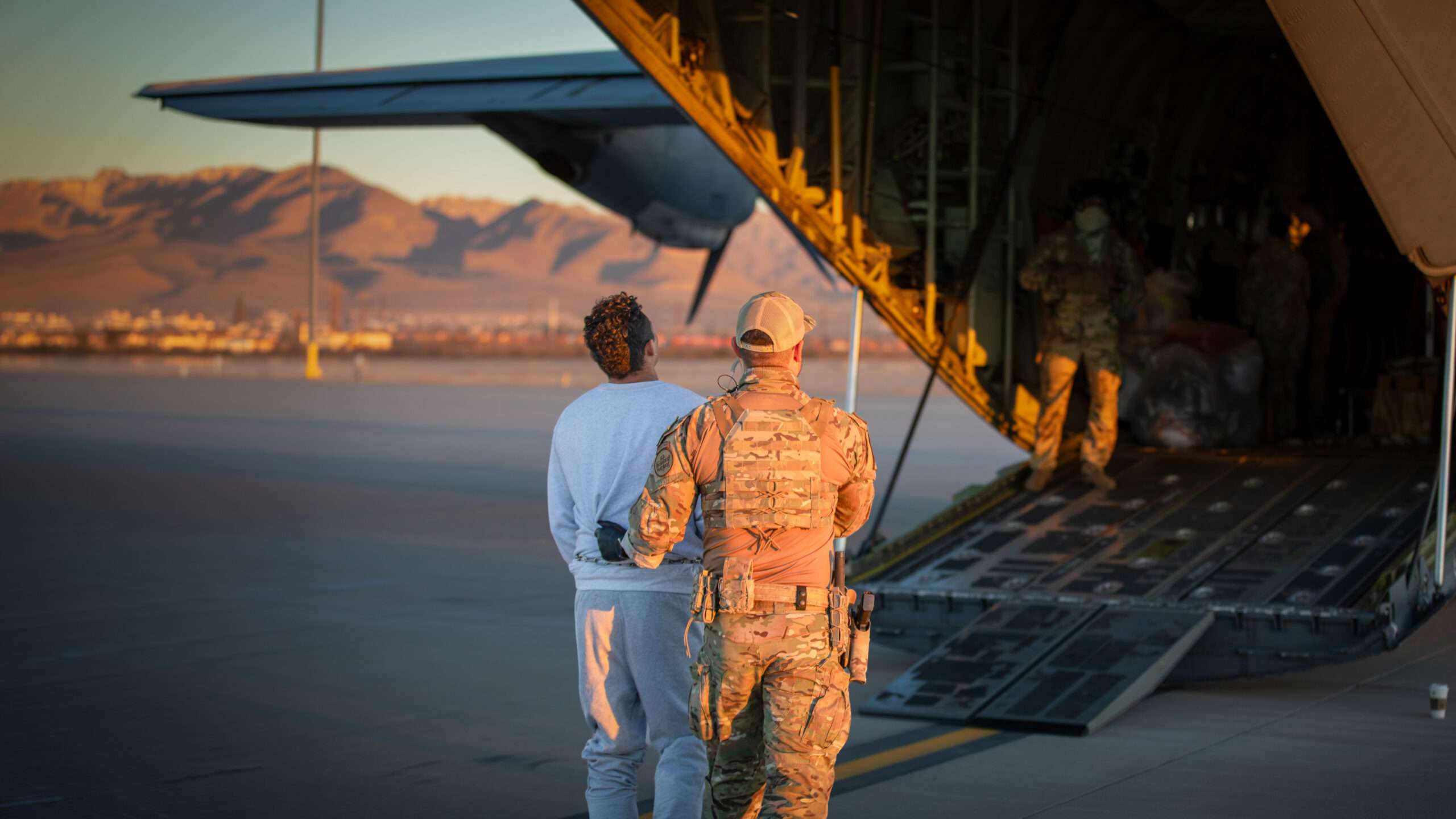
Camp East Montana stands as the United States’ largest facility devoted to immigration detention, and it has long been shadowed by reports of violence and neglect, as evidenced by a sequence of investigations conducted both inside and outside government channels.
Dozens of detainees at this nation’s biggest immigration detention center told researchers from civil rights groups that they endure beatings, medical neglect, malnutrition, and brutal living conditions.
In a joint report issued today, Human Rights Watch and the American Civil Liberties Union (ACLU) assert that the abuses described by 71 people held at Camp East Montana—privately run and located inside the Fort Bliss Army Base near El Paso, Texas—violate both national and international human rights standards.
“People we spoke with conveyed extreme cruelty and potential violations of international human rights law,” said Angélica César Rosales, a Human Rights Watch fellow and the report’s author. “They came forward about life-threatening medical neglect. They described living in squalor, being struck by masked guards, and having at various times their ability to communicate with the outside world completely cut off. In some cases, this may amount to enforced disappearance under international law.”
The findings add to a growing stream of human rights reports, investigative journalism, and internal audits that have exposed widespread abuses at Camp East Montana, which is currently configured to hold up to 5,000 detainees.
Notoriously, Camp East Montana is tied to the death of Geraldo Lunas Campos on January 3. The Department of Homeland Security (DHS) initially asserted that Lunas Campos had attempted suicide and died amid a struggle in which “guards were trying to save him.” Yet, the El Paso Medical Examiner’s Office ruled the death a homicide by asphyxiation. Several detainees at Camp East Montana later alleged that guards had strangled Lunas Campos.
The facility comprises large, soft-sided canvas tents without windows, with cages inside. The report describes deplorable showers and toilets, shortages of hygiene supplies, and periods when detainees are kept indoors for weeks at a time without outdoor time.
“From August to September, I went a full month without seeing sunlight,” reported one detainee. “The guards simply didn’t take us outside. People in my unit grew anxious and desperate with nothing to do. I felt trapped; it was torture.”
Of the 71 detainees interviewed by Human Rights Watch, 64—distributed across at least five tent units—”either personally experienced beatings or witnessed peers being assaulted by ‘anti-disturbance’ personnel,” the report notes. The violence often followed protests over conditions inside the camp.
“The guards rush into our pod in groups of fifteen, sometimes twenty,” one interviewee described. “They wear all black, masks covering everything except their eyes, and no name tags. They arrive, seize whoever they can, and begin beating them… They are in control and can do whatever they want with us.”
Several detainees recounted Lunas Campos’s death, alleging it was caused by strangulation by guards. One account reads:
Geraldo was handcuffed outside his cell and asking for his medicine. Nurses were handing out medication, so he said, “I need my medicine.” The guards told him to stop talking and return to his cell. When he refused, claiming he would go in only after receiving his medicine, the guards shoved him inside and locked the door. The walls of the SHU are very thin; I could hear everything. It sounded like guards were hitting him, like his body was being punched and slammed. Geraldo cried for help, saying, “I can’t breathe!” repeatedly. The beating continued. He cried, “You’re suffocating me.” Then everything went quiet.
César Rosales notes that one interview that lingered involved a 66-year-old Cuban immigrant who had lived in Florida for more than four decades before his detention. He had survived cancer and had gone on a hunger strike to protest staff’s denial of daily medications he needed.
“When we spoke with him, he’d been on a hunger strike for a couple of days,” Rosales says. “Rather than providing his medications and treatment, they placed him in solitary confinement and later moved him to another detention facility. That is just one of many episodes of abuse and medical neglect we documented, yet it vividly illustrates the mistreatment detainees face. We also spoke with his wife, who told us she fears he may not survive immigration detention.”
An internal Immigration and Customs Enforcement (ICE) review of Camp East Montana earlier this year uncovered numerous violations of national detention standards, including failures to document use of force and medical care, and to respond to grievances about inadequate medical treatment. A detainee with tuberculosis was not isolated; another detainee managed to escape.
A Government Accountability Office audit in June found that ICE wasted millions of dollars by rushing the contract award and the facility’s opening. ICE terminated its contract and shifted to a new private contractor in April.
In response to the internal findings and media inquiries, DHS has argued that the new contract will strengthen oversight of Camp East Montana. “Far from closing, Camp East Montana is upgrading,” a DHS spokesperson told Reason in June.
Nevertheless, Rosales states that she has not observed any meaningful change in what people inside Camp East Montana report.
“Conditions have remained abusive,” Rosales says. “People continue to report living in filth. They face life-threatening medical neglect. In some cases, they’re not allowed recreation in line with ICE and international standards. They still struggle to contact attorneys, and there is no functional law library at the facility, which hampers defending their immigration cases. All of this shows that abuses persist despite a superficial contractor change.”
The report calls for the permanent closure of Camp East Montana and an end to the mass deportation program associated with the previous administration. At a minimum, it urges restoring the three DHS oversight offices that were largely dismantled and revitalizing Congress’ and state lawmakers’ authority to inspect detention facilities.
Allegations of medical neglect, brutality, and denial of due process have poured out of federal immigration detention centers since the mass deportation program began under the prior administration. A separate medical examiner’s report obtained by Reason recently determined that an ICE detainee died from complications linked to a severe dental infection.
