
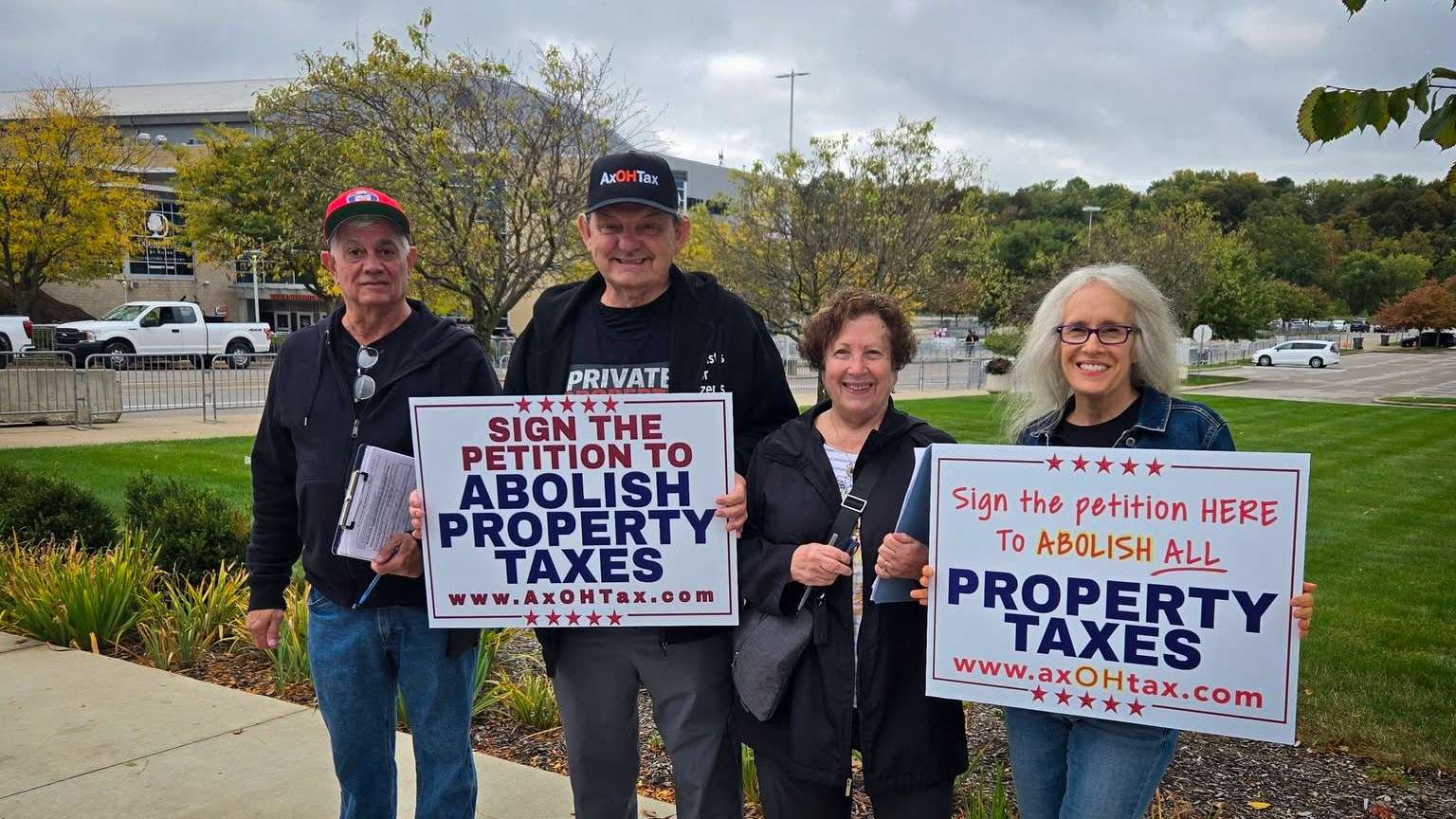
Annual tax bills often leave many homeowners feeling more like perpetual renters.
If you are faced with a steady levy to retain control and usage of a home or another parcel of real estate, can you really be said to own it? Or are you simply leasing it from the person who collects the payments? This question underpins a rising movement against property taxes, a movement that is gaining traction nationwide and could soon confront a major test in Florida’s ballot box in the form of a proposed constitutional amendment aimed at sharply reducing taxes on primary residences.
You are reading The Rattler from J.D. Tuccille and Reason. Get more of J.D.’s commentary on government overreach and threats to everyday liberty.
‘Property Is the Foundation of Liberty’—and a Big Source of Tax Revenue
Reform advocates understandably champion private property as sacrosanct, arguing that rising levies threaten that sanctity. Opponents, on the other hand, fear a drop in government revenues, but they also worry that lowering property taxes would push fiscal authority upward to state governments at the expense of local self-government.
“Property is the foundation of liberty,” contends economist Vance Ginn. “It embodies the right to the fruits of voluntary exchange, investment, and saving—not a privilege granted by the state. Taxing property again each year after it has been purchased with after-tax income is to deny true ownership. Property taxes function like an annual wealth tax or an unrealized capital-gains levy, applied regardless of income or the ability to pay.”
Countering Ginn’s stance in the discussion is Jared Walczak of the Tax Foundation, who isn’t exactly an admirer of property taxes but believes they are preferable to some alternatives.
“Spending restraint can ease the burden of property taxes,” Walczak argues. “But given that property taxes make up about 70 percent of local tax receipts nationwide and even more in certain states, any talk of scrapping them must reckon with possible revenue substitutes.”
“It is axiomatic that whatever you tax, you obtain less of,” he adds. “Taxation of income reduces income-generating labor and investment, for instance. Yet since land cannot move, taxing property distorts market choices less than taxation of income or even sales would.”
Walczak also notes that while property taxes are typically levied by local governments, most viable alternatives tend to reside at the state level. Transferring more tax authority upward would shift power away from homeowners facing steep bills toward higher-level policymakers.
Ginn replies that governments at every level cost more than they should and that “the moral and fiscal failure of property taxes lies not only in how the money is raised, but also in how much government spends.”
Thus, the debate over property taxes becomes not only a clash between those seeking to shrink the state’s take and those advocating for larger government, but also a confrontation between anti-tax activists and their frequent allies who champion local control. In a recent piece on the groundswell against property taxes, Politico’s Liam Dillon notes that “the uprising’s fiercest battles are taking place in Red States where this issue has become yet another fault line on the right.”
Localities Rely Heavily on Property Tax Revenues
The intensity of the debate is partly rooted in how much governments rely on these taxes. “In fiscal year 2023, property taxes made up 28.9 percent of total state and local tax collections in the United States, more than any other revenue source, even though they are largely collected at the local level,” wrote Janelle Fritts for the Tax Foundation.
In the United States, property tax rates typically fall between about half a percent and just under two percent of a home’s assessed value. States that depend most on them—New Hampshire (1.5 percent in 2024) and Texas (1.4 percent in 2024)—also tend to leave substantial responsibilities to localities that might be handled at the state level in other places. It’s worth noting that Cato’s Freedom in the 50 States ranks New Hampshire as having the second-least burdensome tax regime, with Texas not far behind in fourth place.
On the lower end, Alabama (0.37 percent in 2024), Arizona (0.48 percent), Hawaii (0.29 percent), and Utah (0.48 percent) levy the smallest property taxes. Some states, such as Illinois (1.88 percent in 2024) and New Jersey (also 1.88 percent), tax a wide array of things to support expansive governments. Hawaii, though it has relatively modest property taxes, is nonetheless ranked as the most tax-burdened state by Cato.
As noted, economists tend to favor property taxes because they are efficient, barely distort economic choices, and empower localities relative to higher levels of government. Yet as Politico’s Dillon emphasizes, “everyone who isn’t an economist seems to despise property taxes.”
Homeowners Don’t Care for the Insecurity Embedded in Property Tax Bills
Property taxes rise in tandem with assessed property values, values that homeowners have little control over as markets swing with supply and demand. They resemble an annual rent that must be paid to keep a roof overhead, even when the home has already been paid for. This diminishes the sense of security that owners feel, since their living arrangement hinges on satisfying local authorities’ demands. While sales taxes can be softened by consuming less and income taxes hinge on earning, property taxes—except in some places—come due regardless of circumstances.
Rapid increases in property values in recent years have driven higher tax bills for Americans who merely stayed put, though localities can and sometimes do adjust tax rates to offset rising values. USA Today reported that “between 2019 and 2023, the median annual property tax value rose by about 25%.” This surge has energized efforts to reduce or abolish the taxes.
Reform efforts have succeeded in more than a dozen states, according to Governing. Most of these moves have centered on reducing levies, though attention is turning to Florida, where Amendment 3 would, if adopted, incrementally lift the homestead exemption to $250,000 and would require the Legislature to establish a uniform method for counties and municipalities to raise the exemption to the full assessed value, effectively eliminating property taxes on owner-occupied residences.
To become law, the amendment would need 60 percent of voters to approve. Polls indicate more supporters than opponents, though not necessarily enough to secure the supermajority needed for passage.
According to the Tax Foundation, in Florida, “the statewide average sales tax rate would need to climb from 7.02 to 15.34 percent to compensate for the property tax revenue,” assuming the replacement revenue is equivalent. Localities could see different rates if they chose to implement local sales taxes rather than relying on the state level.
Of course, this presumes that state and local governments continue delivering public services at the same level. But as economist Ginn notes, the issue isn’t solely about how property taxes raise money, but about how much government is funded overall. If the property tax revolt is a broader push against expansive government, it may demand a smaller revenue base to sustain a leaner state.
