
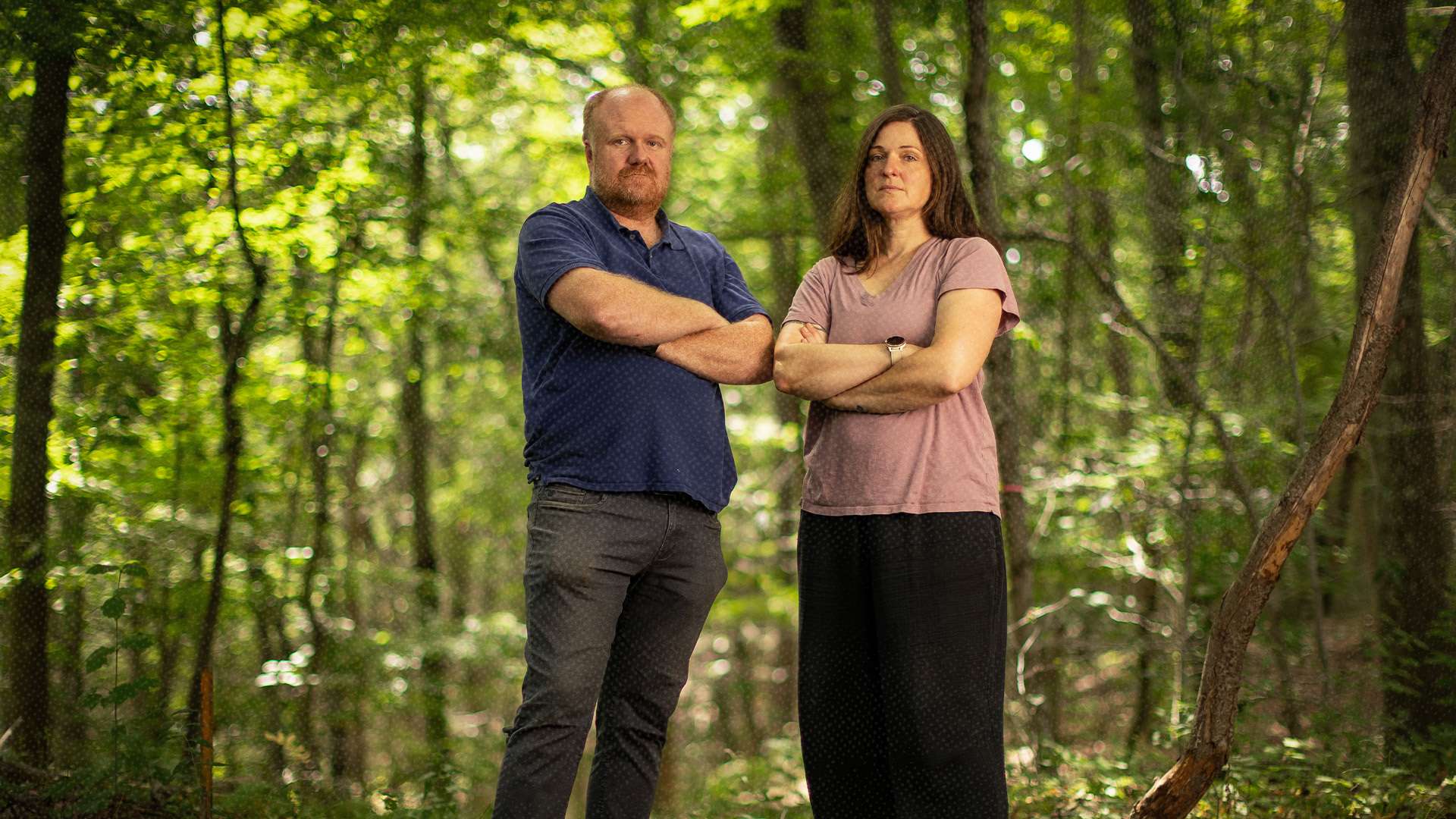
Property ownership stands as one of the most long-standing pillars of liberty. “America’s Founders understood clearly that private property is the bedrock not only of prosperity but of freedom itself,” Roger Pilon, founder of the Cato Institute’s Center for Constitutional Studies, wrote in 2017.
Yet far too often, officials impose needless rules on how land can be used. One couple is challenging their town over the simple right to let people walk on their property.
Charles Copley met Elizabeth while both were pursuing Ph.D. studies at Oxford University. After several years in his native South Africa, they relocated with their children to Connecticut to be nearer Elizabeth’s relatives.
Longing to make the area their permanent home, they purchased two rural parcels totaling 50 acres in Roxbury in 2022. Their aim was not only to reside there but to shape the land—farming, planting, and customizing the property in ways that would honor their family while safeguarding its natural beauty.
They hired a forester to draft a ten-year forest management plan, which the town approved, and they began removing invasive species and clearing miles of walking trails across all 50 acres.
The trails were intended to curb invasive plants, but they would require ongoing upkeep. To accomplish that, the Copleys began using Sniffspot, a platform akin to Airbnb that lets landowners rent out land by the hour for hikes or dog walks. They charged a modest $10 per hour, while the app managed scheduling and payments. In exchange, steady foot traffic would help prevent the trails from overgrowth.
That arrangement functioned smoothly for several months—until April 2025, when the Copleys received a letter from the city. A zoning enforcement officer asserted that the Copleys were “operating a ‘dog park,’” and warned that the operation had to cease unless it complied with home enterprise requirements.
Coincidentally, the town had enacted an ordinance just a week earlier regulating short-term rentals, such as Airbnb. But as Charles notes to Reason, “one of the things that that short-term rental ordinance did was to prohibit any kind of hourly rentals.” (Elizabeth recalls that at an earlier town meeting they were told—incorrectly, as it turned out—that the ordinance wouldn’t affect them.)
Confused yet hopeful to avoid legal trouble, the Copleys pursued a home enterprise license. Yet their property comprises two plots, and the trails span both; town officials said a single license could not cover two plots. They could choose to merge the plots, but that would entail an expensive surveying process, could diminish the property’s value, and would impede their future ability to build freely.
This sparked months of discussions in which officials offered inconsistent guidance about how the Copleys could lawfully allow people to hike on their land, and when pressed, they could not cite a specific town ordinance that forbade the activity.
To be clear, the conduct in question is charging $10 per hour to hike on their land.
What was intended to be only a minor component of the Copleys’ multi-year plan for the property became a central focus. “I’m running a farm here; I need to be able to plan,” Charles says. “I’ve got nut trees I want to plant. I’ve got invasives I need to remove.” And yet the hiking trails have consumed a disproportionate share of the family’s time.
On Thursday, the Institute for Justice (I.J.), a public-interest law firm, sent a letter to the town of Roxbury on the Copleys’ behalf.
“We’d like the town to tell us what ordinance prohibits the Copleys from inviting people onto their property for a small fee to walk on their trails in the same way that…any other private landowner would be allowed to invite people onto their land,” I.J. senior attorney Ari Bargil told Reason. “And if there is no such ordinance that they can point to, we’d like the town to confirm that they could resume their operation as they were before, peacefully and harmlessly allowing people onto their land.”
Although the town’s ordinances do not explicitly address by-the-hour trail rentals, the letter notes that “all agricultural uses—and all attendant ‘accessory uses’—are permitted by-right,” meaning they conform to current zoning codes and are inherently allowed. The letter also points out that Roxbury had already approved the Copleys’ forest management plan, which “identifies recreational uses such as hunting, hiking, wildlife watching, snowshoeing, and cross-country skiing as consistent with the broader goals of ‘[e]xpand[ing] and improv[ing] the trail system for forest fire suppression, forest management,’” and “‘property maintenance.’”
The case is especially frustrating because it involves restricting an owner’s use of their land in whatever manner they choose, even something as simple as using an app to permit hikers. “The government’s stance seems to be that because something isn’t expressly permitted, it must therefore be prohibited,” Bargil adds.
Yet, if anything, the app provides an added layer of security that would have been absent in earlier times when hourly trail rentals were conducted informally with cash and word of mouth.
“One of the things that was really important to us was to know who the person was that was on our property and when,” Charles explains. “I actually think this is more regulated than many public parks: I know who the person is, I meet them, I explain how everything works. So it’s even more odd to me that this would be a problem.”
The letter gives the town until September 30 to respond; otherwise, the Copleys say they will resume hosting hikers on October 1.
*CORRECTION: This article originally misstated the Copleys’ demands.
