
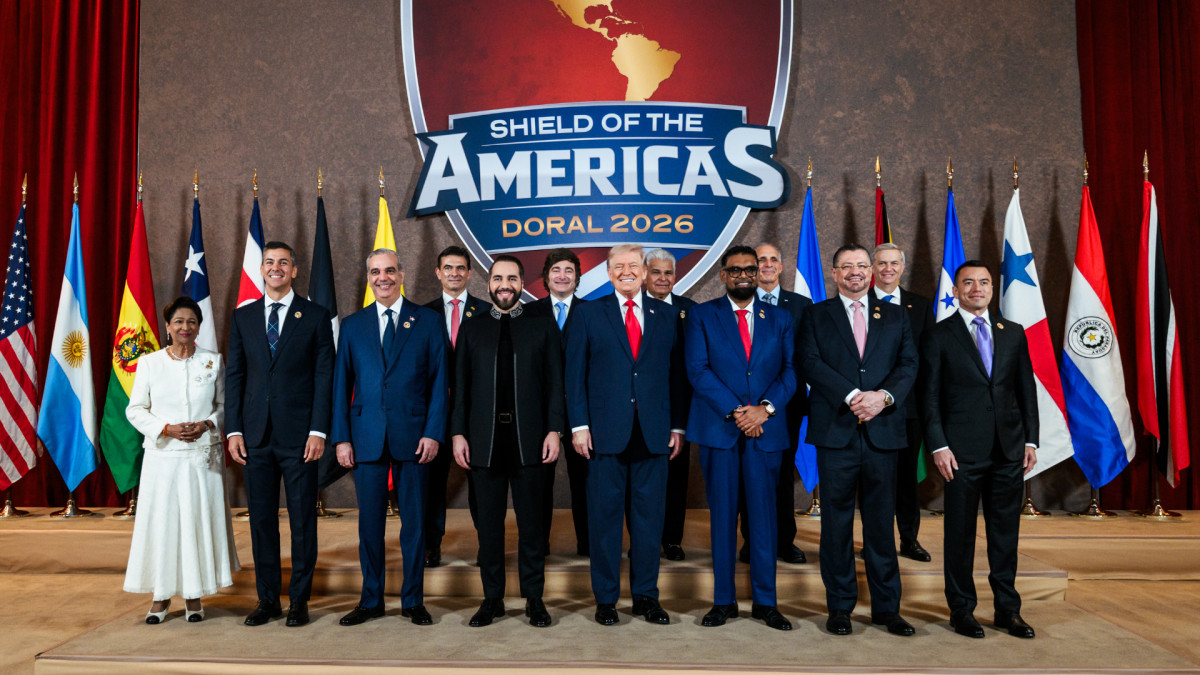
Finally, it happened: Latin America grew tired of waiting, of enduring, of merely surviving. Like a lethargic pendulum, the region moved for decades: left-wing governments promised social justice and only managed polarization; right-wing governments promised economic stability and left unprecedented crises. What has changed now? The speed and force of that pendulum. And, of course, the movement: everything indicates it has become stuck at one end: on the right, in its most radical expression.
In less than two years, seven countries have elected presidents who speak with the thick voice of the most relentless extremism. Echoes that repeat Donald Trump’s formulas as if they were magic recipes: security, economic freedom, order. It’s no accident: it’s a symptom.
“In less than two years, seven countries have elected presidents who speak with the thick voice of the most relentless extremism”
And then there is the violence. As the article “The Dramatic Trumpification in Latin America” (The Dramatic Trumpification of Latin America), published in The Economist, shows, violence appears as a backdrop that darkens everything. Latin America concentrates one third of the world’s homicides. And that figure has become a sort of electoral mantra that serves every purpose: to justify the militarization of any region, allocate funds to build more prisons (and fewer schools), etc. It is the doctrine of the hard hand, of unconditional authoritarianism. The icons? The Bukele model and his megaprisons, his mass detentions turned into a fetish. In short, what was once called totalitarianism now dissolves under the nobility of effectiveness. And citizens in places like Bogotá, Buenos Aires, Santiago or Quito, tired of funerals, extortion, blood running in the streets and impunity rooted in police offices, have accepted the pact: less rights in exchange for fewer dead. And at this point, many others repeat another mantra: “whatever it costs”.
It is true that, while we are talking about a process of rightward shift or Trumpification in Latin America, we cannot treat it as a linear phenomenon, chronologically speaking. There are key dates: 2016 with Brexit and the first arrival of Donald Trump to the White House; 2023, when Javier Milei broke the long Peronist tradition in Argentina; and, definitively, 2025 with Trump’s return to the presidency of the United States. This latter event was the catalyst of the phenomenon, of the process mentioned above. Not because it dictates policy in Latin America per se, but because it legitimized its style, its dogma: sovereignty justified as a tariff wall, security as spectacle and politics as a boxing ring. And many leaders, dazzled by the economic might that the United States represents, have found in him a mirror: a language that allows them to reap benefits from social fatigue. In other words, the Trumpification is not a servile copy: it is an adaptation. Each country has translated the MAGA script into its own dialect.
In this regard, we speak, for example, of the speeches of Noboa’s Ecuador or Milei’s Argentina. But also of those of José Antonio Kast, Abelardo de la Espriella, or Keiko Fujimori.
“Many leaders, dazzled by the economic might that the United States represents, have found in it a mirror that allows them to cash in on social fatigue”
It isn’t just about voting for the right, or for the more conservative options, but about a phenomenon that always bears the stamp of Donald Trump. The new ultra-right leaders express that radicality that tastes more like an easy exit than conviction. For now, Milei, with corruption cases at the top of his government and broken promises that have fractured his electorate, is already paying the political price of his bravado. Noboa is already paying dearly for the arrogance with which he broke diplomatic ties with Mexico. The rest? It still has a lot to prove. In any case, the questions to ask at this moment are: how did Trumpification arise in Latin America? And why has the pendulum stalled on the radical right?
From Brexit and Trump to the echoes of populism in Latin America
It all began somewhere else. It was 2016. David Cameron, in a futile attempt to show his people the virtues of democracy, achieved the opposite. He called for a referendum and the British people voted against themselves, against Europe. Three years later, the United Kingdom left the European Union and showed what no one was prepared to see: that democracy is not a perfect system. That was the first great victory of populism in the present era.
That same year, but months later, democracy failed again: the American people gave Donald Trump their vote of confidence. While in his first term he was not as radical, today, without a doubt, and after two years back in the White House, he embodies the idea that democracy — that system that bets, above all, on the popular will — is already endangered by the country that has been capable of anything, absolutely anything, in its name. Second victory of populism.
“Trump represents the idea that democracy itself —that system that bets, above all, on the popular will— is already endangered by the country that is and has been capable of anything”
Then we lived ten years of a kind of impasse in which the balance of power suggested that democracy, despite its missteps, remained an ideal system. It is improvable, yes, but undoubtedly the best political option globally. Nevertheless, as mentioned earlier, in 2025 Donald Trump returned to the U.S. government and everything changed. And now, indeed, radically. For anyone who still doubted it, populism thrives where democracy has stumbled.
According to the consultancy GobernArte, the phenomenon of trumpification in Latin America does not have an ideological origin: punitive voting is the most clear way to exercise politics from the streets and at the ballot box. In short, the people (or, more precisely, a bit more than half the population) grew tired of promises and incomplete projects, and have leaned toward punishing those who failed. For two decades, the left governed Uruguay, Argentina, Brazil, Venezuela, Chile and Bolivia, but, aside from debatable data and questionable figures, the reality is stark: only Mexico, Brazil and Uruguay remain today as bastions of governments that are not right-wing nor ultra-conservative.
Because, as they also argue at the aforementioned firm, “the right has not returned with a single speech, with a pre-set script from Washington, but has done so by adapting to the social malaise of each country”. When asked, “why does the right return in the region?”, that same polling and analysis firm has identified four variables.
The first is inflation. When economic adjustment and austerity policies, as occurred during Alberto Fernández’s government in Argentina, between 2019 and 2023, hit hard the citizen’s wallet, the ballots, more than a site of democratic exercise, become an opportunity to punish those responsible for never making ends meet. Politics, when you can’t make ends meet, is very hard to understand clearly.
The second is insecurity and crime. If there is one thing Bukele has known how to exploit, it is the fact that El Salvador, before him, was the most dangerous country in the world and, under hisAdministration, became the safest in the continent. It’s true; no one can deny the figures the current Salvadoran government has on security progress. Yet, believing that a model that works in a country of just over six million inhabitants would do the same in one like Colombia (53 million) or Argentina (46 million) is absurd. That is not to mention the enormous differences in social construction and socio-economic particularities of each country. It is by no means the same to govern a city like San Salvador (two million inhabitants when considering the metropolitan area) as to govern a huge urban monster like Mexico City, which has 23 million.
“If Bukele has exploited well the fact that El Salvador, before him, was the most dangerous country in the world, and under his rule became the safest in the continent”
Then comes the anti-political vote, as defined by GobernArte. In other words, populations such as the Colombian or the Argentinian have rewarded the outsider who promises radical changes. The main fatigue of many populations in Latin America has arisen from broken and unkept promises of traditional rulers. And for that reason, many people have preferred to bet on the pragmatic ultras who promise immediate results (even if they sound like fantasies worthy of idyllic futures).
And the last variable is the Trump factor. On that, we have already elaborated earlier in this piece. Trump functions, for many political entities in the region, as a guiding beacon and, more than a protector, as an endorsement. Yes, as an endorsement of incendiary discourse and swagger.
Finally, as they argue in that same consultancy, “the pendulum is not ideology. It is frustration.” That is, people are tired of seeing generations increasingly impoverished, of losing the idea of a prosperous future. Populations like Argentina’s know very well what exiles to Europe look like: for twenty-five years now the Ezeiza international airport in Buenos Aires has seen Argentines every day with suitcases full and a European passport in hand reinventing themselves in the land of their grandparents.
“People are tired of seeing generations increasingly impoverished, of losing the idea of a prosperous future”
In short, the geopolitical map has been remade in Latin America. There are still two years left of Donald Trump in the White House and, theoretically, anything can happen. The midterm elections in November remain, and that could, in some way, limit the furious expansionism of the Republican leader. Nevertheless, countries like Chile, Colombia and Peru will barely enter the phenomenon of rightward shift sweeping the American continent.
How will the continental political map recombine? Will Mexico, Uruguay and Brazil continue to resist the onslaught of Trump and his allies? As stated, there are still two more years of Trump in Washington, but the message is clear: in Latin America, many people vote from frustration and fatigue, from the outrage at the rivers of blood that run through the streets, from the weariness of false promises that end in crises felt in the wallet. In the region, ballots are no longer spaces to exercise democracy, but forums to punish those who, until now, have not kept their promises.
