
Calls for more aggressive security measures evoke the post-9/11 security theater that brought us the TSA.
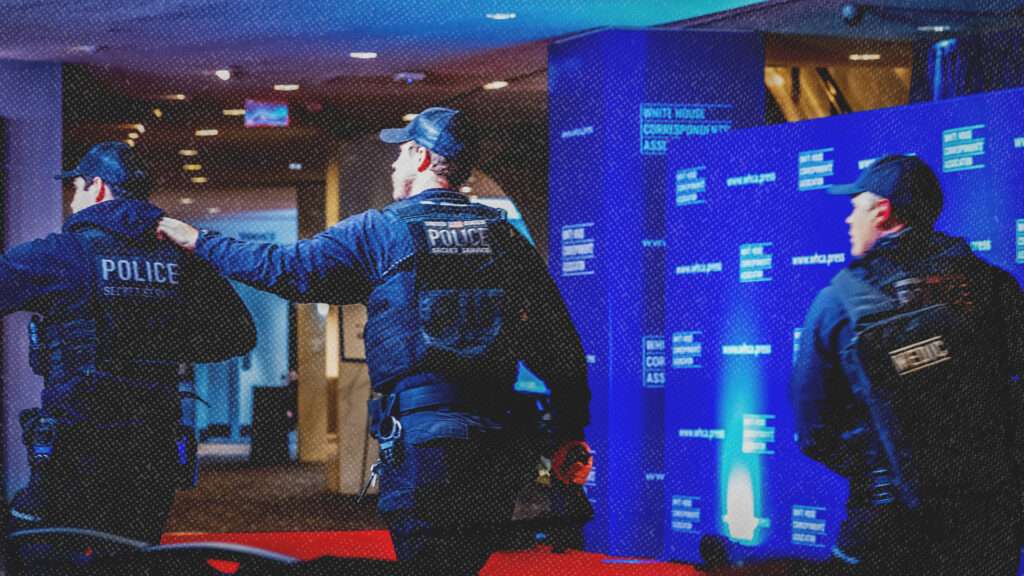
Whispers of tightening security followed the weekend incident at the Washington Hilton, where Secret Service agents restrained a gunman during the annual White House Correspondents’ Association dinner.
“A man charged a security checkpoint armed with multiple weapons, and he was taken down by some very brave members of Secret Service,” President Donald Trump stated while sharing security camera footage on social media.
Authorities later identified the assailant as Cole Tomas Allen, a 31-year-old man from California, who was equipped with a shotgun, a handgun, and knives. Allen reportedly exchanged gunfire with Secret Service personnel, and one agent was struck, though other specifics remained unclear.
Investigators say Allen told them he aimed at “Trump administration officials,” not at the president personally. Yet a digressive manifesto, allegedly sent to family members and published by the New York Post, criticized numerous Trump policies and portrayed the president as “a pedophile, rapist, and traitor.”
Some observers across the political spectrum read Allen’s close call as a warning that warrants broader security measures in the future. That interpretation, however, is misguided; prudence should guide us before we subject ourselves to more pervasive scrutiny.
Trump subsequently argued that the episode underscored the need for a monumental ballroom at the White House, replacing the East Wing he had recently demolished, to host such events with greater safety. “We need the ballroom,” he declared later that night. “Today, we need levels of security that probably nobody’s ever seen before.” A number of conservatives quickly echoed that stance.
Earlier this month, a federal judge paused work on the proposed ballroom amid a civil lawsuit. On Sunday, Acting U.S. Attorney General Todd Blanche posted a letter on X urging the plaintiffs to “voluntarily dismiss” their “frivolous lawsuit today in light of last night’s assassination attempt on President Trump.”
Yet, as Reason’s Eric Boehm notes, “the White House Correspondents’ Association is a private entity, and the president is a guest at their dinner. Assuming the dinner would occur at the White House, if a ballroom were available is a mistaken assumption.”
That does not automatically make the Washington Hilton the most secure option. It has, after all, been the site of a prior assassination attempt on a president. The New York Times observed in 1999 that the Hilton was simply “the only hotel with a banquet room large enough to hold the 2,700 guests.” Carol Leonnig of MS NOW adds that the hotel “boasts one of the largest ballrooms in the city but is a functioning hotel that is difficult to secure.”
The Wall Street Journal also highlighted the “simple security flaws” that allowed a gunman to approach a sitting president who had narrowly survived a campaign rally assassination attempt in Butler, Pennsylvania, less than two years earlier.
Allen even mused in a postscript to his manifesto, “what the hell is the Secret Service doing?…I walk in with multiple weapons and not a single person there considers the possibility that I could be a threat. The security at the event is all outside, focused on protestors and current arrivals, because apparently no one thought about what happens if someone checks in the day before.”
Within hours of the Saturday events, The Daily Beast’s executive editor Hugh Dougherty published a first-hand account, recounting how he discovered the shooter had been booked in the hotel room next to his own.
“It does not take a security expert to unravel the layers of failure that happened at a Washington, D.C. hotel on Saturday night,” Dougherty wrote. “How on earth could someone with a disassembled long gun check into a room at a hotel where the president was going to speak?”
Dougherty argued that security appeared too lax, noting that when he and a colleague checked into the hotel on separate days, their luggage wasn’t screened and they weren’t directed through a metal detector.
Yet those complaints overlook the fact that the Secret Service carried out its core duties reasonably well. Unlike the 2024 Pennsylvania incident, where a lone shooter with a long gun clambered up the side of an unsecured building within reach of a major presidential candidate, agents at the Hilton succeeded in preventing Allen from reaching the ballroom.
“Guests were able to access the Hilton’s lobby and lower levels without going through security scans, and only passed through magnetometers before they entered the ballroom where the dinner was held,” the Wall Street Journal noted. But that checkpoint is where Allen, likely aware he wouldn’t get through with his weapons, apparently tried to sprint past the agents, who subdued him before he reached the event.
“It’s not—and shouldn’t be—the job of the Secret Service to secure the whole building. There was a threat to the president and it was stopped well before it could pose a threat to the president,” Garrett Graff wrote on Substack. “So far as we know right now, this seems like the system basically working as designed amid the always necessary trade-offs of security in a free society.”
Indeed, Dougherty—and, ironically, Allen—would prefer the Secret Service to either seal off the entire 1,100-room hotel or subject every guest to a comprehensive search of their luggage and belongings any time the president appears at a private event.
Such breadth of public security echoes the post-9/11 security theater. In a bid to avert a repeat of that day’s terror attacks, authorities funneled trillions of dollars into measures like tightening airport screening, effectively transferring a task once handled by private firms to government agencies. Years later, the federal Transportation Security Administration (TSA) continues to perform no better than private screeners, and in some tests, fails to detect weapons a staggering 90 percent of the time.
