
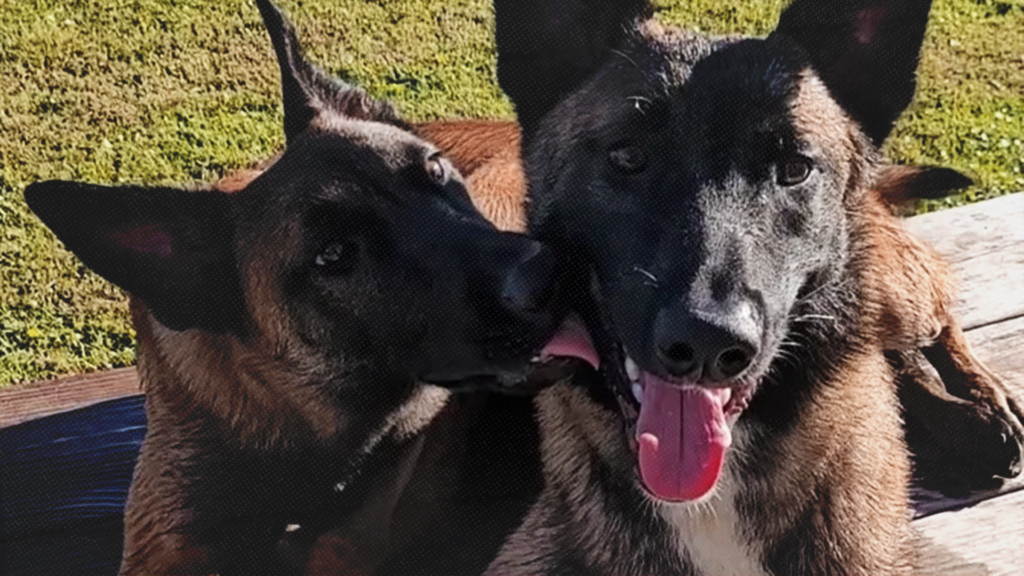
An appeals court in North Carolina on Wednesday dismissed a First Amendment challenge brought by Lydia Nikac, who argued that a judge’s ruling blocking her from publicly sharing body camera footage of a state trooper fatally shooting her two dogs violated her rights.
In October 2024, following the fatal shooting of two of her dogs by a North Carolina State Highway Patrol officer, Nikac, who works as a professional dog trainer, sought access to the body camera recording of the incident. The trial judge, however, did not permit her to disclose the footage publicly. A three-judge panel of the North Carolina Court of Appeals unanimously determined that the judge’s decision was not an abuse of discretion under the state’s laws, which keep body camera footage nonpublic by default.
Nikac contended that the restriction functioned as an unconstitutional prior restraint under the First Amendment, but the appellate court concluded that there is a legitimate government interest in at least temporarily suppressing the material, that she would have another opportunity to seek release in the future, and that nothing prevented her from publicly commenting on the footage or pursuing a civil case.
On October 5, 2024, Nikac, who runs a business specializing in agility and police-work training for dogs, spotted a man attempting to break into her car. She dialed 911 and, with the assistance of her two Belgian Malinois, Bonnie and Clyde, managed to corner the intruder.
When North Carolina State Trooper Justin Maness arrived at the scene, he found the intruder on the ground while the two dogs moved around him in a circling pattern.
Per the appeals court’s account, Bonnie and Clyde were also barking at Maness. “Trooper Maness instructed Petitioner to ‘control’ her dogs,” the opinion notes. “He then drew his weapon and fired several rounds at the dogs, killing them both.”
Dash-cam footage released by Nikac shows Maness repeatedly ordering her to control the dogs and threatening to shoot them before he steps onto her property. The actual shootings occur outside the frame of the video.
“Clyde tried to escape after Maness started shooting,” Nikac later told WITN, a local news outlet. “I don’t know where he went afterward, and then Bonnie ran over because she heard the gunshots, so she came to say hello,” she said. “She looked up, and he had a clear shot, and he shot her in the heart. When she tried to move around, he kept firing and firing.”
“I can’t imagine living my life without those two. They meant everything to me,” Nikac added. “They were also my demonstration dogs, and now I have nothing to show for.”
Neighbors described the dogs as friendly.
“They were approachable,” one neighbor told WITN. “They were the kindest dogs in the world. You couldn’t ask for better companions.”
The decision against Nikac reflects the predictable outcome of North Carolina’s stringent 2016 body camera law. Under this framework, individuals who appear in police body camera or dashcam footage may request copies from the relevant agency. If the request is denied, they must seek a judge’s permission, and the judge must determine that there is a “compelling public interest” in releasing the footage.
Advocates for transparency and media organizations warned at the time that the statute would hinder accountability and run counter to the very purpose of equipping officers with cameras.
In 2017, a North Carolina judge blocked the release of footage showing a teen’s confrontation with police against the wishes of the teen’s family and the Greensboro City Council. In 2021, deputies in Pasquotank County shot and killed a father of seven while attempting to execute a drug warrant; a judge initially refused to release the video to the public and even limited how much of the footage his family could view.
Incidents in which police kill family pets are disturbingly frequent—so much so that Reason magazine maintains a “puppycide” category in its archives. Officers are rarely trained to interpret canine behavior or to manage aggressive dogs using non-lethal methods. These shootings have spurred substantial lawsuits and widespread media attention. For example, last year a small town in Missouri agreed to pay $500,000 to settle a suit filed by a man whose 13-pound, blind, deaf Shih Tzu was shot and killed by a police officer.
This June, another Belgian Malinois trained by Nikac died after its handler, a member of the Pitt County Sheriff’s Office, left it in a hot car.
