
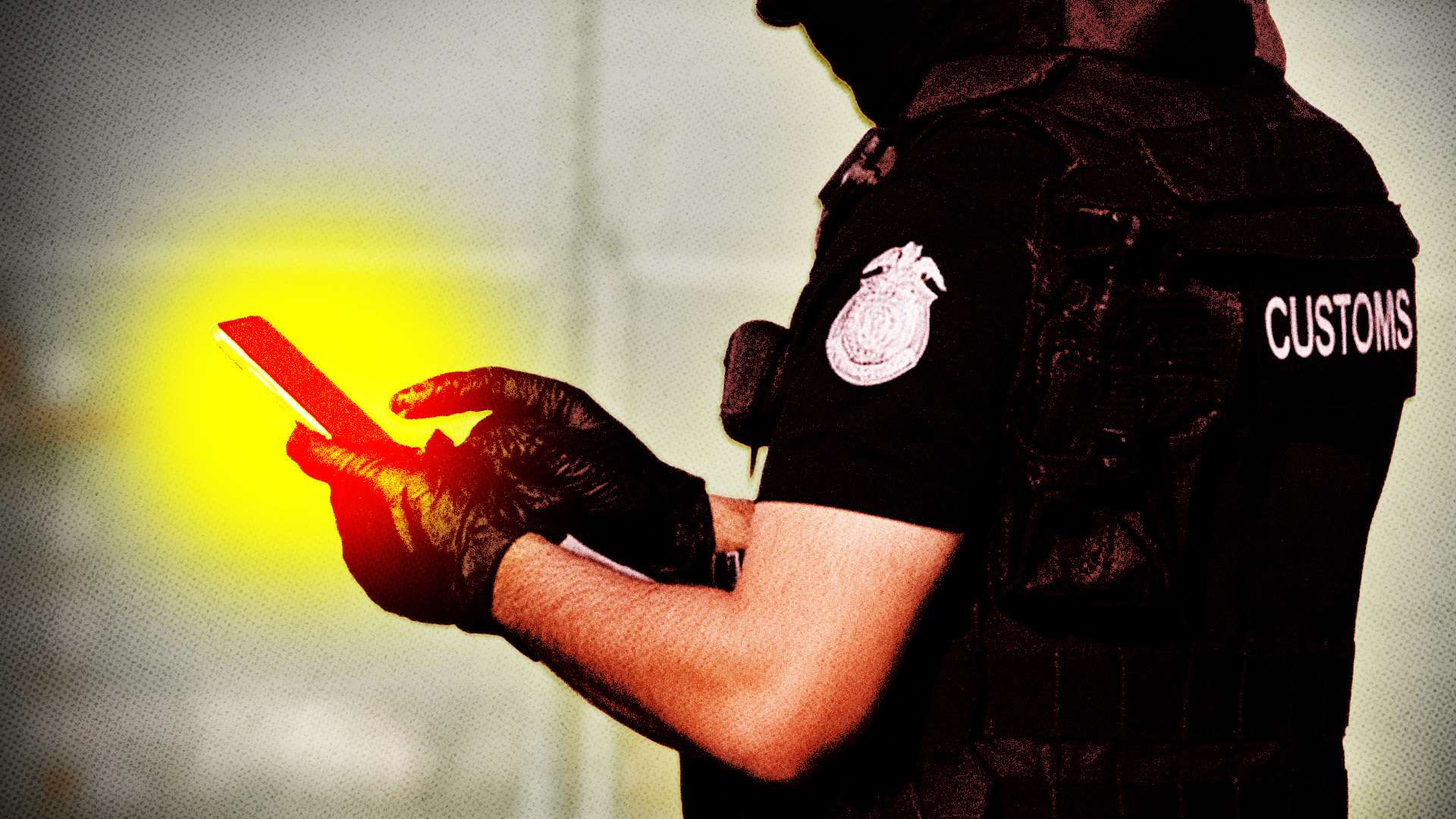
A federal appellate panel has determined that border officials may inspect a traveler’s cellphone and photograph its contents without a warrant or any hint of criminal conduct.
Travelers entering the United States through points like New York, Vermont, or Connecticut should take note: authorities can examine your mobile device even when there is no reason to believe you are engaged in wrongdoing.
That takeaway emerges from a decision issued on Thursday by the U.S. Court of Appeals for the Second Circuit. Judge Steven Menashi explained that “no suspicion is required before the government searches a traveler’s property at the border.” Drawing on the Supreme Court’s reasoning in U.S. v. Ramsey (1977), the court reiterated that the tradition of border searches conducted without probable cause or a warrant has a long history that predates the Fourth Amendment.
In cases such as U.S. v. Smith (2023) and U.S. v. Sultanov (2024)—both within the Second Circuit’s reach—lower courts had held that a warrant was necessary before examining a suspect’s cellphone at the border. The Thursday ruling rejects that warrant requirement, establishing a precedent for the circuit in similar future matters.
The dispute centered on Chinwendu Alisigwe, a permanent resident of the United States who was later found guilty in 2024 of bank fraud, conspiracy to commit bank fraud, and conspiracy to launder money.
The sequence traceable to 2018 involved the United Kingdom Border Task Force seizing a counterfeit South African passport that bore an American nonimmigrant visa for Wilhelm Heintz. The task force handed the passport to U.S. authorities, who linked it to Alisigwe, who had a pending naturalization application in the United States. This counterfeit document prompted a joint probe involving U.S. Citizenship and Immigration Services, Homeland Security Investigations (HSI), the HSI Attaché in London, and the Justice Department.
In early 2019, while returning from a trip to Nigeria, Alisigwe was stopped at John F. Kennedy International Airport by agents from HSI and Customs and Border Protection. When the officer presented the fake passport, Alisigwe claimed he did not know when or where the photograph had been taken. After directing Alisigwe to unlock his cellphone, the officer scrolled through the device and used a separate phone to photograph images found in Alisigwe’s gallery. Several years later, agents again stopped him at the same airport, performing a manual review of his cellphone by scrolling and taking pictures.
Following these discoveries, investigators gathered more evidence supporting the fraud allegations, and Alisigwe was released into the country. He was subsequently arrested and charged with numerous offenses, ultimately receiving a five-year prison sentence.
During the initial trial in the Southern District of New York, Judge Valerie E. Caproni rejected the defense’s motion to suppress the material obtained from the cellphone. Caproni accepted that cellphone searches cannot be conducted without a reasonable basis for suspecting criminal activity because they are not routine border searches, but she concluded that law enforcement had reasonable suspicion to justify both searches of the device.
The Second Circuit’s ruling goes further than Caproni’s reasoning, holding that the government’s interests at the border outweigh an individual’s right to privacy. The court asserted that the degree of intrusion determines whether a border search is “routine.” A search is deemed non-routine only when it involves highly invasive border procedures such as strip searches or cavity searches. Since a cellphone is merely a piece of property, the court found that precedents indicate the government does not need reasonable suspicion to search a traveler’s cellphone at the border.
This decision reinforces how federal courts interpret the executive branch’s authority at border checkpoints, including airports.
In U.S. v. Flores-Montano (2004), the Supreme Court held that “the Government’s interest in preventing the entry of unwanted people and effects is at its peak at the international border,” meaning that border searches conducted to protect the country’s sovereignty are reasonable simply because they occur at the border.
While Judge Eunice C. Lee concurred with the majority’s result—that a cellphone at an international airport may be searched without a warrant or probable cause—she declined to join the court’s broader attempt to read the Fourth Amendment as accepting a further erosion of privacy through suspicionless cellphone searches at the border. Lee expressed concerns about extending such allowances, particularly given the potential for political or discriminatory motives, and their impact on constitutional rights.
In her concurring view, Lee emphasized that the extraordinary reach of a cellphone into private life should factor into whether airport searches of these devices are considered “routine.” She noted that, although a cellphone search may not involve the same physical intrusion as a strip search, it is far closer in privacy impact to a body search than to a luggage check because of the vast amount of information a phone can reveal.
Ultimately, Lee concluded that the court’s ruling diminishes the Constitution’s privacy protections.
“Permitting suspicionless cellphone searches at the border undercuts the core privacy principles the Fourth Amendment was designed to safeguard,” she wrote, and she urged caution in fashioning rules that further weaken this fundamental protection.
