
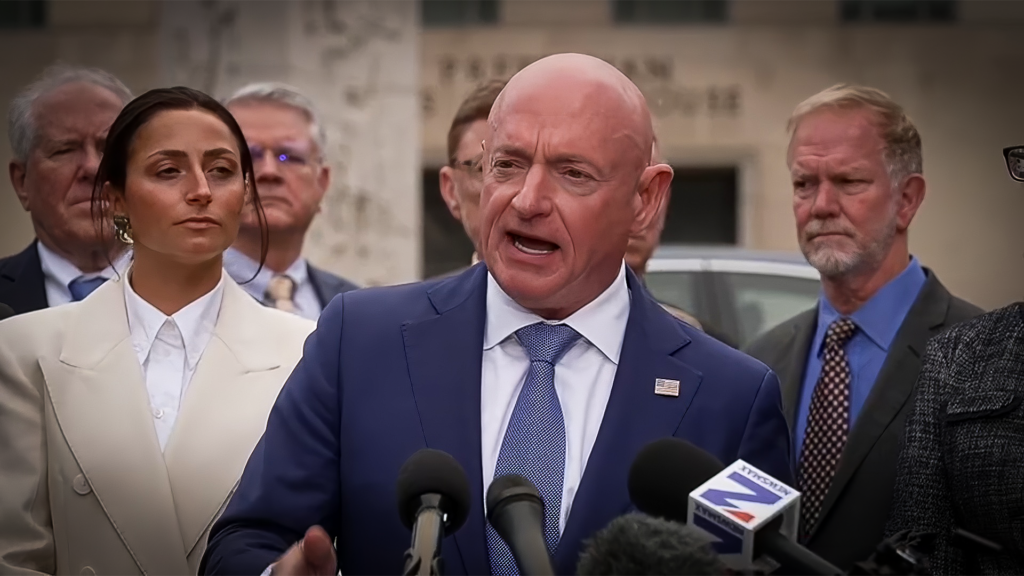
The defense secretary maintains that he possesses the authority to discipline Senator Mark Kelly (D–Ariz.), a retired U.S. Navy captain, for remarks he alone deems to be “prejudicial to good order and discipline” within the armed forces. This assertion lies at the core of Kelly’s First Amendment lawsuit against Hegseth and faced robust resistance at the U.S. Court of Appeals for the D.C. Circuit during oral arguments on Thursday.
Hegseth seeks to overturn a preliminary injunction issued on February 12 by U.S. District Judge Richard Leon, which bars any disciplinary steps against Kelly—potentially even a cut to his retirement rank and pay—based largely on a November 18 video in which the senator and five other Democratic lawmakers reminded the military of its duty to resist unlawful orders. Leon, appointed by George W. Bush, concluded that Kelly was likely to succeed on the claim that such retaliation would violate the First Amendment.
At Thursday’s D.C. Circuit hearing in Kelly v. Hegseth, Kelly’s counsel, Benjamin Mizer, contended that “the punishments inflicted on Senator Kelly amount to textbook retaliation against disfavored speech.” He noted that the January 5 letter of censure sent to Kelly “on its face targets the senator for his public statements.”
Those statements include Kelly’s admonition of military leaders for removing admirals and generals and for surrounding themselves with “yes men,” as well as his assertion that he would always defend the Constitution. Mizer emphasized that these remarks, made while Kelly served on the Senate Armed Services Committee and the Senate Intelligence Committee, arise from a constitutional obligation to oversee the military. The fact that he is a highly decorated veteran who receives a pension does not authorize the defendants to retaliate against his protected political speech.
Hegseth’s position rests primarily on the Supreme Court’s 1974 ruling in Parker v. Levy, which upheld a court-martial sentence imposed on an active-duty officer who publicly urged soldiers to disobey deployment orders during the Vietnam War. The decision underscored the “fundamental necessity for obedience” within the armed forces’ “specialized society,” justifying speech restrictions that would otherwise be constitutionally impermissible. The central question in Kelly v. Hegseth is whether that reasoning extends to retired officers like Kelly, implying they are not free to express views that the defense secretary deems harmful to military discipline.
The Justice Department’s lawyer, John Bailey, urged the panel to accept that view. Yet two of the three judges signaled reluctance to equate Kelly with Captain Howard Levy, the Army physician whose punishment Parker approved.
Judge Nina Pillard, appointed by Barack Obama, observed that Kelly, unlike Levy and contrary to Hegseth’s repeated claims in the censure letter, did not advocate disobeying lawful orders. Instead, the video criticized the obligation to “refuse illegal orders,” a principle Pillard noted is taught at Annapolis to every midshipman.
The video itself faulted the Trump administration for “driving a wedge between our uniformed military and intelligence professionals and American citizens,” but it did not specify concrete examples of illegal orders. Pillard further observed that Hegseth’s letter likewise “fails to identify particular orders or categories of orders” that Kelly allegedly urged should be disobeyed.
Judge Florence Pan, a Joe Biden appointee, highlighted the broader ramifications of the government’s position. If a retired officer wishes to speak publicly about obeying or disobeying illegal orders, Pan reasoned, they would have to relinquish their rank, their pay, and their retired status to voice those views because otherwise they would be barred from saying them. These are people who have served their country, many risking their lives; and the suggestion is that they must surrender their retired status to articulate something that is taught as a basic principle at West Point and the Naval Academy: you can disobey illegal orders.
When Hegseth states that Kelly’s remarks were “prejudicial to good order and discipline,” Pan insisted that such a label would lead soldiers to conclude that the senator was telling them to disobey lawful orders, even if he had stated the opposite. Hegseth also argues that the video, in combination with Kelly’s criticism of President Donald Trump’s domestic military deployments and his actions against suspected cocaine smugglers, amounts to urging defiance of orders tied to those operations. Pan countered that this assumes the average soldier would grasp the entire context to reach that inference, which she found implausible.
Judge Karen Henderson, a George H. W. Bush appointee, expressed greater sympathy with Bailey’s view, repeatedly noting that Kelly is “a senator with a bully pulpit,” meaning his words could be particularly influential and potentially raise concerns about military discipline. Henderson also asserted that Kelly’s public critique of Trump’s National Guard deployments “has no meaning beyond seeking to stop the deployment.” She added that retired officers remain subject to court-martial, implying that lesser penalties are necessarily available.
By contrast, Pillard observed that there are no precedents addressing the speech rights of retired service members—a point Leon highlighted when deciding to issue an injunction. She noted the government’s argument that the contested speech fell outside First Amendment protection under Parker, but emphasized that Parker involved an active-duty officer, whereas Kelly is retired, making the facts distinct: Levy urged people to refuse orders in Vietnam, while Kelly merely stated a truism—that illegal orders should be declined—an assertion that no one disputes.
The panel’s question was whether Parker governs the present scenario. Pan remarked that if it does not, the case ends there. Leon did not definitively adopt a standard equating retirees with civilians; he simply rejected the sole government claim that the issue fell outside protection under Parker. That is all that was before the court.
There is a possibility of a separate standard for military retirees that would grant them more leeway than active-duty personnel but less than civilians, Pan acknowledged. However, that line of argument was never fully developed because the government hadn’t presented it. Consequently, Leon’s ruling rested on rejecting the argument that military retirees are on par with active-duty members.
If such equivalence were accepted, Hegseth could regulate the speech of roughly two million retired officers. In a brief backing Kelly, 73 former admirals, generals, and service secretaries—holding positions under presidents from both major parties—emphasized the chilling effect that would result from such authority.
The speech of military retirees, Mizer argued to the D.C. Circuit, is being chilled by the actions of the defendants. They fear public policy discourse and fear for their pensions, leading to an extraordinary chilling effect that stifles open commentary.
According to the government’s stance, retired officers would have to surrender their pensions if they do not want the secretary of defense to regulate their speech. Mizer contended that this position is an affront both to the service veterans have rendered to the country and to the First Amendment.
