
Across the nation, crime rates have been easing—a trajectory that predates Donald Trump’s presidency.
One month after Washington, D.C., marked the United States’ 250th anniversary, the city reached a less brag-worthy milestone: a full year since the president dispatched thousands of National Guard troops to the capital.
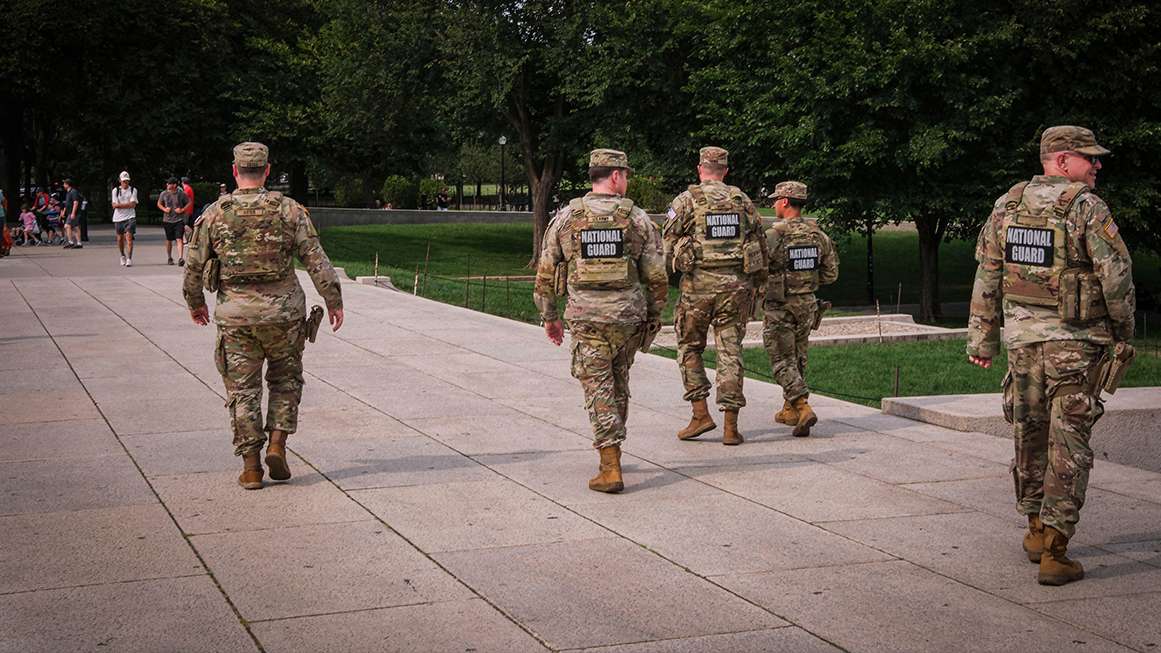
The roughly 4,600 National Guard members have become an inescapable fixture in the capital, roaming the National Mall and downtown streets in tight clusters of three or four, or idling in Metro stations while chatting. On occasion, they are assigned to pick up litter in parks. Tourists snap photos with them near the fenced-off Lafayette Square in front of the White House.
They aren’t going anywhere. The Trump administration is pressing ahead with plans to secure as many as 2,000 housing units to sustain long-term Guard deployments. The Department of Defense has estimated that extending the mission from October 2026 through the end of Trump’s term in January 2029 would cost roughly $1.4 billion.
According to officials in the Trump administration, all of this has been necessary to “transform” D.C. “from a crime-ridden city into a safe and beautiful haven for residents and visitors alike.”
Crime in D.C. is down about 20 percent from 2025, according to the Metropolitan Police Department, but a Reuters investigation from August found National Guard soldiers were involved in only a small fraction of arrests in the city’s safer areas, primarily for minor offenses such as shoplifting and jumping the turnstiles. Nationwide, crime has been declining—an trend that began before Trump took office and includes cities that do not host federal law enforcement and troops.
Even if the Guard’s presence has helped contribute to a drop in crime, it represents a civil-liberties nightmare. It places untrained military personnel in the role of policing civilians. It usurps local police departments that are ostensibly answerable to the communities they serve, and it normalizes the deployment of military forces within the country—a red line for a free society.
“There’s a deep irony that here we are in the capital of the free world, and our president is treating it like a police state,” Scott Michelman, legal director of the ACLU of the District of Columbia, told PBS in August. “D.C. residents have lived with our National Guard troops in our neighborhoods for about a year, despite the absence of any genuine emergency and really any reason for them to be here.”
Last November, a federal court preliminarily ruled that the deployment was illegal. Yet an appeals court allowed the Trump administration to keep troops in D.C. while it considers the administration’s appeal of that ruling.
The appeals court decision is questionable. The panel seems aware that every day the case lingers is another day that D.C. residents endure a potentially illegal military occupation, and another day that taxpayers foot the bill for a costly display of presidential hubris.
The damages are mounting. The first anniversary of Trump’s National Guard deployment to D.C. should mark the end of this episode.
