
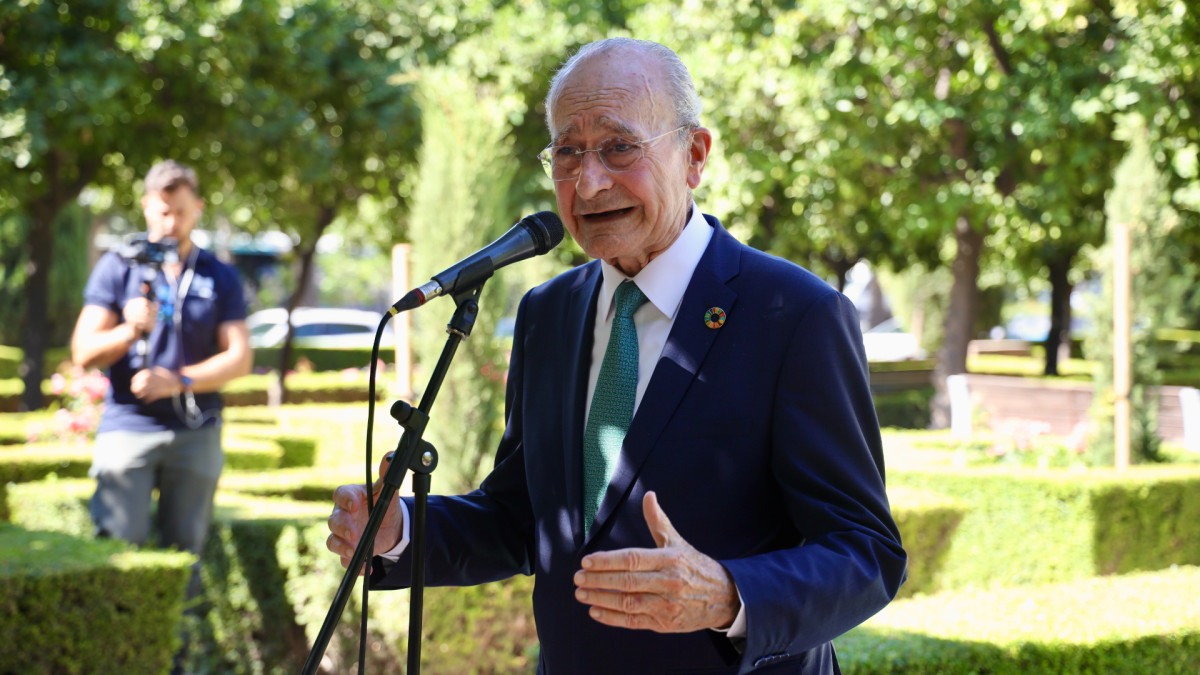
Francisco de la Torre is the only mayor Málaga has known this century and the second longest-serving among all Spanish provincial capitals. Only the Pontevedra mayor, Miguel Anxo Fernández Lores (BNG), surpasses him by a year.
Just a few days ago, De la Torre cleared up the uncertainty: in 2027 he will face his seventh reelection. He entered the Casona del Parque as a councilor in 1995, and no one has managed to defeat him. In 2011 he reached his peak with 53% of the votes. In the 2023 municipal elections he obtained 49%, meaning that almost one out of every two voters supported his candidacy.
The city is a model of cultural and tourist success and also a case study in saturation. The price of housing has risen by 110% in ten years. The mayor defends himself: “The city can build 30,000 homes, but it does not have installed energy capacity”.
De la Torre, like all great mayors, is not a mere follower of his party. He has his own views on everything and distributes his support evenly to all sides. On housing, he is closer to the central government’s positions than to those of the Junta de Andalucía on a key issue such as the freeze period for VPO. He also disagrees with the Junta on the tourist tax issue, but he reminds the central government that the low frequency of Cercanías affects housing prices or that the rigidity of the local finance law does not allow him to use tourist tax money to help with rental matters.
“The city is a model of cultural and tourist success and also an example of saturation. Housing prices have risen 110% in ten years”
Behind Antonio Banderas’ Soho Theatre, the Pompidou, Picasso and Thyssen museums, the 2030 World Cup stadium, and the undeniable fact that Málaga has long ceased being the gateway airport to the Costa del Sol to become a place to live or work, the city experiences steady growth that has pushed it past 600,000 inhabitants and has placed pressure on Andalusia’s economic capital to the point of opening a citizen and electoral debate about whether Málaga has reached a ceiling or remains a model of success.
Nobody doubts that De la Torre, who has been involved in politics since 1971, when he was president of the Diputación, and who has passed through the pre-autonomic government as a councilor and through centrist parties such as UCD, the PRD of Miquel Roca and Florentino Pérez, or the CDS of Adolfo Suárez, will win again in 2027, but the question is with what result.
“The highly probable entry of Adelante Andalucía into the Plenum of the Casona del Parque could give De la Torre a scare”
The PP—or, more precisely, De la Torre—and Vox s accumulate nineteen councilors—their numbers are seventeen and two, respectively, compared to the twelve on the left: ten from PSOE and two from Con Málaga. The most probable entry of Adelante Andalucía into the Plenary of the Casona del Parque could intimidate De la Torre, since his access to the City Hall is already assumed after achieving 11.2% of the votes in the recent regional elections. The question is whether those councilors will come at the expense of PSOE or Con Málaga.
The PSOE, after two elections with Dani Pérez, will change its candidate. The renewal has not been easy. Dani Pérez leaves for the Andalusian Parliament, but in his farewell he said: “Paco, this City Hall has been better for having you”. The remark did not go down well with the new Socialist spokesperson, Mariano Ruiz Araujo, who was the third on the municipal Socialist list.
Vox, like Adelante Andalucía, has not yet announced its candidate. The Vox members managed in 2023 to enter the Málaga city council for the first time with 7.7% of the votes and two councilors, who, in the end, could be decisive in ensuring that De la Torre remains mayor for the eighth consecutive time.
