
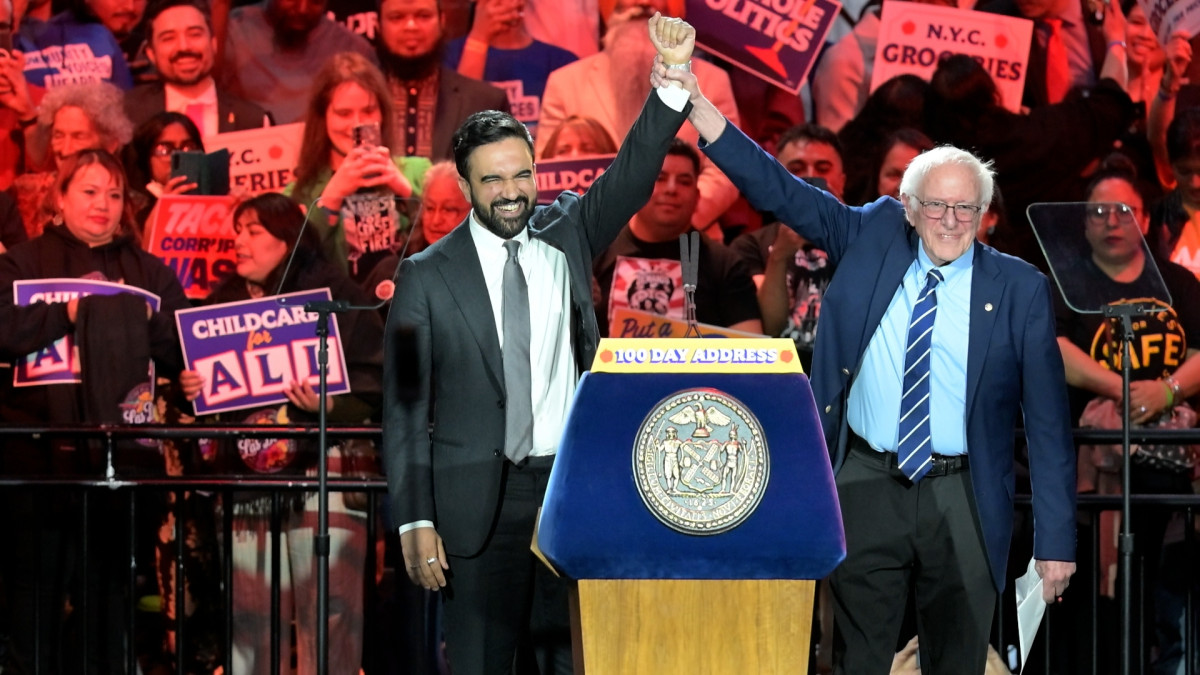
La historia de la izquierda y de los movimientos progresistas es también la historia de sus fracturas. Desde la Comuna de París en 1871, cuando los revolucionarios se devoraron entre sí antes de que los cañones de Versalles terminaran el trabajo, hasta las disputas internas que pulverizaron al Frente Popular español en plena Guerra Civil, el progresismo ha demostrado una capacidad inusual para el canibalismo. Los enemigos externos siempre han dado la cara, pero las heridas más profundas se han abierto desde dentro: luchas por la pureza ideológica, disputas de liderazgo, traiciones disfrazadas de principios. Hablamos, en términos claros, de una pulsión autodestructiva que reaparece hoy en el Partido Demócrata de Estados Unidos. Y lo hace justo cuando más necesita cohesión.
We are three months away from the midterm elections, and the blue party arrives with an open wound: the dissent between moderates and progressives has become a battleground that threatens the party’s strength ahead of the November vote, a pivotal moment for both its future and the country. Recent primaries painted a fragmented map: progressive victories in New Jersey, moderate resistance in Iowa, and a open showdown in California. It would seem that each state tells a different narrative about what it means to be a Democrat, and that diversity, far from strengthening the party, erodes it, condemning it.
“Una pulsión autodestructiva que reaparece hoy en el Partido Demócrata de Estados Unidos. Y lo hace justo cuando más necesita cohesión”
The official line tries to project unity in the face of the Republican advance, but the facts put that narrative under scrutiny. Senators in some key states back alternative candidacies, while figures linked to the Democratic Socialists of America (DSA, for its acronym in English) — the organization to which Zohran Mamdani, mayor of New York City, belongs — push incumbents aside. Chuck Schumer’s leadership — the New York senator and a recognized Democratic figure — is being questioned, as if caught between more conciliatory positions and those who demand to follow, to the letter, a more radical agenda. In short, the Democratic Party talks about unity but acts as if internal distrust were the common language.
What is the result of these internal cracks? A party looking at itself in the mirror and, in the reflection, discovering deep fissures: a murky electoral strategy, a fragmented agenda and a narrative that is increasingly weakened. Then the unavoidable question arises: can the Democratic Party rebuild its identity before the polls confirm what is evident today, namely that internal fracture is its greatest enemy? In politics, perception is often more lethal than reality and, unfortunately, today, for that party, the dominant perception is that of a fractured party.
But the Democratic fracture goes beyond the electoral arena. The wound is deeper. It is risky to say that that party is “to the left,” but for contextual and comparative purposes with other regions on the geopolitical map, if we allowed ourselves that liberty, we would see that it seems destined to argue between pragmatism and purity, between the urgency to win elections and the need to sustain a common discourse. And it is precisely that tension — which appears to become an internal wound and which, at other historical moments, did not take long to become hemorrhagic and ended in catastrophic defeats — that looms today and threatens to repeat itself. The Democratic future, in short, is up for dispute, and what is at stake is not only control of Congress but the possibility of remaining a recognizable force capable of governing in unity.
“In politics, perception is often more lethal than reality, and, unfortunately, today for that party, the dominant perception is that it is a fractured party”
So, what is the scenario heading into the midterm elections? Basically, those elections will function as a laboratory of identities: moderates against the impetuous demanding urgent transformations. And the risk? The risk is that, while they marshal resources for that battle, the Republican opponent can advance more calmly. History, as we have already noted, has shown this many times. Politics has taught us many times: the enemies of progress are often within one’s own ranks.
A Gridlocked Electoral Landscape Ahead of the Midterm Elections
The midterm elections will be held on November 3. And at this point, there are no clear predictions about how the congressional map will realign. Why? There are two main reasons: first, the horizon, according to various outlets, tilts toward the party of choice; second, given the last presidential elections with Donald Trump in the mix, anything can change at a moment’s notice.
Polls published by outlets friendly to the Democrats sketch an optimistic horizon, as one would expect. Emerson College — a private university in Boston, culturally and politically closer to the Democratic Party — places the blue party at 53% of the generic-ballot vote, versus 42% for the Republican. In this case, the Democrat edge is largely attributed to women voters, according to the study. Meanwhile, The Hill and Decision Desk HQ — a media outlet and an electoral-analysis firm, respectively — calibrate the figure: between four and six points of advantage for the Democrats, with good prospects of regaining the House — 224 blue seats to 211 red — though the Senate would remain tilted toward the GOP — Grand Old Party, as the Republican Party is popularly known. Finally, Morning Consult — a polling and public-opinion company — shows 45% versus 42%.
On the other hand, other analyses nuance the advantages shown. The Pew Research Center, a nonpartisan think tank, while conceding a six-point difference, insists that there is a 20% share of voters who remain undecided: that, in a country like the United States, is a huge and open space for last-minute shifts. In addition, the Brookings Institution — one of the most influential think tanks on public policy — maintains that Trump’s approval hovers around 40% and that, although Democrats appear, for the first time since 2010, as the more reliable economic option, the Senate remains a difficult terrain to reverse the trend. Finally, the USA Today Network cautions that while many general-vote maps show certain advantages for Democratic votes, the level of indecision or apathy remains high and that, as Pew Research also notes, makes clear predictions impossible ahead of the midterms.
“Polls function like a kaleidoscope: the images returned depend on the angle from which they are viewed”
Thus, polls function like a kaleidoscope: the images returned depend on the angle from which they are viewed. And, amid these contradictory narratives, where, regardless of the numbers and percentages, the most important thing is that there remains a high degree of uncertainty, undecided voters, and some apathy in various locales, no prediction fully satisfies either side. The only certainty, for the moment, is that the internal fractures of the Democratic Party are the lame leg of a project that, in theory, has everything it needs to reach elections with a relatively—yet solid—advantage just around the corner.
Is Trump Really That Unpopular?
In 2026, the president’s popularity has plummeted. Since the start of the year, two storms have put his figure into question: the Epstein files and the war in Iran.
The major scandal that erupted after the publication of files previously classified related to the international network of sexual exploitation and political favors tied to Jeffrey Epstein was the first. It reopened old suspicions about the opacity of his connections and his ties to the upper echelons of global power. But, shortly after that controversy flooded headlines worldwide, came the second storm: the war in Iran. In Public Agenda we have addressed and analyzed that topic in depth, and we have highlighted that it has been, above all, a military intervention that has cost the United States, to date, between 37.5 and 38.4 billion dollars — according to estimates from the Pentagon itself and analysis centers such as MilitarySpend.org —, as well as its indirect effects on inflation, unemployment, and general discontent in cities like Los Angeles or New York. Polls such as The Economist/YouGov or CNN place his approval at historic lows: between 34% and 35%; that is, around 60% of Americans do not approve of his handling this year.
“Poll numbers did not reflect at all in the final result”
Based on the above, we would have the portrait of a president who, instead of consolidating his power, loses it at the hands of his own mistakes. But that is not where this phenomenon ends. If we recall Trump’s popularity in the final stretch of the 2024 presidential elections, we will see that poll numbers did not reflect at all in the final result. In the months leading up to the election, Kamala Harris and Trump contested a tight race and, for not a few weeks, the Democratic candidate held a significant lead. Yet none of that appeared in the final tally, where much of the electoral map was painted red by swing states, with the exception of key states for the blue party, such as California and New York.
Where does this lead us? To recall that after those elections, a fact emerged that seriously questioned the weight of private money in American democracy: Elon Musk was the largest individual donor of the 2024 electoral cycle and spent at least $288 million to help elect Donald Trump and other Republican candidates. That injection of capital and media support immediately sparked controversy over the influence of a single donor in the campaign, especially in the states that were initially undecided.
Finally, given the Democratic Party’s internal fractures and the uncertainty surrounding Donald Trump’s campaigns, if Democrats do not manage to rebuild their political project from unity, in November’s elections one could expect any possible outcome.
