
The Democratic Socialists of America are poised to extend their footprint in government after the 2026 vote.
Since the political upheaval sparked by Bernie Sanders and Donald Trump in 2015, the seasoned centrists within the two dominant parties have sensitized themselves to the approaching clatter of populist challengers.
For the Republicans, the rush remains a constant peril, ready to be redirected by the president’s direction. Even in his declining late-term stretch, Trump in 2026 managed to purge two sitting U.S. senators in primary battles, further accelerating his decade-long overhaul of the GOP.
For the Democrats, the surge has been more intermittent and erratic, as illustrated by the stunning 2018 New York primary where House Democratic Caucus Chair Joe Crowley was toppled by the unknown at the time Alexandria Ocasio-Cortez. AOC is one of only a couple of current members of Congress affiliated with the Democratic Socialists of America (DSA), a fringe group that drew little attention back then. No longer.
When DSA darling Zohran Mamdani won the mayoral race in New York City in November 2025, it was easy to dismiss the hyperbolic reactions—from Cynthia Nixon calling him a “miracle of nature” to Jon Stewart likening the son of a film producer and academic to Jackie Robinson—as merely a localized phenomenon in a deeply blue city with plenty of media coverage. Yet Mamdani’s spring push went national, as he backed in House primaries three challengers (two DSA and one former DSA member), including a rookie, incendiary candidate who unseated the chair of the Congressional Hispanic Caucus.
AOC’s DSA caucus in the House could potentially triple in size, with the NYC victors possibly joined by contenders from Philadelphia, Denver, and Detroit. But the real test of the socialists’ resolve will unfold in the Senate.
Insurgent factions within major parties reveal themselves by showing when they are willing to lose. The Tea Party, in its productive window from 2009 to 2013, backed some extreme primary contenders who later squandered opportunities in general elections, such as the anti–Sharia law crusader Sharron Angle, who faltered in her bid to topple a vulnerable Sen. Harry Reid (D–Nev.). Trump, too, has enforced loyalty by jeopardizing incumbents, as he did earlier this year by replacing longtime Sen. John Cornyn (R–Texas) with the deeply compromised Texas Attorney General Ken Paxton.
Nothing matters more this year for Democrats—and, arguably, for the national electorate—than seizing control of the tightly divided Senate, which at press time was widely viewed as a 50–50 contest. The final two years of Trump’s presidency could look markedly different if the opposition party holds the whip hand over the Senate’s oversight and investigative powers. Yet such is the disdain of younger Democratic voters toward the party establishment that the DSA and its allies fought vigorously to nominate three highly flawed candidates to contested statewide Senate races.

The first candidate, Maine’s blunt Graham Platner, generated an unusual wave of enthusiasm for railing against billionaires and issuing harsh critiques of Israel, before withdrawing amid sexual misconduct allegations and lingering controversy over a Nazi tattoo. A second contender, Florida’s Angie Nixon, scored an upset against Trump-era stalwart Alex Vindman by championing Medicare for All and Gaza peace, then promptly began distancing herself from the DSA (which had only recently joined and never endorsed her). Regardless of the outcome in the Democratic primary, incumbent Republican Sen. Ashley Moody remains the favorite.
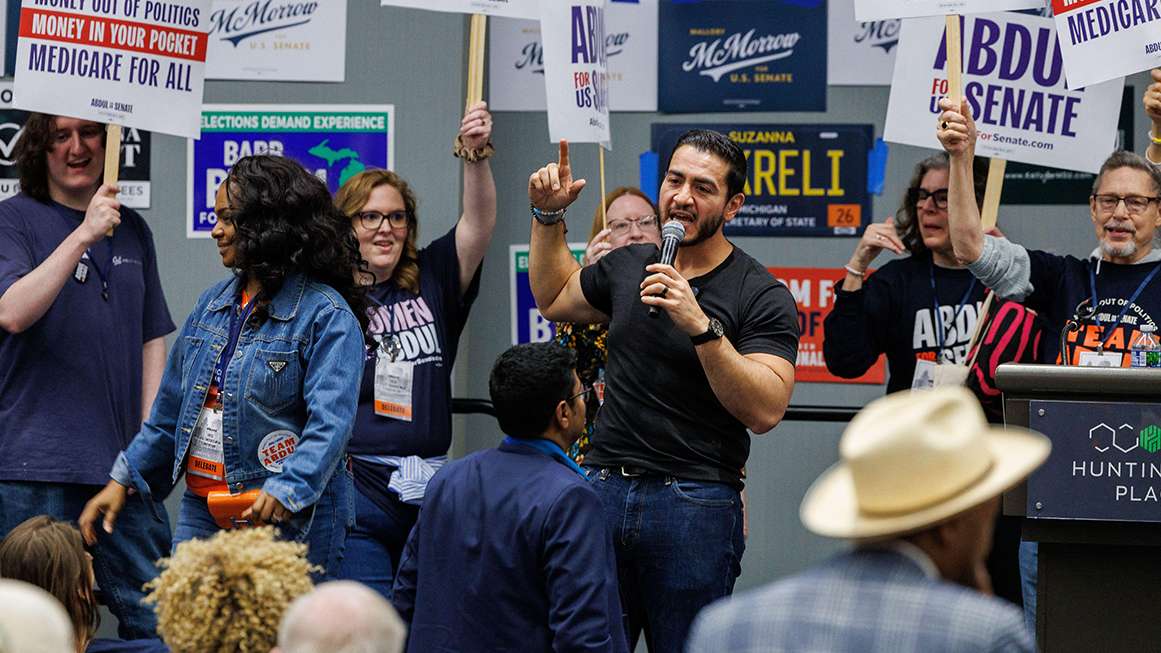
The true center of DSA energy—and risk—rests with the third candidate, Michigan’s Abdul El-Sayed, who won a razor-thin primary and faces an equally tight general election that could determine the Senate’s delicate balance. El-Sayed, who blends Mamdani’s media appeal with Platner’s raw fury, isn’t technically a DSA member (naming tensions within far-left coalitions are infamous), yet he has become the public face of the socialist left in the lead-up to November.
What does El-Sayed advocate? Medicare for All, a framework that buries data centers beneath a mountain of obligations and regulations, and above all, a severing of America’s alignment with Israel, a country he struggles to affirm as a legitimate state. “Every definition of a Jewish state ends up in some articulation of illiberal values,” he told CNN this summer. “Every single one.”
That emphasis has given El-Sayed’s opponent, Mike Rogers, a veteran on national security and surveillance who has become an ally of Trump, an opening. Democratic control of the Senate could hinge on the perceived antisemitism that accompanies the left’s stance of condemning Israel as a genocidal, apartheid state.
Can a small handful of congressional DSA hopefuls, including several likely to fall short, justify the continuous anxiety about a “sexy socialist summer”? Perhaps, indeed.
Consider those anxious moderates. How will they adjust to keep the populist threat at bay? House Minority Leader Hakeem Jeffries (D–N.Y.) faces broad calls from the DSA to step aside after declaring on Meet the Press that he does not support Medicare for All (a plan that would be prohibitively expensive and would criminalize private insurance, among other drawbacks). Pennsylvania Democratic Governor Josh Shapiro, a leading party centrist, signed an August executive order limiting data centers—only 14 months after welcoming them with open arms. I recently asked Senator Chris Murphy (D–Conn.) whether the government running grocery stores (as Mamdani’s New York would soon have) is a sound idea, and he paused, unsure how to respond, like a student who hadn’t done the assigned reading.
Though numerically modest, the DSA challenge is nudging the larger party leftward on taxing billionaires (including California’s controversial wealth tax ballot measure this November), opposing data centers, expanding the already unaffordable entitlement state, and taking a critical stance toward Israel. This remains true even if El-Sayed loses: in primaries, candidates can be eliminated while the intensity of grassroots support matters more than the outcome for the broader party’s direction, even if it risks becoming political poison for some.
Hillary Clinton deflected Sanders’s challenge in 2016, yet later accommodated many of his policy aims within the party platform, particularly on the economic issues dear to the old socialist. Joe Biden fend off a fervently progressive 2020 field, presenting himself as a moderate in the general election, but then delegated substantial portions of his economic program to Senator Elizabeth Warren while pursuing government-wide initiatives centered on diversity, equity, and inclusion. When young, ambitious professionals lean strongly in a specific direction, even senior figures can be swayed, either to blunt intraparty competition or as a matter of staffing arithmetic.
There remains a possibility that extended exposure to the DSA’s Castro-leaning, Hamas-appeasing, sometimes economically naïve younger ranks will erode their electoral standing after a decade of growth (and especially the last ten months). But as long as openly socialist candidates keep winning, the anti-socialists in both parties will have to stay vigilant and active.
