
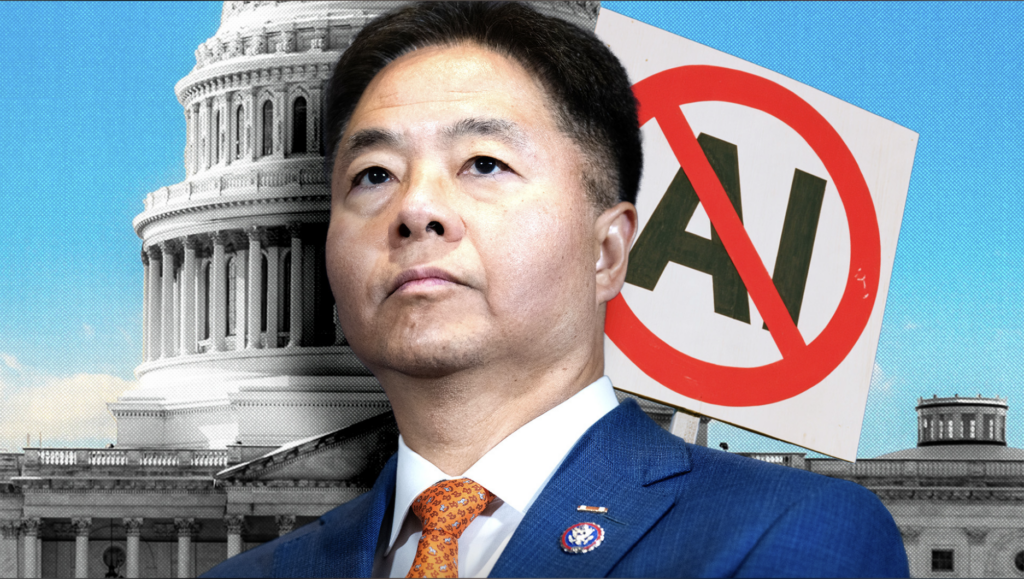
Yes, that’s as ominous as it sounds.
While I am glad to witness certain Republicans losing control of Congress, I am already apprehensive about what a Democrat-led chamber could mean for technology policy. Ignoring these worries would be easy, which is why this Reclaim the Net preview of Democratic AI proposals stands out as a clear warning flare.
Public sentiment toward artificial intelligence ran hot in the midterm vote, and Democrats appear ready to move quickly once they hold the majority, with the aim of expanding government influence over the AI sector and the results it yields.
You are reading Sex & Tech, from Elizabeth Nolan Brown. Get more of Elizabeth’s coverage on sex, technology, bodily autonomy, law, and online culture.
“Top of the Democratic agenda on day 1 needs to be a pause on advanced AI development, regulation of this out of control industry, and a ban on artificial superintelligence,” posted U.S. Rep. Yassamin Ansari (D–Ariz.) the day after the election.
A Democrat-led Congress will convene AI companies for hearings and push for “reasonable guardrails on AI,” Rep. Ted Lieu (D–Calif.), vice chair of the House Democratic Caucus, stated at a post-election briefing.
Guardrails may sound mild. Moderate. Who could be against guardrails?
Yet “the ‘guardrails’ Lieu and other Democrats envision are those that would empower authorities to determine who may develop and deploy software, and under what terms,” notes Reclaim the Net’s Dan Frieth.
@RepYassAnsari A ban in US while China moves ahead?
— Christina Hoff Sommers (@CHSommers) November 5, 2026
“Guardrails” would allow foreign actors to keep building increasingly capable AI while U.S. firms trail behind. Or permit federal regulators to determine winners and losers in the U.S. AI market, creating openings for political meddling and granting Washington sweeping sway over every facet of AI development and deployment.
(If the federal government can decide whether your company can grow, or even continue to exist, you’re unlikely to resist many of its demands—even if those demands include robotic weaponry and mass-surveillance systems.)
“Guardrails” would also mean compelling companies to monitor and report more conversations to authorities. They would require curbing the spread of “misinformation”—as defined by those in power, naturally. (What could go wrong?) They would also mandate identity checks to exclude minors.
Guardrails equate to reduced privacy for all AI users and to narrower space for free expression.
Guardrails might further translate into empowering people—attorneys general among them—to sue AI firms, inviting a wave of culture-war–driven lawsuits, if social-media dynamics offer any hint. It would sustain politicians and personal-injury lawyers in blaming Big Tech for broader social ills and call for crackdowns on “harmful” content that touches on sexuality, mental health information, and more.
Some new Democrats also ran on AI restrictions. For instance, Manny Rutinel, the incoming Democratic representative from Colorado, backed “age checks and parental controls for AI chatbots aimed at minors,” which, in practice, would mean universal identity checks.
Rep.-elect Scott Wiener (D–Calif.) backed “a comprehensive federal framework addressing disclosure requirements for AI-generated political content, real civil and criminal penalties for weaponized deepfakes, and platform accountability for amplifying synthetic disinformation.”
“There are genuine harms AI can cause, and we should watch how the government uses this technology—and yet the torrent of bills and statements from Democrats who will soon control Congress isn’t about that,” Frieth notes. Instead, it centers on expanding government power over who can use AI, who can create AI, and what AI is allowed to say.
More Sex & Tech
Inbox: @SenJudiciaryGOP will hold a hearing entitled, “Roblox and Online Gaming: Digital Playgrounds Endangering America’s Children” a week from today
— Ben Brody (@BenBrodyDC) November 10, 2026
• Technology affords helicopter parents a whole new set of ways to be overbearing, and both parents and kids are paying the price.
• Texas’ incoming attorney general, Democrat Nathan Johnson, said on Tuesday that he will not continue Ken Paxton’s practice of suing doctors in other states for providing abortion medication to patients in Texas, The Texas Tribune reports. “I will not pursue the notion that Texas law has extraterritorial reach,” Johnson stated.
• “A final appeal court in the UK ended a centuries-long ban on gay sex in Trinidad and Tobago on Tuesday,” concluding a nearly decade-long campaign for LGBTQ rights in the twin-island nation, notes The Independent.
• The Substack crew examines how the platform influenced this election cycle. “In Tuesday’s consequential midterm, all seven Democratic incumbents who flipped Republican-held Senate seats—James Talarico in Texas, former Sen. Sherrod Brown in Ohio, former Gov. Roy Cooper in North Carolina, Josh Turek in Iowa, Troy Jackson in Maine, Dr. Annie Andrews in South Carolina, and Rev. Adam Hamilton in Kansas—maintained Substack pages throughout the race,” the piece notes.
• UK porn creators are seeing their content suddenly vanish as sites rush to purge anything that could violate the country’s new porn law.
• In The Social Network, Aaron Sorkin’s casual treatment of facts stands in sharp contrast to the standards he demands of others, observes Ryan Self. “From his opinion pieces on fact-checking to his self-righteous speeches in films, Sorkin has positioned himself as a crusader against misinformation. The irony is, he seems oblivious to having fallen into the very trap he attacks.”
