
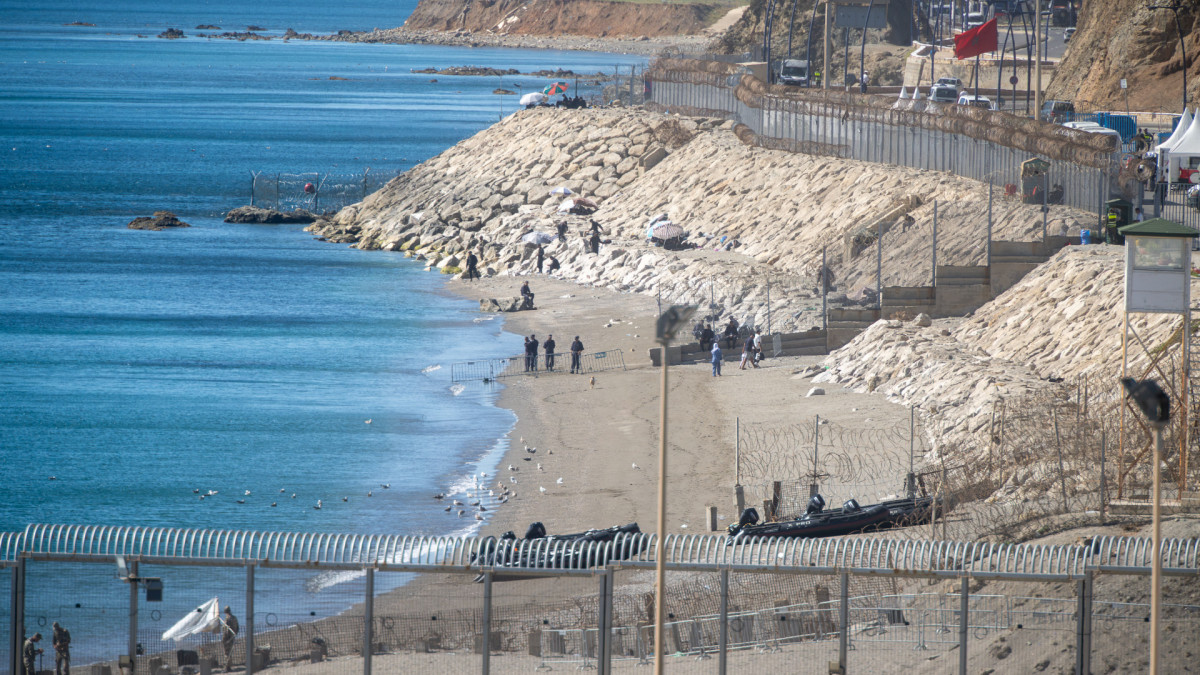
There is not a single measure that Spaniards overwhelmingly endorse to respond to a massive and irregular entry of people through Ceuta or Melilla. Instead, there are two options that are virtually tied and point in different directions: 23.9% would request a direct intervention by the European Union, for example through the deployment of Frontex, while 23.6% would opt for immediate returns at the border.
“While deploying Frontex transfers part of the crisis management to the European level, immediate returns are an immediate action confined to the national sphere”
These are the two most chosen responses in the Cluster17 survey for Agenda Pública, conducted between August 22 and 25, when the Ceuta crisis was still occupying much of the political conversation. Together they account for nearly half of the responses, but it is difficult to interpret these two options as part of the same plan. While deploying Frontex moves part of the crisis management to the European level, immediate returns are an action immediate and confined to the national domain.
Behind these two options comes the deployment of the Armed Forces to control the border perimeter, chosen by 14.6%. Another 12.4% prefer to impose economic sanctions on Morocco and 11.7% advocate guaranteeing humanitarian reception and processing asylum applications individually in temporary stay centers.
On the lower end, it stands out that only 5.5% of Spaniards would choose as their main response to negotiate bilaterally with Morocco offering economic concessions to reinforce border control. The possibility of quickly distributing migrants between the peninsula and other European countries reaches 3.6%, while 3.1% would temporarily suspend diplomatic relations with Rabat.
In light of the data, there is a stronger preference for europeanizing the response or applying pressure than for strengthening bilateral negotiations through incentives. In this vein, sanctions against Morocco receive more than double the support of negotiations with concessions.
Since the fieldwork ended, the Government has moved precisely in the option most supported by those polled. On August 28, the Ministry of the Interior formally requested from the European Commission the reinforcement of Frontex, Europol, and the European Union Agency for Asylum for triage work and the subsequent processing of cases of those remaining in Ceuta. In Frontex’s case, Spain has requested ten additional agents and the extension of the Minerva operation, which was already active in the area.
Vox looks at the border while PSOE and Sumar focus on Europe and reception
The voting memory quickly breaks the tie that appears in the overall population. When preferences are cross-referenced with the party supported in 2023, each electorate sets very different priorities in response to the crisis.
Among those who voted for Vox in 2023, 40.4% would carry out immediate returns and another 35.1% would deploy the Armed Forces. Three out of four thus concentrate on these two responses. European intervention is far behind, at 13.7%.
Voters of the PP also place returns first, with 36.4%, though their second option is to seek intervention by the European Union, chosen by 24.4%. Military deployment reaches 17.5% and economic sanctions on Morocco 15.5%.
By contrast, the Socialist electorate organizes its preferences differently. European intervention clearly tops the list, at 28.7%, and humanitarian reception and the individual processing of asylum requests reach 23.4%. Immediate returns fall to 11.5%.
Finally, among Sumar voters, humanitarian reception becomes the main response directly, at 29.7%, followed by European intervention at 23.6%. Only 5.2% would choose immediate returns and 3.1% would deploy the Armed Forces.
“On the right they prioritize immediate border control and on the left they give more weight to European intervention or humanitarian management”
The fracture, therefore, goes beyond a difference in the intensity of the response. On the right they prioritize immediate border control and on the left they give more weight to European intervention or humanitarian management. The intervention of the European Union is the only major option that retains substantial support across electorates in both blocs.
With higher income, more support for a European response
On the other hand, when studying responses by income level, preferences sort themselves with a certain clarity. Among those earning less than 1,000 euros per month, 17.2% would request direct EU intervention, but among those earning more than 5,000 euros this rises to 32.1%.
Between the two extremes, the percentage increases almost step by step: 19.9% among those earning 1,000 to 1,500 euros, 21.5% between 1,500 and 2,000, 23.9% between 2,000 and 3,000, and 27.5% between 3,000 and 5,000. In other words, the preference to europeanize border management rises by fifteen points from the lowest to the highest income brackets.
At the lowest levels there is also a greater tilt toward some national responses. Among those earning less than 1,000 euros, the deployment of the Armed Forces is the first option, at 25.8%, ahead of immediate returns (21.1%) and European intervention. Among those earning more than 5,000 euros, the opposite occurs: the EU occupies first place with 32.1%, followed by returns at 26.8%.
“Spaniards do not share a uniform approach to responding to the border crisis: some want greater national capacity for control, others prefer shifting part of the response to Brussels, and a portion of the electorate prioritizes reception”
The results finally leave a narrower ground for agreement than the initial tie might suggest. Spaniards do not share a uniform approach to responding to the border crisis: some want more national control capacity, others prefer shifting part of the response to Brussels, and a portion of the electorate prioritizes reception. They do, however, largely agree on rejecting one option: returning to negotiations with Morocco.
The strategy of relations with Morocco, based on cooperation with Rabat, appears weakened in the eyes of the population. Only 5.5% would choose to offer concessions so that Morocco strengthens its controls. The Spanish discussion centers on whether the response should be more European, more coercive, or more humanitarian; almost never about giving more incentives to Rabat.
