
Less than an hour after the dissolution of the Cortes, Isabel Díaz Ayuso urged not to vote by mail. The party’s spokesperson distanced themselves, but the message had already spread. That same day, Santiago Abascal joined the suspicion of postal ballot manipulation with a straightforward slogan: vote in the ballot box. And on October 12 the Supreme Court confirmed the provisional suspension of the vote of 163,020 Spaniards registered in the exterior census who obtained nationality through the so-called law of grandchildren, unless they documentaryly prove the exile of their ancestors.
We must separate the layers. The mail-in vote has no basis: there is no evidence of manipulation in a procedure that Spain has used for decades. The issue of the law of grandchildren, however, is a real legal controversy. The Supreme Court is debating whether a 2022 ministerial instruction, which presumed exiles among those who left Spain between 1936 and 1955, went beyond the law. There is a separate vote, there was a challenge by the State Attorney’s Office, and there will be doctrinal debate for years. But in public discourse both matters have ended up fused into a single idea: that the result of the November 29 could be unclear.
That is the communications operation. It isn’t about winning an argument, but rather to sow doubt before any result exists. Doubt functions like insurance: if the November 29 vote goes well, no one will remember the suspicion; if it goes badly, the narrative is already written. For the sower, the cost is nearly zero. For the system, the cost is cumulative.
“Doubt functions like insurance: if the November 29 vote goes well, no one will remember the suspicion; if it goes badly, the narrative is already written”
The figures matter little in this game. The State Attorney’s Office calculated that, with the historical participation of the external vote hovering around 8%, the individuals who would be affected by voting are about 14,120, insufficient to alter the result by pure arithmetic. The figure is accurate and does not dispel anything. The suspicion does not live on numbers; it lives on repetition.
Neither does the bunker-like framing help. Presenting the Supreme Court’s decision as a boundary between the grandchildren of exile and the grandchildren of Franco, as the prime minister did, turns a technical census discussion into another identity chapter. When all players treat the electoral architecture as ammunition, the referee ends up in no-man’s land.
In Latin America we know this script well, and Brazil has just re-enacted it. Jair Bolsonaro spent years questioning electronic ballots without providing evidence. He lost in 2022, never explicitly acknowledged the defeat, and, a week after Lula’s inauguration, thousands of followers stormed the offices of the three branches in Brasília.
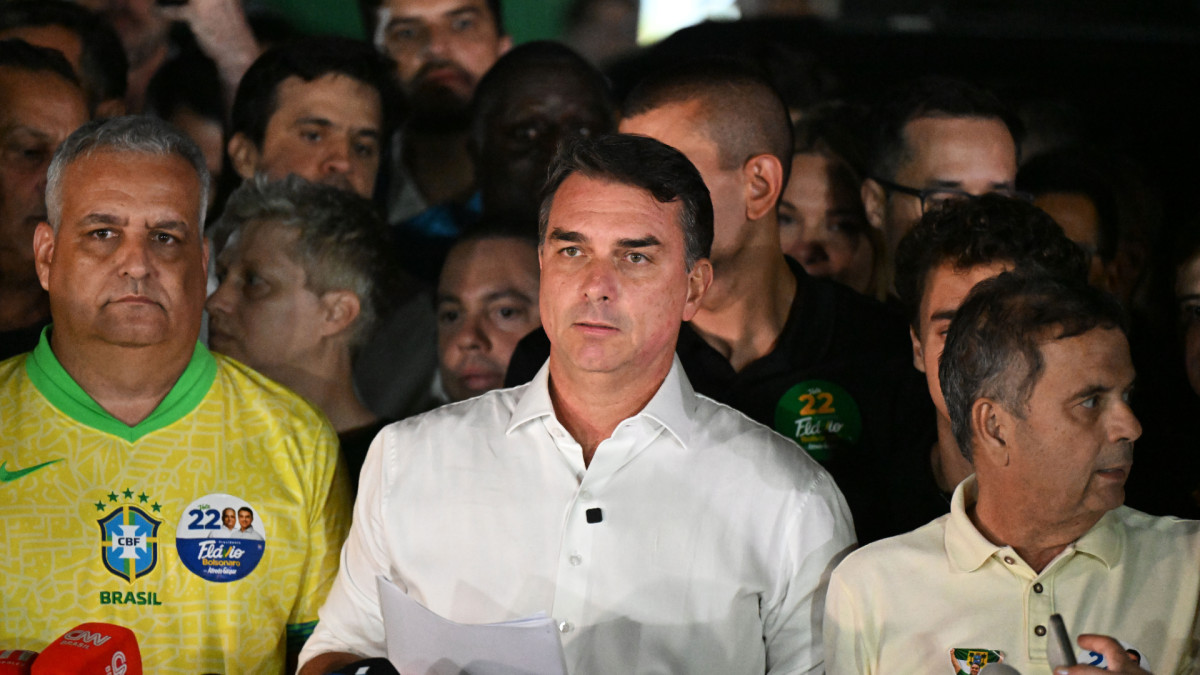
This Sunday it was his son’s turn. Senator Flávio Bolsonaro lost the runoff to Lula by more than four million votes (51.8% to 48.2%) and that same night announced that he does not recognize the result and would ask the courts to annul the election. The pretext is no longer electronic ballots, but the Supreme Court’s decision to extend voting by two hours due to transportation problems affecting voters, which his own campaign had also denounced. His allies echoed the message on social networks within minutes. Election-law experts see it as very unlikely that the appeal will change anything. Nor is it necessary: the aim is not to win in court, but to ensure that a portion of the country does not feel the president who has just been elected as theirs.
In Mexico, the fraud claim from 2006 translated into weeks of protests on Reforma Avenue and into a distrust that survived the conflict. Years later, already in government, the same movement pushed reforms to curb the electoral referee. The lesson is uncomfortable: the doubt sown during the campaign does not stay in the campaign. It becomes institutionalized and, as seen in Brazil, it is inherited.
“The objective is not to win in the courts, but to ensure that a portion of the country does not feel the president just elected as theirs.”
There are also counterexamples. Costa Rica, not far away, has made its Supreme Electoral Tribunal a national asset, which many Costa Ricans call the fourth power. Anyone who has worked on campaigns there knows that this trust was not decreed: it accumulated election after election, with real-time open data and with parties that, upon losing, accepted the result.
Spain arrives at the November 29 vote with a solid electoral system and an electoral administration that has held up well. Precisely for that reason, the moment is delicate: trust wears out much faster than it accumulates. Three measures would help.
- Preventive transparency. The Central Electoral Board and the Electoral Census Office can publish now, in detail and in an open format, how the Supreme Court’s decision will be applied and how many voters are affected per country. An official datum on time is worth more than ten denials.
- Prevent rather than deny. Denying comes late. Explaining beforehand how mail-in voting works, what safeguards it has, and the path each envelope follows reduces the surface area of suspicion.
- An explicit commitment to accepting the result. In Latin America this has been done with ethical electoral pacts signed before the electoral bodies and international observers. It may seem a minor gesture, but it isn’t: it forces each party to say out loud whether it is willing to lose.
Whoever wins on the November 29 vote will govern with the institutions left by the campaign. It is in their interest that they remain standing.
