
Dismissed on First Amendment grounds.
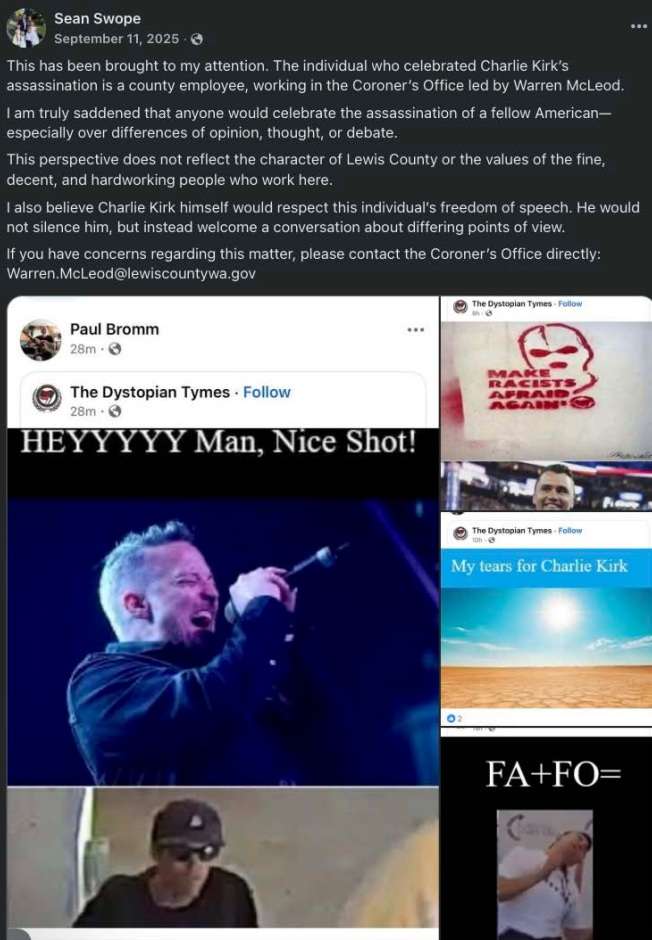
An excerpt from Judge Benjamin Settle’s longish opinion Monday in Bromm v. Lewis County (W.D. Wash.):
Plaintiff Paul Bromm was employed as a part-time Deputy Coroner with Lewis County. After conservative activist and media personality Charlie Kirk was shot in September 2025, Bromm shared memes and made other posts on his Facebook that appeared to make light of the killing, even suggesting it was deserved.
Bromm was placed on administrative leave and then terminated for his posts. Bromm sued Lewis County, the City of Centralia, and five individual defendants, asserting 42 U.S.C. § 1983 claims premised on alleged violations of his First Amendment right to free speech, and that defendant [County] Commissioner Sean Swope “doxed” him in violation of RCW 4.24.792.
Here’s the court’s analysis as to doxing; I’ll discuss Bromm’s First Amendment claim in a separate post:
The doxing statute prohibits the unauthorized publication of “personal identifying information” either with intent or knowledge that the information will be used to harm the individual whose information it is, or with reckless disregard for the risk that the information will be used to harm them. “Personal identifying information” is defined as:
any information that can be used to distinguish or trace an individual’s identity, including without limitation name, prior legal name, alias, mother’s maiden name, or date or place of birth, in combination with any other information that is linked or linkable to an individual such as:
(i) Social security number, home address, mailing address, phone number, email address, social media accounts, or biometric data;
(ii) Medical, financial, education, consumer, or employment information, data, or records;
(iii) Any other sensitive private information that is linked or linkable to a specific identifiable individual, such as gender identity, sexual orientation, or any sexually intimate visual depiction; or
(iv) Any information, including without limitation usernames and passwords, that enables access to a person’s email accounts, social media accounts, electronic forum accounts, chat or instant message accounts, cloud storage accounts, banking or financial accounts, computer networks, computers or phones, teleconferencing services, video-teleconferencing services, or other digital meeting rooms.
An individual whose information has been shared in violation of the doxing statute has a state law cause of action against the individual or individuals who shared the information. However, the prohibition does not apply to “providing personal identifying information in connection with an exercise of the right of freedom of speech or of the press.”
Bromm alleges that Swope doxed him by identifying him as an employee with the Lewis County Coroner’s office (after Bromm had removed that information from his profile) and sharing his employer, Coroner McCleod’s email address. Swope does not challenge Bromm’s claim on its elements but instead argues that he had his own First Amendment right to make his post, making it exempt under RCW 4.24.472(2)(b).
The Court agrees…. Bromm’s original post touched on a matter of public concern, [so] it only makes sense that Swope’s responses would be accorded the same treatment. Just as Bromm had an interest in sharing his memes, so too did Swope have an interest in criticizing him, and in communicating that criticism to his constituents. Indeed, Bromm acknowledges that the posts “contained political commentary,” but he nonetheless argues that “Swope’s First Amendment argument addresses only his initial publication and does not answer the evidence that he later pinned the post to the top of his Facebook page.” But Bromm does not explain why a social media post qualifying for First Amendment protection would lose that protection based on how prominently displayed it is.
Even construing the facts in the light most favorable to Bromm, Swope’s Facebook post was an exercise of his First Amendment rights and therefore did not violate RCW 4.24.472 as a matter of law.
David Edward Bailey (Lewis County Prosecutor’s Office) and Elena C. Bundy and Kristofer John Bundy (Bundy Law Group PLLC) represent Swope (among other defendants).
