
The European economic and industrial policy is the main instrument in the modernization and decarbonization of the productive fabric. It is, therefore, one of the keys to the European economic transformation toward the consolidation of its global competitiveness. The reports prepared by Enrico Letta and Mario Draghi outline a reform agenda aimed at completing the single market and promoting an expansive industrial policy: more flexibility in state aid and merger control, a focus on decarbonization technologies, minimum capacity in critical sectors along value chains, mass electrification, subsidies for decarbonizing energy-intensive industry and a push for innovation and scale in cutting-edge technologies (quantum computing, AI software, robotics, semiconductors).
“The main weaknesses of the EU are energy prices and regulatory and fiscal fragmentation, as well as the lack of a fully integrated capital market”
The financing they propose to achieve these transformations would combine, on the one hand, fiscal measures such as a European competitiveness fund backed by European public investment (800,000 billion euros per year according to Draghi), although the new (Multiannual Financial Framework) MFF foresees a much smaller amount (one-tenth). On the other hand, they point to the urgent need to create the Union of Savings and Investments (Capital Markets Union) and the Banking Union to mobilize savings and non-banking capital, as well as to be able to count on a risk-free European asset (joint debt issuance) and to strengthen the euro (Letta). The main weak points of the EU are energy prices and regulatory and fiscal fragmentation, as well as the lack of a fully integrated capital market that prevents scaling industrial and technological investments like its rivals.
Following this road map, during the first year of Ursula von der Leyen’s second term the European Commission activated initiatives such as the Compass for Competitiveness, the Clean Industrial Deal, the Plan for Affordable Energy and the Union of Savings and Investments. Despite the political shift and priorities, the fundamental shortcomings have not yet been corrected nor have the essential reforms indicated by the reports been implemented. Europe is over-diagnosed, but the pace of action is worryingly slow.
Now, in January 2026, after a year of the Von der Leyen II Commission, EsadeGeo publishes a report in which progress and deficits regarding the objectives established by the Clean Industrial Deal are evaluated. As well as highlighting the indispensable reforms for those objectives to be realized.
Environment and Reforms. Toward a Union of Savings and Investments
The fundamental reform to finance the technification, electrification and modernization of European industry is the culmination of the Union of Savings and Investments (backed by the Banking Union). This is the only way to efficiently channel 70% of European savings into productive investments within the continent. A capital market that provides scale, both in large European “champions” and in budding innovative projects.
Current data suggest fragmentation and passivity of European private capital. 34% of savings accumulated in the EU, about 11 trillion euros, remains in the form of bank deposits. According to the Commission, around 300 billion euros of European savings are invested each year in the United States.
Financing the industrial policy
The new State Aid framework allows Member States to call and grant specific aid. However, if public financing is granted in a disjointed way and ends up falling to the Member States, it can cause significant distortions in the single market and in competition. Regarding public funding, a catalyst for industrial projects, the European Commission and the Clean Industrial Deal rely on the European Investment Bank (EIB) as an investment instrument.
In 2024, the EIB set a record by ensuring that 60% of its investments directly supported the energy transition. In 2025, Member States have raised the EIB’s annual lending limit to 100 billion, which, combined with the regular budget (MFF), is still below Draghi’s annual figure for European public investment.
Electrification and Energy Autonomy
In February 2025, the European Commission presented the Action Plan for Affordable Energy, a set of measures specifically aimed at reducing energy costs and facilitating large-scale electrification of the economy, a key condition for European industrial competitiveness. The objective is to increase the economy-wide electrification rate from the current 21.3% to 32% by 2030. To achieve this, it is essential to complete the internal energy market with physical interconnections. In other words, modernize the electricity grid infrastructure and cross-border European connections. The Electric Market Reform, in force since 2024, was a decisive step. The industrial sector as a whole accounts for 25% of final energy consumption in the EU. Electricity accounts for 33% and natural gas 31% of industrial consumption. A notable fact is that 50% of energy consumption in industry is used for industrial heat generation, which is the most difficult segment to electrify.
“Despite the rapid expansion of renewables, around 67% of the EU’s total energy demand is still met by oil and gas”
The European industrial policy and the Clean Industrial Deal are based on the evidence that there is a very clear interrelationship between energy cost reduction, electrification, industrial competitiveness and EU autonomy. Energy prices are the greatest obstacle to the global competitiveness of European industry. In 2023, 58% of total energy demand was imported and 42% was produced within the EU. Despite the rapid expansion of renewables, around 67% of the EU’s total energy demand continues to be met by oil and gas. 19% comes from renewables and 11% from nuclear fission. The easiest way to reduce costs is to replace external dependence on fossil fuels with electricity generated from renewable sources and stored on European soil. The current data show that electricity generation accounts for approximately 23% of final energy consumption. 47% of the EU’s electricity demand is generated from renewable energy sources; many countries, including Spain (57%), exceed 50%.
There is capacity to generate 70% of electricity from renewable sources. To unlock that capacity and reliably supply industrial production, it is necessary to modernize the electrical grids and develop storage infrastructure (batteries).
Technological Autonomy and Reducing Dependencies
The Clean Industrial Deal sets as its goal to reach 40% European production of key components for clean technologies. In the case of batteries, the objective of more than 40% domestic manufacture is met, although dependence remains high and concentrated in China. Regarding solar energy, production of photovoltaic modules remains highly import-dependent and China still holds 98% of the European market. In wind installations, Europe is not dependent and shows some self-sufficiency, being a net exporter of turbines and generators, with a 27% increase in 2024. The real European dependence is manifested in critical minerals and rare earths.
Although the Critical Raw Materials Act—the European regulation on critical materials—establishes targets for self-sufficiency and recycling, the EU still depends on imports by more than 60%, often concentrated in a single supplier, for most of these materials. Materials that, on the other hand, are essential for the manufacture of technological components, renewable infrastructure and for high-value industry in general.
The Industrial Decarbonization Acceleration Act is another fundamental regulation for which the Commission plans a draft in early 2026. This measure aims to boost demand for clean products manufactured in the EU, incorporating criteria of low environmental footprint, resilience and “Made in Europe” in public procurement.
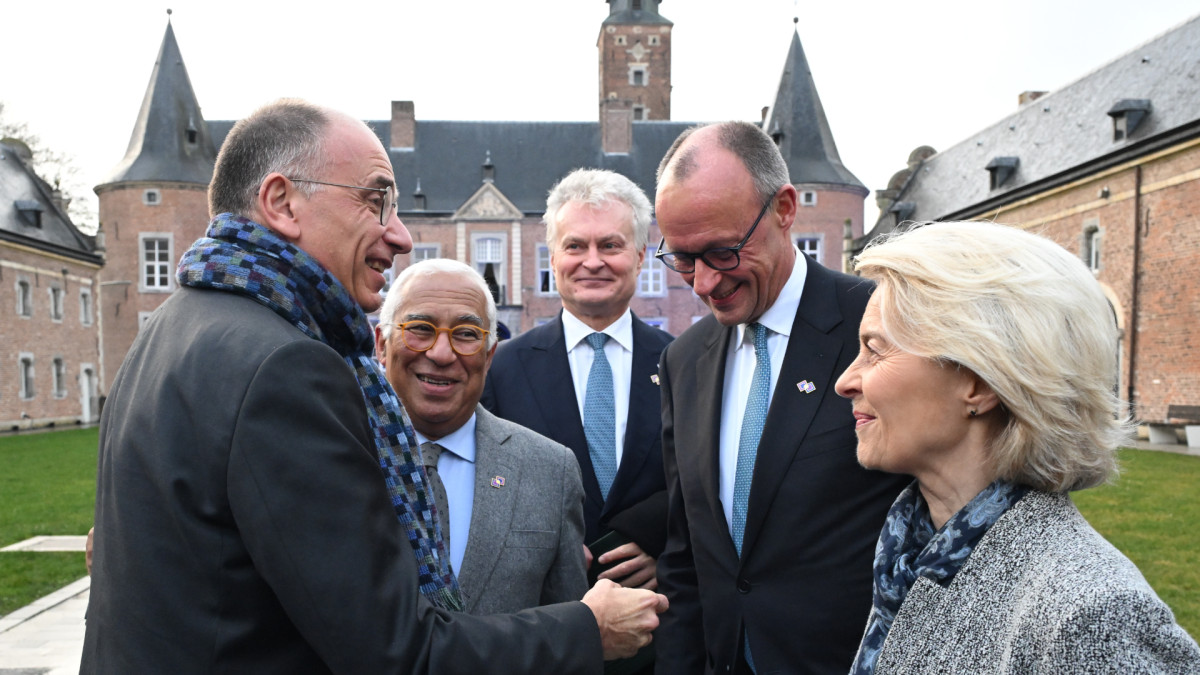
Europe has the elements to accelerate its three interconnected objectives: competitiveness, decarbonization and autonomy. The elements that must be combined with greater dynamism and efficiency are: private and public capital, technological innovation, talent, developed industrial fabric, domestic demand, foreign trade, renewable energy infrastructure, electrification, and global supply chains. European industrial policy and the Clean Industrial Deal have set the path and the objectives. There is a need to reach the necessary consensus to address the reforms of real significance that channel all available resources toward the economic and industrial transformation of the coming decade. European leaders met at an informal gathering to discuss the competitiveness agenda on February 12, seeking that agreement.
- Creation of a European ‘safe asset’ through a Commission proposal (the predecessor to the NGEU). The issuance of such common debt asset is the most efficient way to finance the push for urgent transformations.
- Increase EU fiscal resources. Use revenues from CBAM and ETS in investments that directly benefit the decarbonization of industrial sectors.
- Coordinated financing and European public spending, managed from EU institutions. Not from the Member States.
- Modernization of electricity grid infrastructure, innovation in storage and an increase in cross-border interconnections, with the backing of public capital.
- Promotion and public funding of strategic European-scale industrial and technological projects (European champions). Quantum computing, biotechnology, artificial intelligence.
- Continue diversifying global supply chains and trade agreements, especially in critical inputs.
- Open dialogue and planning between public institutions and the industrial sectors.
- Reform the ETS (Emissions Trading System) and the CBAM (Carbon Border Adjustment Mechanism), whose expansion is planned for 2026.

Natalie Foster
I’m a political writer focused on making complex issues clear, accessible, and worth engaging with. From local dynamics to national debates, I aim to connect facts with context so readers can form their own informed views. I believe strong journalism should challenge, question, and open space for thoughtful discussion rather than amplify noise.