
Marine Tondelier stands among the principal designers of France’s New Popular Front, a coalition that in 2024 led the legislative elections. Despite the united front’s success—bringing together voices from Jean-Luc Mélenchon’s radical left to Olivier Faure’s center-left Socialists—the model now seems to have reached its limit. The reason is that La France Insoumise and the Socialists do not appear inclined to repeat it. She laments this: “I find it a very selfish attitude, even indecent”.
She serves as the national secretary of the Ecologists and has spent over a decade in local opposition in Hénin-Beaumont, a northern French town known, among other things, as Marine Le Pen’s stronghold. Consequently, she has a firsthand understanding of what the French radical right proposes.
Every European capital has the 2027 French presidential election on its calendar, and the Greens’ leader is already sounding the alarm: “And if France falls, Europe falls”. Confronted with the prospect of a National Rally (RN) rising to power, she asserts her rejection of both the Socialists and La France Insoumise forming a single front, while also warning about the risks for Europe and for France: “If Europe shifts because France has shifted, then we really enter another world”.
As for her program and the ecological vision in a world growing increasingly unstable, she argues that “Our industrial, energy, cultural and digital vulnerabilities are being weaponised by our enemies, especially by Trump and Putin”. On demography and the sustainability of the welfare state, Tondelier, who is expecting her second child, contends that “The fall in birth rates is also a kind of silent strike of the wombs of women who are not doing well and who do not see themselves in that life”.
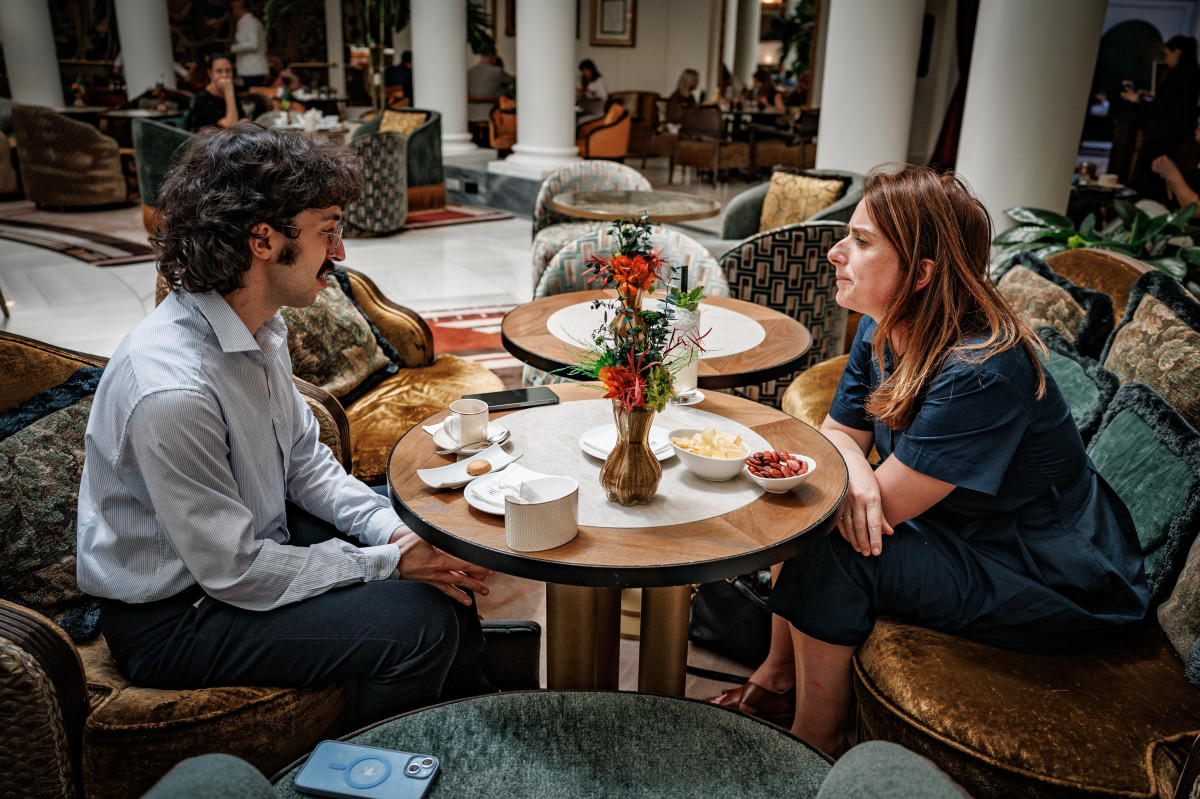
Marine Tondelier talks with Jorge de Diego about the future of the French left and the risk of a National Rally victory. Photo: Agenda Pública / Tania Sieira
It is being discussed in every European capital that France is setting the political calendar with the 2027 presidential election. If an RN candidate reached the Élysée, what would change for France and for Europe?
I have served as an opposition councillor in Hénin-Beaumont since 2014, a city governed by the National Rally. That has given me a direct view of the alterations the far right brings when in power. What is clear is that, in a world where major democracies—even the United States, with its long democratic history—are tilting toward the reactionary, we can observe a kind of domino effect gradually taking shape: states fall one after another and pull each other down. The next domino could be France.
“In a world where major democracies —including the United States, with its long democratic history— are shifting to the reactionary side, we can see a kind of domino effect beginning”
And if France falls, Europe falls. Today, there are few progressive countries left in Europe, and even fewer left-wing ones. Europe remains the entity capable of standing up to imperialism. If Europe shifts because France has shifted, we really enter a different world. That is why, as an ecologist and with the French presidential election in view, I will do everything in my power, not only for the ecologists but for my entire political camp, to avoid that scenario.
Looking ahead to that presidential election, how do you think the French left should present itself? And beyond tactical considerations, how would you like it to present itself?
From the start, what the ecologists have defended is the need for a united candidacy between the left and the ecologists. Our stance has been consistent and coherent: we have supported it, we have advocated for it, and we are doing everything possible to build it. Yet it is far from simple.
“Mélenchon and the Socialists agree on not wanting to work together again, and that destroys any ambition of victory for the left”
Today we find ourselves in a situation where we understand that Jean-Luc Mélenchon does not want to cooperate with others and is pursuing his own path, while many Socialists are tempted to go in the opposite direction. Ultimately, both sides agree on not wanting to work together again, and that sabotages any hope of a leftist victory, now and in the future. I view this as a very selfish attitude, even indecent, because it means we will not be adequate to the task for the people we are meant to defend: some vote for us, others do not, and yet others abstain altogether.
We ecologists watch what is unfolding with worry, but we do not back down: we will continue to push for a common candidacy with determination.
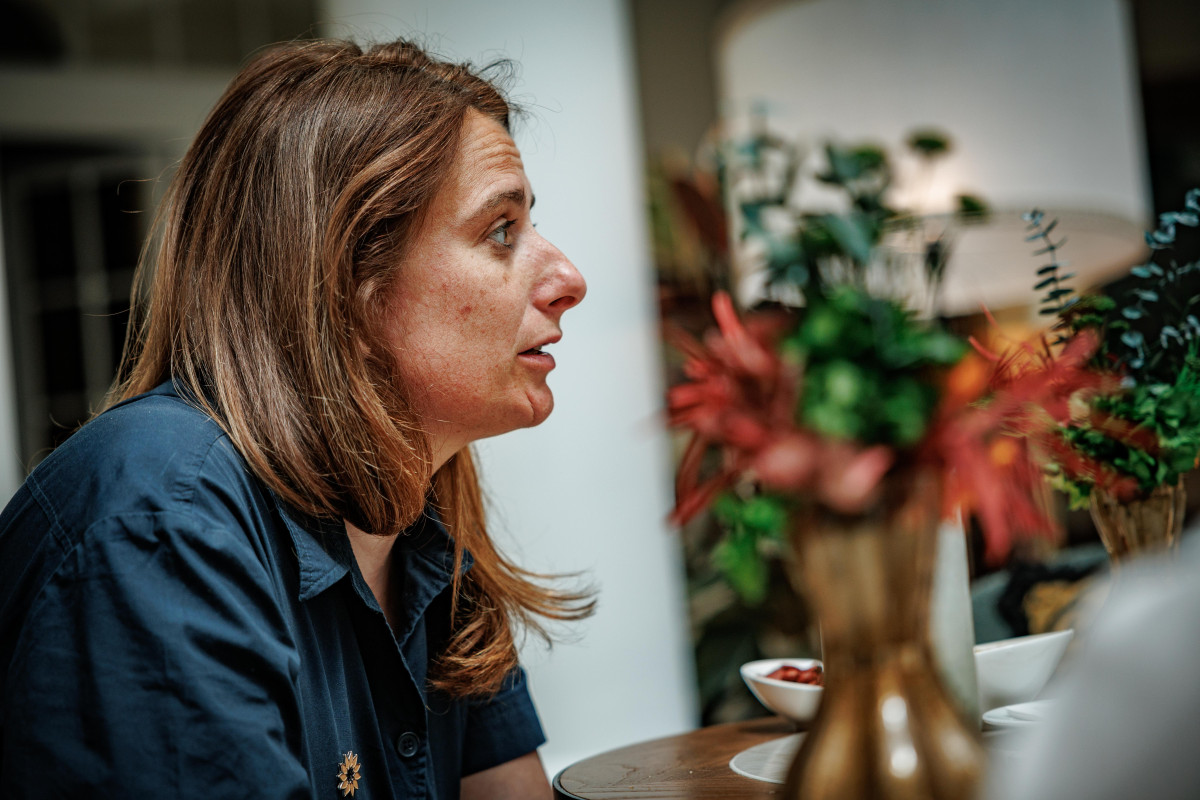
In 2024, Marine Tondelier was one of the most visible faces of the New Popular Front. Photo: Agenda Pública / Tania Sieira
The New Popular Front was regarded as a success in 2024. If the challenge now is even greater, why does it feel harder to replicate that unity?
That is precisely what I spend my time arguing. Is the danger of the National Rally coming to power smaller today than it was yesterday? No. There is no proof of that. That’s why I spoke earlier about indecency and the irresponsible nature of this strategy.
Since 2024, the notion of an irreconcilable left has taken root in France. Some Socialists contribute to it, and so does Jean-Luc Mélenchon. It’s like laying mines across a battlefield: once you scatter mines everywhere, even if reconciliation comes later, the mines stay. There is something irreversible about what is happening, and that troubles me greatly.
One of the Greens’ most recognizable contributions in France has been in cities: mobility, urban calming, renaturation, housing and proximity. What is your model for the city today, and what have you learned from governing major municipalities such as Lyon? Do you think Spain has something to learn in this area?
I don’t have a complete view of Spain, but we are currently in Madrid, a city as large as Lyon, and the challenges are shared. The foremost issue here—and perhaps more acute than in Lyon—is housing: tensions with Airbnb, tourism, or very wealthy individuals who want a flat in every European capital while ordinary people struggle to find a decent home. These are problems we share.
What I am profoundly proud of in French cities run by ecologists is their resolve to alter life, reshape the city, and thereby genuinely transform people’s lives. These are very tangible improvements: kilometers of bike lanes, organic and locally-sourced meals in school canteens, universal holidays, and cooling islands during heatwaves. It represents a clear upgrade in the quality of life.
I also think that in Spain the phenomenon of urban concentration is stronger. Traveling by train from Barcelona, you notice fields, small villages, and low density outside the big cities. France has more mid-sized cities.
“It is good that Spanish cities draw inspiration from French ecologist cities, but French ecologists also draw inspiration from what is being done in Spanish cities”
And France can likewise draw lessons from Spain. In my presidential program I am addressing loneliness, because it affects one in four French people. It is astonishing. The World Health Organization notes that loneliness has health effects comparable to smoking fifteen cigarettes a day. It is a social, societal and public health issue. That is why I have chosen to address it by looking at models from the United Kingdom or Japan, where ministries exist specifically to combat loneliness.
In Barcelona there is a city department dedicated to this issue and a 2020-2030 plan with measures that interest me for France, such as social prescribing: allowing doctors to prescribe free activities or resources offered by the city, from museum visits to nature walks or adapted sports activities. It is true that Spanish cities can inspire French ecologists, but French ecologists also draw from what is being done in Spanish cities. Not so much from Madrid, which is governed by the right.
Putting ideas such as ecological transition back at the centre of the debate seems even more difficult in a context marked by geopolitical crises and economic instability. How do you see it? How do you try to make your issues count?
I do not completely agree with the framing of the question, because what we are experiencing geopolitically proves precisely that ecologists were right for a long time and that it is urgent to implement their proposals.
For a long time, Europeans believed that pursuing a peace project would be enough to protect us. It was the famous end-of-history notion: peace, prosperity forever and, if needed, armies that would suffice. Yet today peace is not guaranteed, and it is not enough to possess bombs, ammunition and planes. Our industrial, energy, cultural and digital vulnerabilities are being weaponised by our adversaries, especially by Trump and Putin.
“What we are experiencing geopolitically proves precisely that the ecologists have been right for a long time”
At the outset of the Ukraine conflict, there was a wake-up call about our energy dependence on Russia. In 2024, France spent more money on buying fertilisers, uranium and energy from Putin than it did in direct aid to Ukraine. That is a problem. At that time, people suggested we should invest more in home insulation and in so-called social leasing for electric cars, a subsidised leasing program to facilitate access to electric vehicles, but those measures did not endure. Then everyone carried on as if nothing had happened.
And then we were surprised again by the blockade of the Strait of Hormuz, even though the Club of Rome had already warned in 1972 that we would face a geopolitical problem because of our dependence on oil.
For me, this does not call ecologist ideals into question. On the contrary, it demonstrates that we arrived too late and that we were not listened to. At the start of the conflict, with the European Green Party, we ran a campaign that said: “Let’s insulate our homes, let’s isolate Putin”. Today, if we wish to guarantee our security and sovereignty, we must invest in renewable energies, which are the only ones we know how to deploy quickly and which render us completely independent and autonomous. And we must also invest in reindustrialisation in a coordinated manner at the European level.
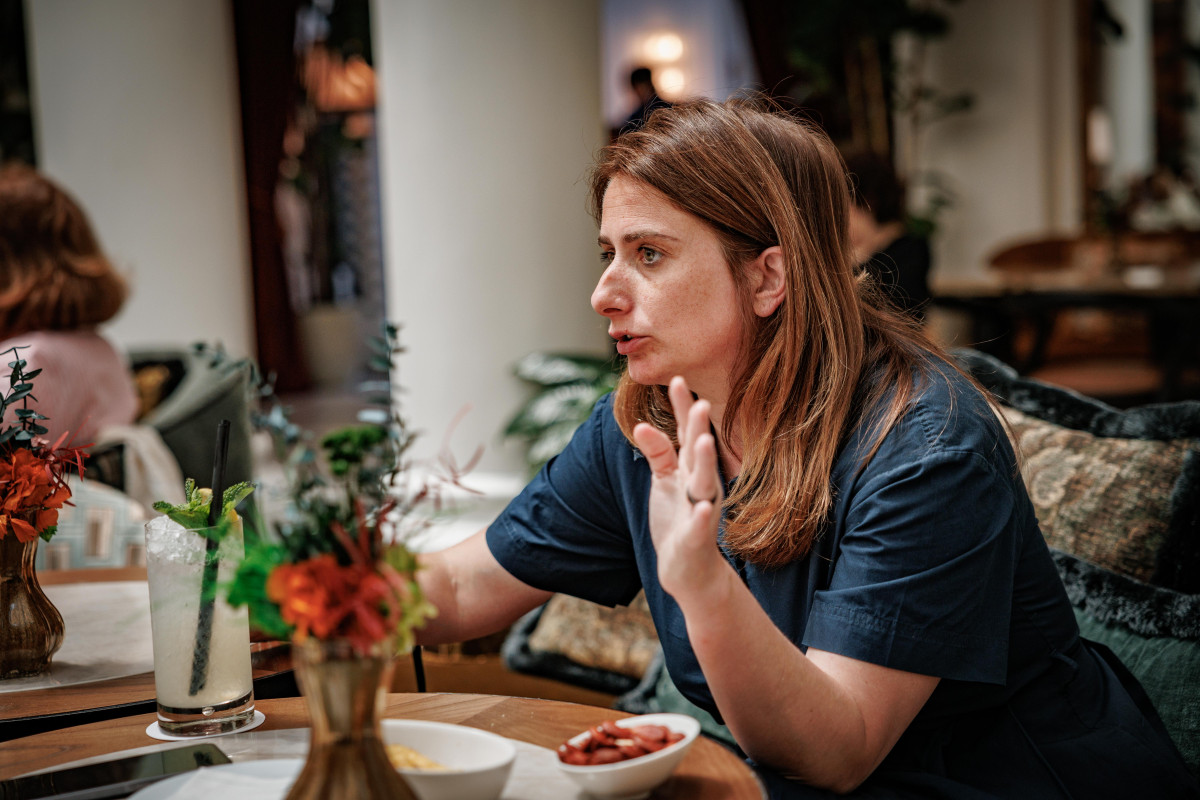
Tondelier argues that the ecological transition is part of Europe’s response to its energy and industrial vulnerabilities. Photo: Agenda Pública / Tania Sieira
In Europe, there has been a backlash against parts of the Green Deal. Beyond the opposition of the radical right, even within the EPP, the party’s secretary general, Dolors Montserrat, said that the pact was a “deindustrialisation plan”. I am not asking you to comment on those statements if you do not want to, but I would like to ask you this: is it possible to escape European stagnation by promoting green industry, or do we perhaps need to readjust our objectives?
I do not think the Green Deal stands in the way of industry. The Green Deal is a condition for our future, for environmental justice and for social justice. If we had implemented it better, there would have been greater social justice. The mistake of the centrists is to assume that ecology can be pursued without social justice. We disagree.
It is inappropriate to pit the Green Deal against industry. We are drafting a plan for the French presidential race with clear aims for France, but we also want a European strategy. It is pointless for everyone to do everything. We need to understand what some countries already do well, where we Europeans are vulnerable, and how each country that has the capacity and willingness can contribute to filling those gaps and reducing our vulnerabilities. We need European collective intelligence.
Allow me to illustrate: steel. I hail from northern France, a region that once mined coal and now hosts ArcelorMittal. If Arcelor were to shut down in Dunkirk and Fos-sur-Mer, we would lose the ability to produce European steel. It is not realistic to expect a reopening within two years. If it closes, it closes. And for the rest of our lives we would depend on Chinese and American steel.
“We ecologists claim to take much better care of industry than those who are allowing French and European industry to decline”
I am not pretending to be hypocritical: when I fight for air quality, I visit Arcelor and insist on caution, but I prefer steel made in Dunkirk, under better environmental and social conditions, to Chinese steel that has travelled halfway across the world and wasn’t produced with the same energy. We ecologists claim to look after industry much more responsibly than those who allow French and European industry to falter. We are highly ambitious and deeply concerned about this issue.
Europe is facing an increasingly intense debate on demography: aging, low birth rates, the sustainability of the welfare state, migration and territorial balance. From an ecologist perspective, how should this challenge be addressed?
It all began with a remark by Emmanuel Macron about the “demographic rearmament” of the French people. It struck me deeply because I was undergoing medically assisted reproduction at the time. I already had one child and found it very difficult to have a second. I’m now pregnant naturally, but for three years I endured a complicated process that many European couples experience. Many of us felt it as a provocation, and the couples and women concerned did not take it well.
On television we see many older white men discussing demography as if women’s bodies belong to them: that social protections will collapse, that the next world war will be lost, that the economy will lose power. There is a heavy guilt placed on women.
History shows that when these topics are addressed in this way, especially between the two world wars, it was then that very freedom-restricting laws against women were passed. In France, in 1920, contraceptives and any campaign promoting their use were banned, with disastrous consequences. And in Europe, natalist reforms targeting women, as in Italy or Hungary, have never truly increased birth rates. The countries with the highest birth rates are those that promote equality.
“Demography is not a problem, it is a fact. And if we want to deal with it, we need a living feminist policy”
That means a woman who does not wish to have children should have the right not to have them, a couple who does not want children should have that right too, and a woman who does want children should have the conditions to pursue that project. If you have housing problems, if you live in substandard housing, if you struggle to skip meals or to cut portions, you cannot easily envision bringing a child into the world. If you are a woman and you fear you may have to stop working because you cannot find childcare or because it would affect your retirement, that is hardly encouraging. And if, on top of that, you wonder what kind of society that child will grow up in, with climate change or conflict, that does not help either.
The fall in birth rates is also a kind of silent strike of the wombs of women who are not thriving and who do not see themselves in that life. Women who do not want to have children deserve to be left alone, but we must also care for those who would like to have them and hesitate because of the conditions in which they would raise them. That is the task of politics. Demography is not a problem, it is a fact. And if we want to address it, we need a living feminist policy, far more relevant than all the moralising talks we hear on television.
To finish, what is your wish for France in 2027?
To avert the worst and, perhaps, to achieve something better.
Thank you very much.
