
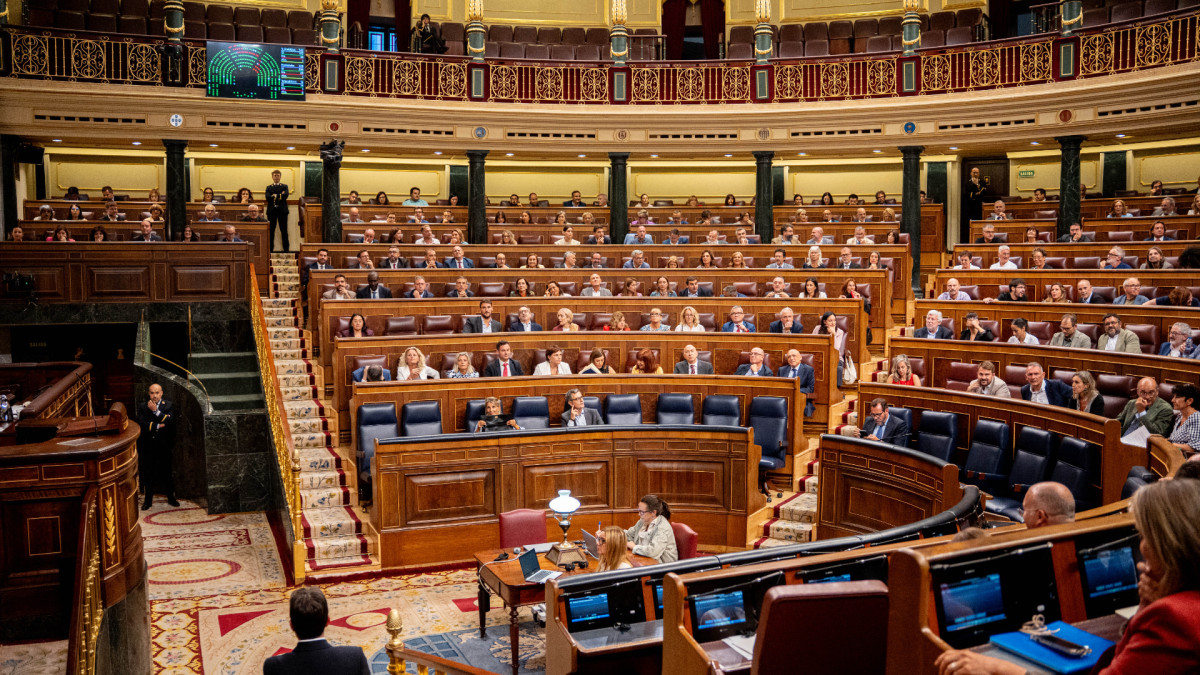
During the last four decades, Spanish politics has hinged on the idea that elections are won in the center and that the PSOE and the PP reach government thanks to the ambivalent voters between them and the mobilization of voters who participate in the electoral contest but are less politicized. Thus, the one who wins over the “moderate” voter governs, and the two major parties moved toward that center in campaigns for pure arithmetic.
The data from the CIS barometer of September 2026 —the first vote estimate after the Ceuta crisis— indicate that this rule has stopped working. Not because the center has emptied, which it has not, but because it has ceased to be the terrain on which competition takes place. In this sense, one can say that the center is still there, almost as populous as in 2023. However, what has disappeared is the competition for it: today the PSOE fights within the left and the PP within the right with a Vox that has broadened its electoral base.
Compared with the postelectoral snapshot of the 2023 general elections, the latest barometer is the portrait of a country that has not changed sides, but has changed temperature. Seven and a half percentage points of the electorate have shifted from the temperate positions to the two extremes of the spectrum, while the aggregate weight of the left and the right remains intact. In other words, it is not that there are crossovers across the blocs, but that many people have moved away from them.
“What has disappeared is the competition for it: today the PSOE fights within the left and the PP within the right with a Vox that has broadened its electoral base”
The direct consequence of voters concentrating on the extremes is that challenging the center ceases to be profitable and consolidating one’s own flank becomes so. Hence, within each bloc today a different battle is fought—the PSOE monopolizes the decentered space to its left and the PP defends its space against the Vox threat—while the competition between blocs, which used to decide elections, has almost disappeared.
The country has become tenser
In September 2023, 18.4% of respondents placed themselves at one of the two ends of the ideological scale. Three years later, that percentage has risen to 25.8% —the one point moves from 12.6% to 17.7%; the ten point from 5.8% to 8.1%—. By contrast, the central band (ranging from four to seven) falls from 48.8% to 42.7%. Now, this has a second part: the ideological self-placement at five barely moves, from 21.4% to 20.5%, and the country’s ideological mean remains practically stable, from 4.67 to 4.61, a difference without statistical significance.
There is no swing to the left or to the right: there is a migration. What has diminished are the three, the four, and the six—the positions of those who feel on one side but without loudness. It is the very profile of ideological polarization. The underlying preferences remain the same, but with the added intensity when declaring allegiance to one’s own side.
First battle: the PSOE against its left
As of today, it is a decided battle of which the CIS only certifies the outcome. The Socialist Party appears as hegemonic in the segment from one to three on the scale. It preserves what it had, around 45%, while the space to its left collapses: where Sumar and Podemos totaled 28% in 2023, today they barely reach 18%. Thus, the barometer confirms three years of decomposition of the Spanish left space, which today still lacks leadership after Yolanda Díaz resigned in February from leading the 2027 candidacy. Added to this is the absence of a defined brand and of a distinctive narrative that sets it apart from the government of which it is a part.
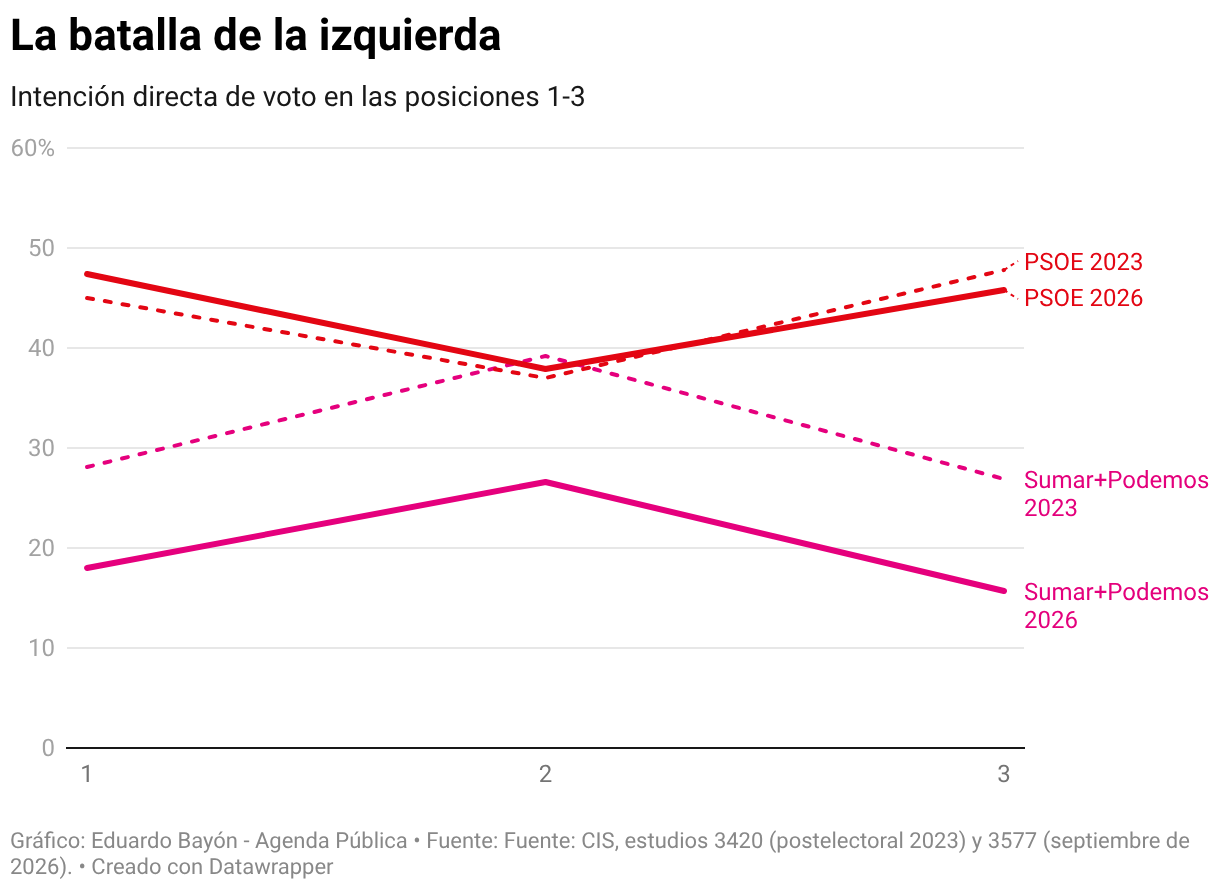
On the other hand, in position four the socialist vote falls by ten points and the undecideds nearly double, while self-placement in the center (five) is reduced by half. Thus, the PSOE gains depth, but loses breadth. Almost half of its voters are already located in the two leftmost boxes, whereas in 2023 they were fewer than a third.
“It preserves what it had, around 45%, while the space to its left collapses: where Sumar and Podemos totaled 28% in 2023, today they reach only 18%”
At this point it is necessary to note that self-placement is not a fixed trait. Part of the swelling of voters at point one may be due to socialists who previously described themselves as center-left and today define themselves without nuance in the face of the country’s cultural and political context. In short, it is not only that the PSOE attracts the left; it is that the left voting for it describes itself in another way.
Second battle: the PP against Vox
The contest between the PP and Vox remains open at a moment when immigration again occupies the political and media agenda, and Santiago Abascal’s followers have regained electoral momentum, placing them in an expansion phase once more.
The CIS portrait shows how, in the center, the PP remains where it was in 2023, around 26% of direct vote at position five, with a median self-placement of its electorate barely changing. What the PP is losing to Vox concentrates on its own right flank. At position seven, the popular party falls eight points; at eight they lose thirteen and at the far end of the scale they drop by eighteen. In contrast, Vox traces the inverse path and at ten goes from capturing three in ten voters to capturing one in two. The competition between them is not fought in the center — even though Vox appears ahead of the PSOE at position five in direct vote intention — but between seven and ten.
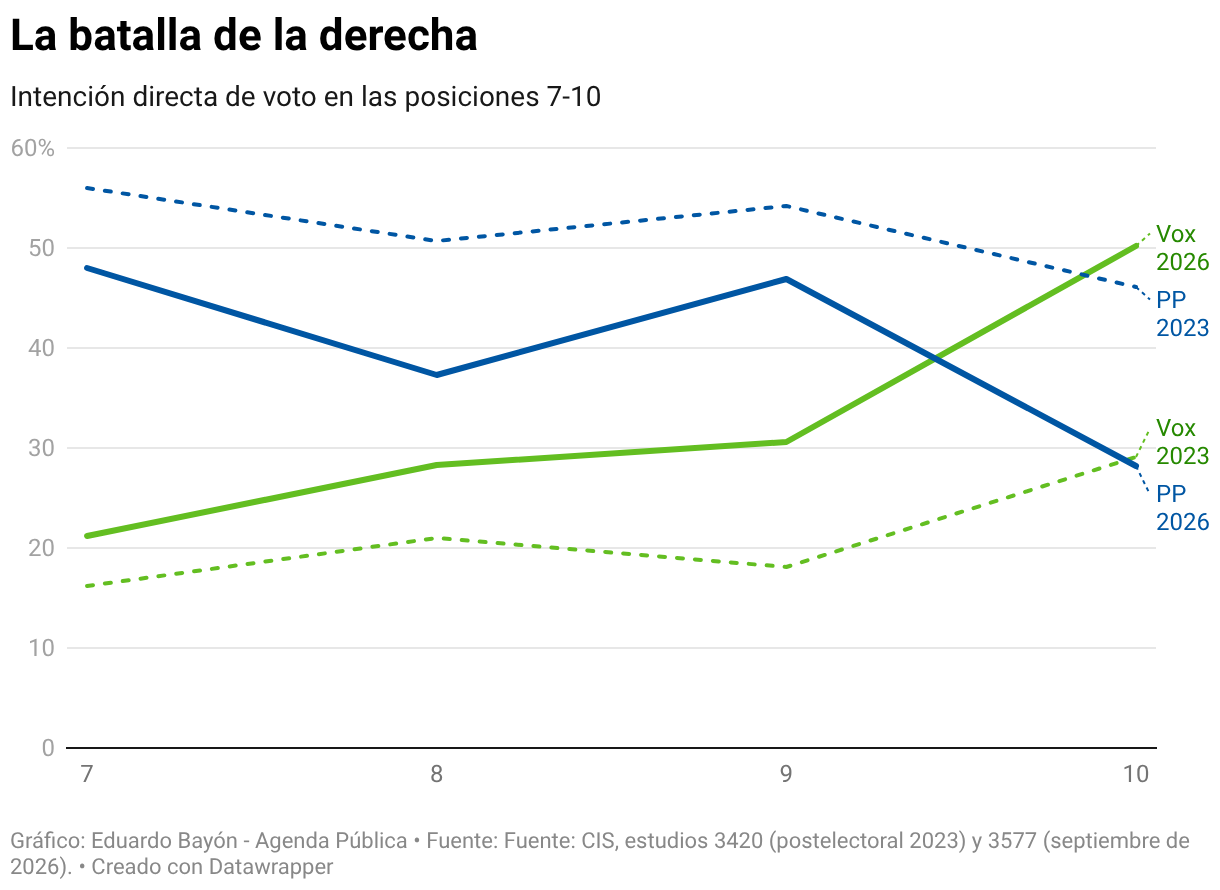
That confirms the lack of returns from the PP’s strategy, since hardening the rhetoric to block the rightward competitor is not working. The PP does not broaden its electoral base in a right where it continues to assume Vox’s frame. And every time it does, it helps Vox grow. It is the mechanism that, for example, also operated throughout August with Ceuta. When Alberto Núñez Feijóo talks about invasion, he does not contest the framework and the electoral space with Abascal; he reinforces it.
“The competition between both is not fought in the center — even though Vox appears ahead of the PSOE at position five in direct vote intention — but between seven and ten”
Meanwhile, Vox’s electorate grows at the extremes, as expected, but also grows among those who declare themselves centrist. What thins out is the middle band. It is a bimodal electorate: a hard core that is ever larger and a second pool of voters who place themselves at five, a self-placement in which those who consider themselves apolitical due to a general disdain for politicians also tend to position themselves. It can be inferred that Vox is not growing in the center due to moderation, but because five on the CIS scale has filled with anger.
The overtaking that isn’t really a surpass
The headline that has circulated this week —”Vox overtakes the PSOE in the center”— depends entirely on the indicator used. In direct vote, it is true: 11.9% versus 9%. In vote-plus-sympathy, they are tied. And finally, in ideological closeness, when asked which party is closest to one’s own ideas, the PSOE still clearly leads: 15% versus 11.8%.
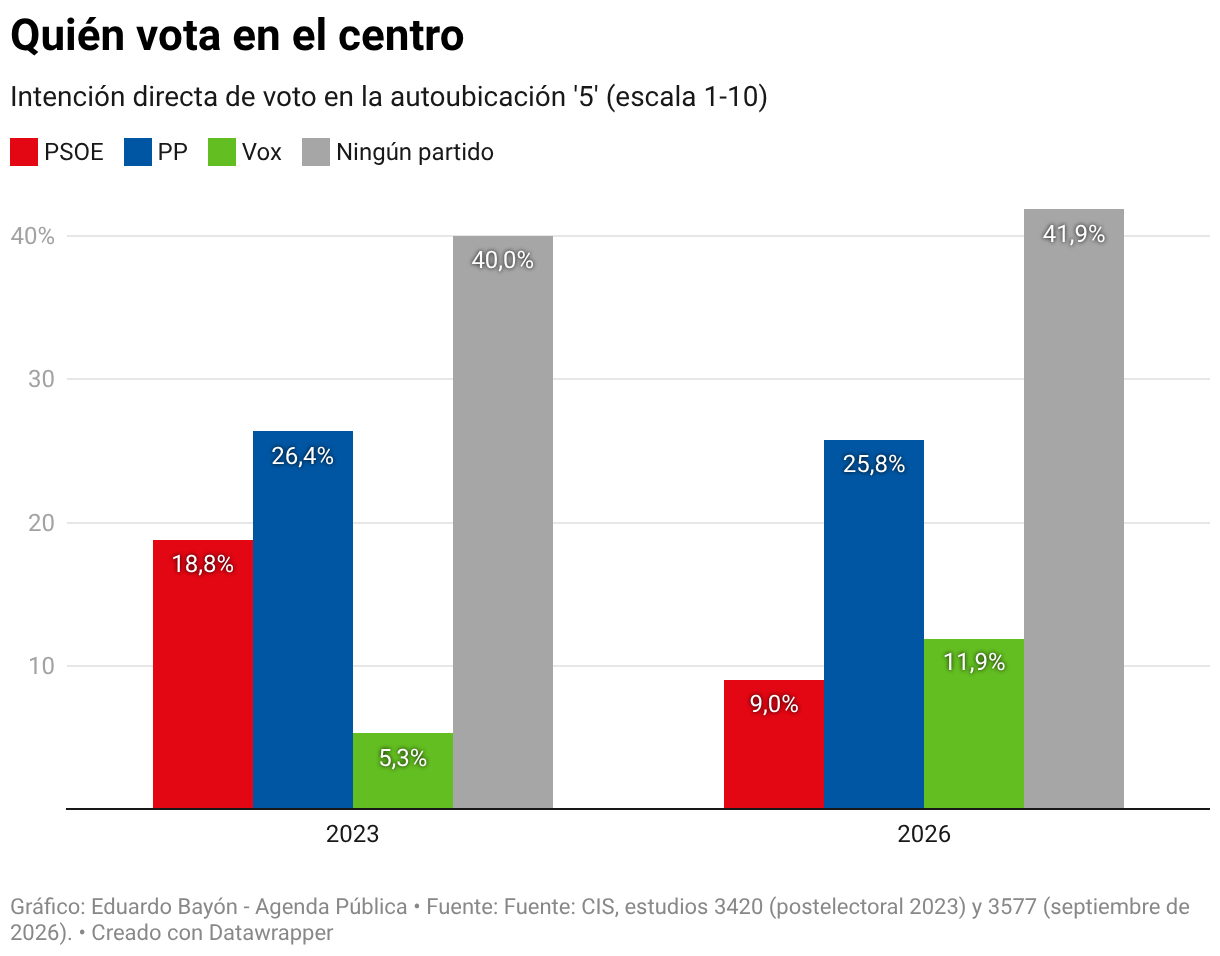
There is also another reading. The self-placement five voters who leaned toward the Socialists have not become converts; they have fallen silent. Four in ten voters placed at five do not mention any party when asked who they would vote for. The PSOE retains affinity, but is losing the ability to convert it into votes in this ideological spectrum. By contrast, Vox has less affinity and mobilizes it better.
“The PSOE keeps the affinity, but is losing the ability to convert it into votes in this ideological spectrum. By contrast, Vox has less affinity and mobilizes it better”
That is the same diagnosis that has been repeated this year. The Socialist problem is not preference, it is intensity: its vote has not left for the opponent, it has sat on the couch at home, showing reluctance to go vote. That means two things: first, that it is recoverable, and second, that it can only be recovered by mobilization.
What is the center good for today
The center remains the most volatile electorate. Seven out of ten voters placed at 5 say they decide their vote based on what convinces them at the moment; at the far left, only one in three. In 2023 the PP won the center by a wide margin, was the leading force in the elections and did not govern. The center can influence who finishes first, but the blocs decide who governs.
“The center can influence notably who finishes first, but the blocs decide who governs”
A country like this can still deliver victories in the center, but no longer through conquest: the center is not won by taking it from the opponent, because there is hardly anyone willing to cross over. It is won by mobilizing those who do not identify with anyone. That is a contest of intensity, not of position. What the center no longer yields are governments.
There remains also the underlying question: was 2019 an anomaly or a preview? The 2026 data point to a system where competition is won more on intensity than on position. There are not more citizens of the left or the right than three years ago, but there are many more willing to declare it without nuance, self-placing themselves in harsher positions.
