
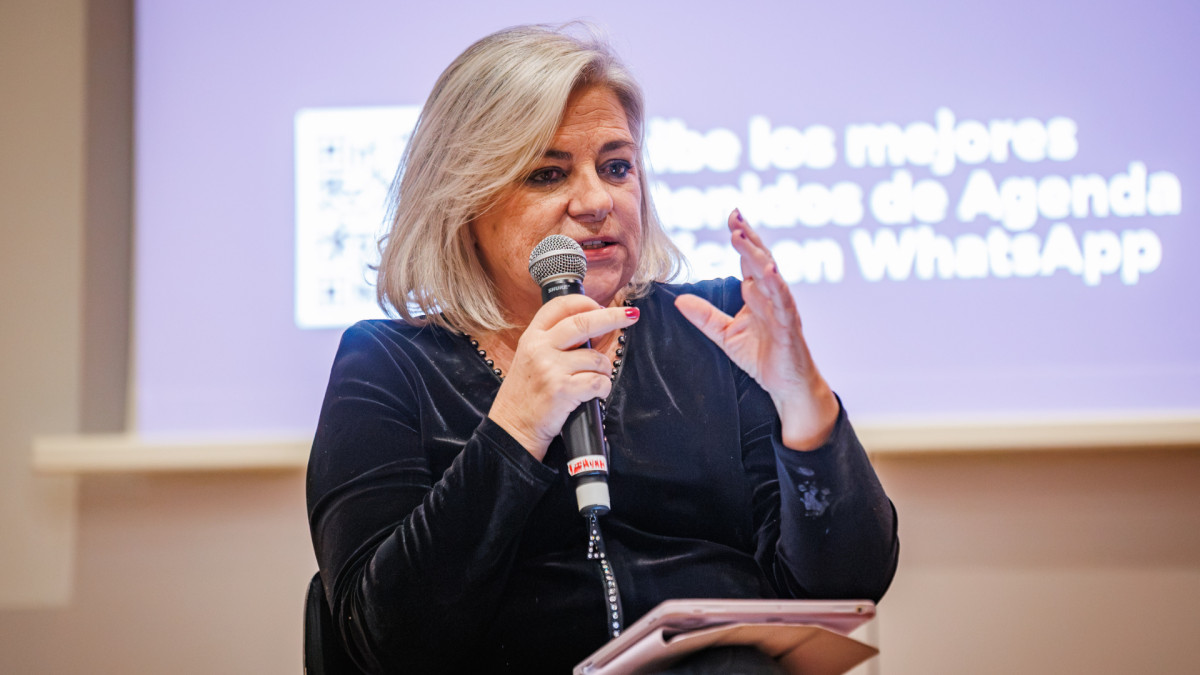
Elena Valenciano knows from within the difficulties involved in leading a political party. She was the deputy secretary-general of the PSOE, a member of the Congress, and a member of the European Parliament, in addition to taking on responsibilities within the socialist group of the European Parliament. Her decades-long engagement in Spanish and European politics has coincided with the evolution of party systems, the economic crisis, and the emergence of new political forces. That experience gave special weight to her contribution during the conversation organized by Agenda Pública in Madrid on November 20th.
“Polarization comes more from top to bottom than from bottom to top,” said the former socialist leader, inviting reflection on the role played by political organizations in a climate of confrontation. Valenciano believes that there exists a tactical polarization promoted by the leadership of political parties, especially the major ones, which use it to keep their voters cohesive. Her analysis focused on the responsibility of the parties themselves when interpreting social differences and conveying them to public discourse.
“There exists a tactical polarization promoted by the leadership of political parties, especially the major ones, who resort to it to keep their voters cohesive”
The paradox, in her view, is that this strategy has consolidated precisely when societies need more conversation. Economic uncertainty and technological transformations, in a changing international environment, are making it increasingly difficult to govern with simple answers. Meanwhile, parties have tended to withdraw into themselves. “Political parties operate more like those of the 20th century,” she observed. Their structures have not evolved sufficiently to perform a genuine intermediary function in much more complex societies than those for which they were designed.
Valenciano portrayed organizations in which critical positions find less and less space and where internal discipline reduces the plurality of opinions. That dynamic ends up distancing political conversation from everyday life. Parties need to differentiate themselves to compete and, at the same time, preserve the ability to recognize interests that do not fit perfectly within their programs. Representing a plural society requires precisely opening spaces for these sensitivities and accepting that disagreements are part of democratic activity.
The former deputy secretary-general of the PSOE speaks alongside other former political leaders. Photo: Agenda Pública / Tania Sieira
Why voting does not mean feeling represented?
Her argument gained particular force by distinguishing two realities that are often confused behind electoral turnout figures. “One thing is to participate in elections and another is to feel represented,” she recalled. A democracy can mobilize millions of citizens and, at the same time, increase the distance between voters and their representatives. Identifying with a leader, the fear of a rival’s victory, or the importance attached to results can drive people to the polls, without any of these motivations guaranteeing, on their own, a satisfactory response from institutions to their needs.
“A democracy can mobilize millions of citizens and, at the same time, accentuate the distance between voters and their representatives”
The housing issue provides an example of that distance. Valenciano recalled how tenant organizations have helped transform a daily problem into a political claim, underscoring the importance of parties being able to anticipate social demands and incorporate them into their agendas. The experience of these movements helps to understand how democratic representation is also built outside institutions and how traditional parties can find new channels to learn about citizens’ concerns.
Her reflection also touched on the territorial structure of the State. Spain, she reminded, is a regionalized state, in which many policies depend on administrations governed by different parties. Areas such as housing and public services of health, education, or care for dependents require cooperation among the central government, the autonomous communities, and the municipalities. The effectiveness of public decisions therefore depends on institutional coordination that enables measures approved to be implemented in daily life.
“It is not only about reaching agreements between different ideological positions,” she warned, because those who have the responsibility to implement the decisions must also understand one another. Valenciano called for stable mechanisms of institutional coordination and recalled that the Spanish constitutional system was designed to function through broad agreements. In her view, collaboration between administrations is essential to meet citizens’ expectations and to guarantee that initiatives supported by a parliamentary majority can be implemented effectively.
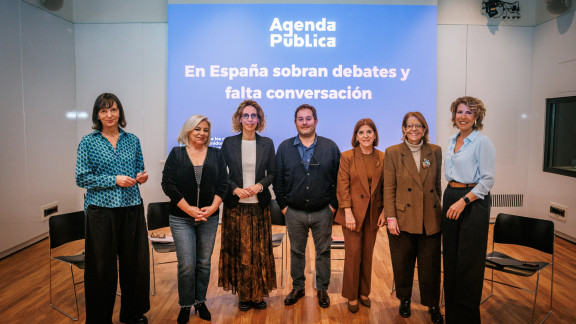
The voices that took part in the meeting, together with the editor and director of ‘Agenda Pública’, Marc López Plana. Photo: Agenda Pública / Tania Sieira
An intergenerational pact
To this, she added another representation problem, tied to the imbalance between generations. The former socialist leader proposed an intergenerational pact that addresses the difficulties for young people to access housing, become independent, and build a life project. While electoral politics responds to the weight of different voter groups, public decisions produce consequences that stretch far beyond a single term. Young generations will have to live with them for longer, even though their smaller demographic share may reduce their influence at the polls.
“Young generations will have to live with them longer, even though their smaller demographic share may reduce their influence at the polls”
At the close of the meeting, Valenciano invited everyone to continue a conversation about the very way we converse. “Are we willing in this country to sit down and talk about the important things, all of us, without prejudice?” Her proposal started from the recognition of the different ideological traditions and the need to recover the ability to regard the adversary as a legitimate interlocutor, especially when problems require shared decisions.
Valenciano’s diagnosis leaves a deeper reflection on the function of parties. Mobilizing voters is an essential part of democratic competition, while representing the citizenry requires listening to different interests and building institutions capable of turning those demands into collective decisions. Perhaps one of the great unfinished tasks of Spanish politics is to recover the capacity to represent, in all its complexity, a society that has changed much faster than the organizations responsible for interpreting its needs.
