
We all recognize Elizabeth Holmes as a villain.
She pitched a radical breakthrough—a blood-test mechanism that could run a full panel from a single finger drop, in a machine roughly the size of a toaster. She was youthful, photogenic, and self-possessed; she emulated Steve Jobs in appearance. Her invention was supposed to disrupt the $60 billion blood-work sector by delivering inexpensive, seamless health monitoring to the general public. Or so the claim went, if the technology had worked. Holmes was convicted of deceiving investors of nearly $500 million; she is serving an 11-year sentence. The saga has been exhaustively covered, and her life was adapted into an Emmy-winning Hulu series led by Amanda Seyfried. She functions as a parable of Big Tech deceit, as much a symbol as a person.
The tale is widely known. You might suppose there is nothing more to add. Yet that belief would be mistaken.
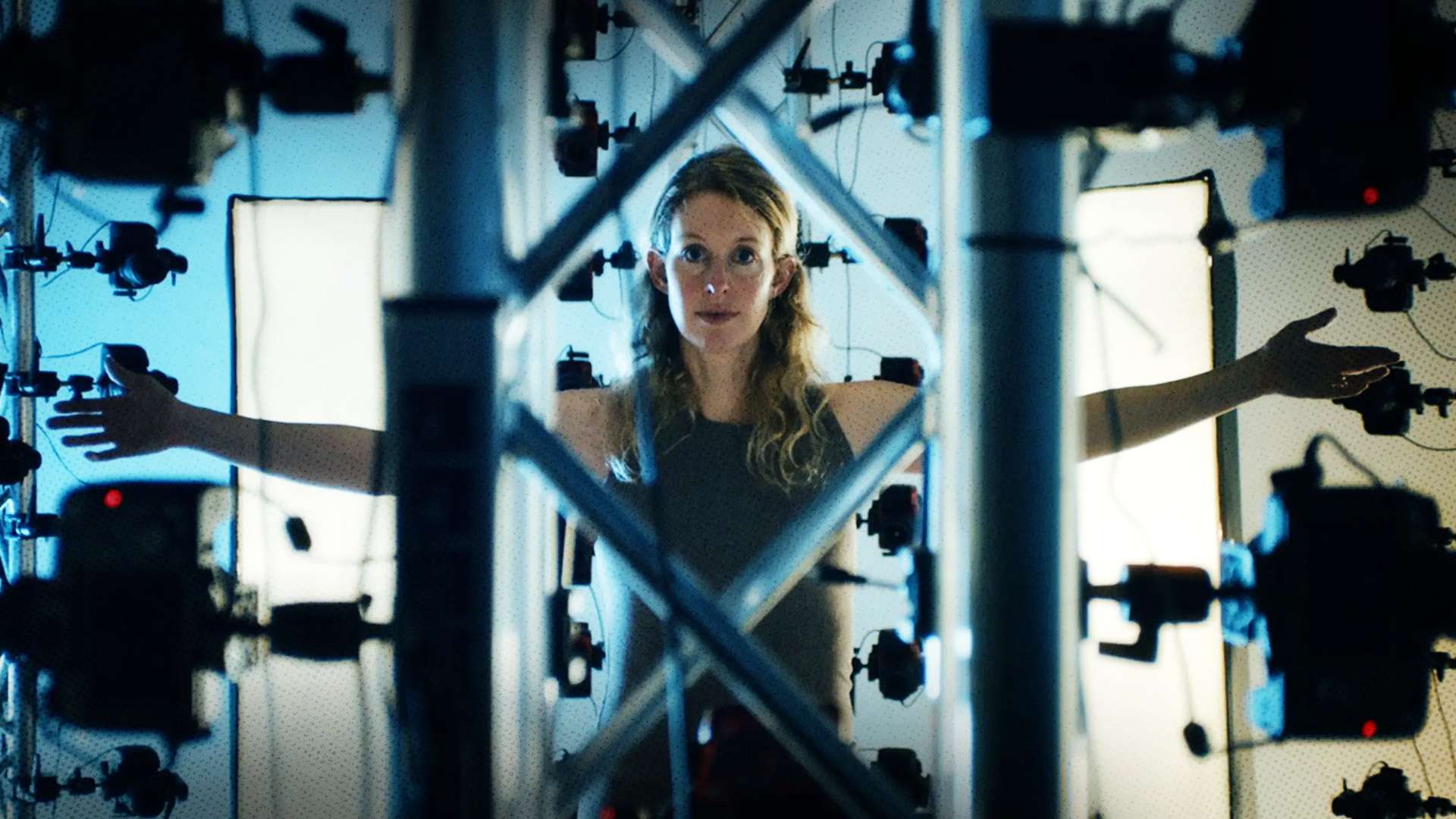
Just before prison, Holmes invited documentarians Nathan Fielder and Lance Oppenheim to live with her, her partner Billy Evans, and their two young children in their beachfront rental in San Diego, offering unfettered access and complete transparency. The result is this year’s most compelling documentary, You Can See Everything. When the camera catches Billy in the shower, the film delivers on its promise of visibility; yes, you can see everything.
But what remains unseen is the essence of Holmes herself. The central puzzle of this era’s most infamous fraudster drives the film: is she cynical and calculating—a venomous liar and possible psychopath? Or is she something more enigmatic—a damaged yet fragile person who genuinely believes her own stories, or at least accepts the narratives she tells herself afterward to rationalize them?
Fielder and his subject appear uncertain themselves; the film becomes, in part, their attempt to square their own ambivalence, to reckon with a conclusion they cannot reach. It reads as a hall of mirrors that underscores the endless unknowability of a person, even with intimate access.
The filmmakers do not absolve her of villainy; the film does not seek to excuse her fraud or declare her innocent. Yet it offers something exceedingly rare in contemporary storytelling—a sincere, deeply felt empathy for someone whom culture (and the legal system) has already damned. In doing so, they give us one of the year’s most peculiar, most unsettling, and most moving works. You Can See Everything is a small miracle of a movie.
There’s a common notion that the most fascinating villains do not see themselves as villains. They present a coherent inner narrative that renders their actions understandable and positions them as heroes in their own eyes. Fielder and Oppenheim gift Holmes—and the audience—a glimpse of psychological complexity. You don’t truly enter her mind; that’s beyond reach. But you do observe that the story she narrates to herself diverges from the public account of her. It’s unexpectedly kind and generous, yet also brilliantly tricky—so much so that you may question who is being manipulated by whom.
Midway through, the film pivots to a meta-level that I won’t spoil, venturing into high-concept terrain in a bid to probe more deeply what art and imagery can reveal about the human psyche. It is formally daring, often humorous, and it justifies the three-hour duration. I have never encountered anything quite like it.
The exercise leaves the viewer as unsettled as the filmmakers themselves; uncertain about Holmes and her motives, and about Fielder and Oppenheim, two gifted filmmakers who appear to be reexamining not just their chosen medium, but the nature of reality—and especially the reality of the mind—itself. There are moments when You Can See Everything brushes against magical realism, except the enchantment comes from the intricacy of human character and storytelling, as if Gabriel García Márquez penned a tale about a man whose camera can peer into souls. It is dizzying, radiant—a sort of postmodern Rashomon, where perspectives continually shift.
As I exited the cinema, somewhat spellbound, I found myself recalling a line from Saul Bellow’s The Adventures of Augie March: “Nobody should be a mystery intentionally. Unintentionally is mysterious enough.” When it comes to Holmes, it’s impossible to determine which is true. All that can be said is that this supposedly one-note Big Tech antagonist, like many of us, is better understood as a mystery—perhaps even to herself.
