
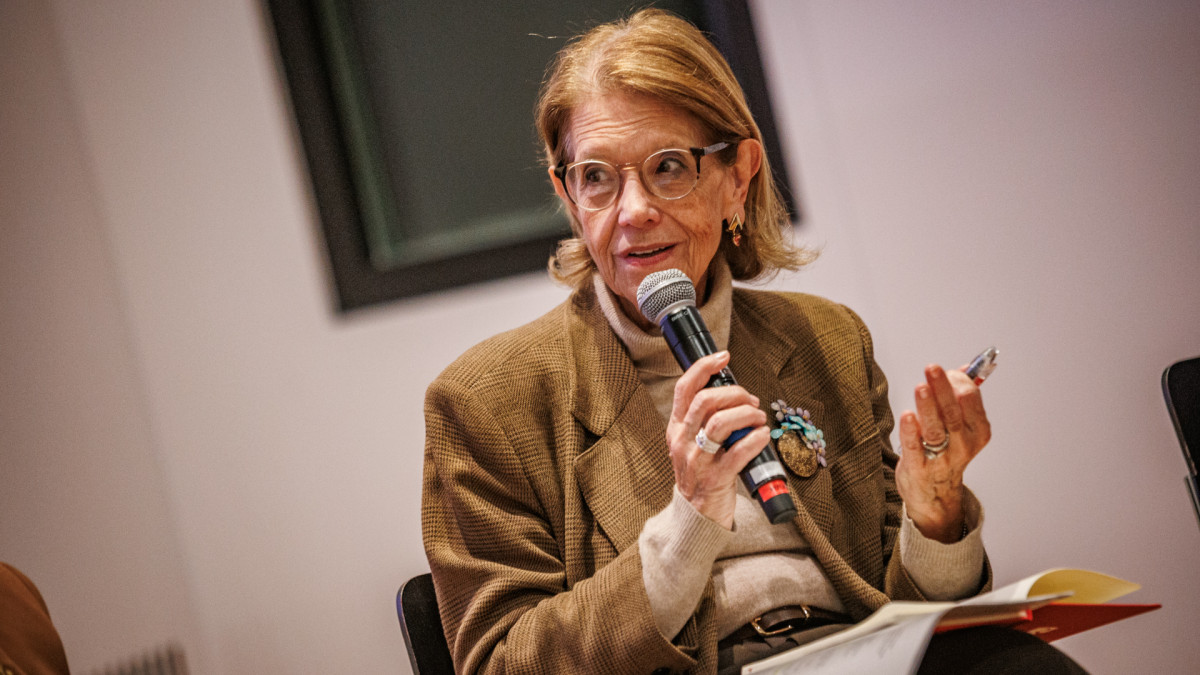
Elvira Rodríguez has passed through several of the institutions where political decisions cease to be mere declarations of intent and become budgets, rules, and responsibilities. She served as Minister of the Environment, Secretary of State for Budgets, President of the Madrid Assembly, and President of the National Securities Market Commission. Her career, straddling politics and economic administration, has allowed her to verify that both activities share a common difficulty, since decisions taken today often bear fruit long after the headlines that accompanied them have faded.
Perhaps for that reason, when Verónica Fumanal opened the conversation organized by Agenda Pública in Madrid with a question about the difficulties of listening, Rodríguez took her answer into the realm of time. “There is too much short-termism, too much immediacy”, she warned. For the former minister, to listen requires paying attention to others’ arguments, reflecting on their reasons and resisting the temptation to react before understanding them. In her view, politics has become accustomed to staying on the surface of problems, trapped in a succession of urgencies that prevents the development of sustained strategies.
“Politics has become accustomed to staying on the surface of problems, trapped in a succession of urgencies that prevents the development of sustained strategies”
Rodríguez shared the panel with four other women from very different political traditions —Elena Valenciano, Carolina Bescansa, Izaskun Bilbao, and Àngels Chacón— gathered to reflect on the deterioration of public discourse. Much of the former minister’s intervention revolved around the responsibility of those who hold government positions and the room for action they still retain to improve how institutions function. Even in an environment shaped by algorithms and the transformations of the media, she considers it possible to recover more constructive practices, based on transparency and generosity.
Her confidence in that capacity for transformation introduced a personal nuance to a conversation that also addressed the structural causes of the current difficulties. Rodríguez argued that the will of public officials remains decisive in recovering a culture oriented toward understanding. “I sincerely believe there is a remedy, or there has to be one, because if there isn’t, we are heading for catastrophe,” she stated. Her reflection affirmed the individual responsibility within institutions and the possibility of improving their functioning through a more open attitude to cooperation.
The former PP minister speaks alongside other former political leaders. Photo: Agenda Pública / Tania Sieira
How to finance Spain’s and the European Union’s priorities?
The most characteristic stance of Rodríguez emerged when the discussion shifted from political forms to governing priorities. The former leader argued for the need to discuss with rigor about Spain’s public accounts and how to finance the services and investments that society demands. In her view, the evaluation of public policies must consider both the merit of their objectives and the costs associated with their implementation, the instruments available, and their sustainability.
“The evaluation of public policies must consider both the merit of their objectives and the costs associated with their implementation, the instruments available, and their sustainability”
The European debate came to reinforce that concern. After recalling the investment needs identified by the report from Draghi, Rodríguez posed how the European Union could finance them while needing to boost its competitiveness against the United States and China. She questioned whether an increase in public debt would be sufficient to meet that challenge and expressed her reservations about Europe’s tendency to address economic problems through new regulations. “Problems are solved by doing, not by prohibiting and regulating”, she summarized. From her perspective, Europe must strengthen its productive capacity and have enough resources to realize its objectives through investments and concrete decisions.
In that reflection, the economic capacity of Europe to sustain its ambitions took on special importance. The defense of the European social model requires a solid productive base, while the pursuit of competitiveness forces a reflection on the role that markets and public institutions should play. Rodríguez thus placed the financing and economic viability of policies at the center of the major European debates, advocating a vision that links political objectives with the means necessary to achieve them.
At the end of the conversation, she recalled a phrase from her childhood that gave the title to an old television program, La unión hace la fuerza. With it, she called for a political culture capable of recognizing ideological differences and, from them, finding spaces for cooperation. Drawing on her experience in economic management and public institutions, Rodríguez asserted the need to recover the capacity to identify shared problems and work together to solve them.
Spanish politics has an extraordinary capacity to announce priorities, though it encounters greater difficulty in sustaining them when they require time, resources, and commitments across administrations. Rodríguez reminded us, in this sense, that the effectiveness of a government should also be judged by its ability to translate announced objectives into concrete decisions and results.
“Spanish politics has an extraordinary capacity to announce priorities, though it finds greater difficulties in sustaining them”
Hence one of the big questions for the next legislature is who is willing to explain how much it costs to build Spain’s future and how they intend to do it. Because setting priorities constitutes only the first step of a task that requires planning, responsibility, and continuity.
