
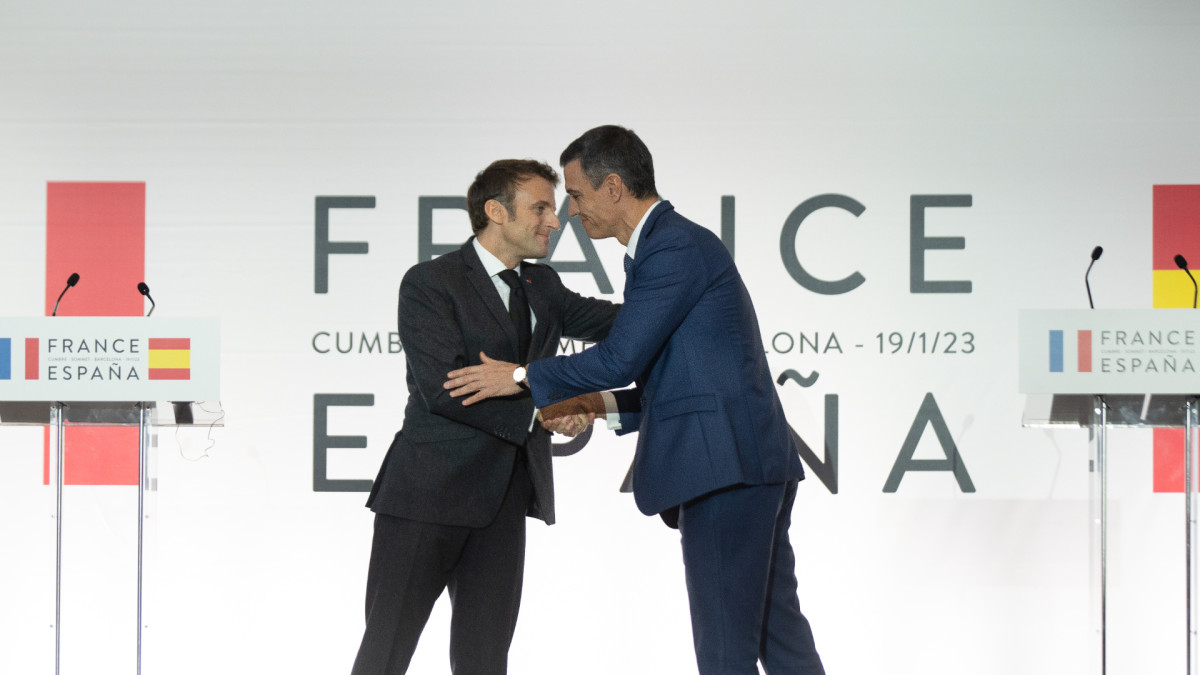
Corría el mes de enero de 2023 cuando the Prime Minister of Spain and the President of the French Republic met at the National Museum of Catalan Art in Barcelona, in Barcelona, to sign the Treaty of Friendship and Cooperation between the two countries, which would later be known as the Barcelona Treaty. At the time, perhaps because of the cynicism of day-to-day politics, it was understood as a mere exercise in public relations. Today it is clear that interpretation was wrong.
The Barcelona Treaty was not a photo op between Emmanuel Macron and Pedro Sánchez. Far from it, it is a document that lays the legal and political foundations for the new architecture of power in Europe.
“Spain can consolidate and maintain its new and powerful status: the leading ‘pivot state’ of Europe”
In June 2026, history knocks again at the door of the Congress of Deputies. The French National Assembly and Senate had already approved the treaty in March 2025, after intense but fruitful legislative debates. Yet, in Spain the text remains trapped in the ever-volatile and polarized Spanish parliamentary machinery. Influential institutions such as Diálogo, the Hispano-French friendship association, have just this week issued an urgent appeal to all Spanish political forces to abandon partisan trench warfare and finally approve a treaty of “strategic interest”, vital for both countries and for the future of the European Union.
And they are not wrong. What is at stake these days in Madrid goes beyond bilateral cooperation. The deputies will participate in a new vote in which Spain can consolidate and maintain its new and powerful status: the leading “pivot state” of Europe.
The end of the Franco-German monolith and the new Europe of twenty-seven
The Barcelona Treaty has historical antecedents that highlight the importance of these kinds of agreements. One of the most relevant examples dates back to 1963, when Charles de Gaulle and Konrad Adenauer signed the famous Elysee Treaty. That historic agreement cemented the Franco-German axis, the undeniable engine that has steered Europe’s destiny for more than six decades. However, the Europe of 1963 — a select club of only six members where Paris and Bonn accounted for roughly two-thirds of total GDP — no longer exists.
The European Union today is a polycentric and fluid behemoth of twenty-seven members —and rising, with an eye on the future and unavoidable enlargements toward the East and the Balkans. The old bilateral formulas no longer suffice to govern it. Moreover, the rigidity and growing frictions in the relationship between the Élysée Palace and Berlin’s chancellery have shown that the traditional “engine” of Europe needs new and agile gears to operate in a far broader and more complex community geography.
“Spain has an unprecedented leadership vocation and a diplomatic agility that has surprised more than one Brussels bureaucrat”
Therefore, the Barcelona Treaty should not be read as the natural product of a Europe radically different. In this new geopolitical ecosystem — marked by prolonged instability on the eastern front, the urgent energy transition, shared demographic crises, and the ongoing reconfiguration of the Atlantic security umbrella — Spain has an unprecedented leadership vocation and a diplomatic agility that has surprised more than a few Brussels bureaucrats.
The difficult art of being Europe’s “pivot state”
In the realm of international relations, a ‘pivot state’ —or pivot state— is defined as an actor that possesses unique strategic assets — whether military, economic, geographic, or ideational — that are coveted by the great powers. Moreover, a pivot state enjoys the mobility and freedom of action needed to tilt between different allies, forging ad hoc coalitions where other powers clash head-on. Globally, powers such as Turkey, South Korea, or Brazil are often classified as pivot states. Within the borders of the European Union, that role belongs today to Spain.
First, demography and economic weight work in its favor. Spain, as the fourth-largest economy in the eurozone, is large enough to look France and Germany in the eye and demand its seat at the decision table. However, it is not so gigantic nor does it carry a hegemonic history heavy enough to raise concerns among medium and small member states.
“In the face of the dysfunction of traditional supply chains and the bet on renewables, the Iberian Peninsula offers a clear and safe bet”
Second, its geography makes it an indispensable security actor. In the face of the dysfunction of traditional supply chains and the bet on renewable energies, the Iberian Peninsula offers a clear and safe bet. The Barcelona Treaty captures this immense structural advantage precisely by safeguarding the push of projects like the H2Med, the gigantic subsea hydrogen pipeline between Barcelona and Marseille, designed to literally redraw Europe’s energy map by supplying green hydrogen to the industrial lungs of central and northern Europe.
Furthermore, Spain is the natural bridge and the vanguard of the Union in its always-complex relations with the Global South. Its historical, linguistic, and corporate links with Latin America, combined with critical proximity to North Africa —a region key to controlling migratory flows and European anti-terrorism efforts— make it the indispensable Brussels compass to look beyond Europe’s own center.
Proyecing power beyond the Pyrenees
Despite all of the above, what has truly solidified Spain’s status as the definitive pivot state is its recent ability to project influence and a hard commitment far beyond its traditional Mediterranean comfort zone.
Historically, Spain’s footprint in Central and Eastern Europe was little more than anecdotal. Today, the situation has been reversed. In recent years, Madrid has woven a network of solid relations with Baltic and Nordic countries. Strategic communication with nations such as Estonia, Sweden, and Finland is now more fluid than ever and, moreover, its sustained response to Russia’s invasion of Ukraine dispelled any doubt about its Atlantic commitment. In Brussels, no one forgets that Spanish leadership was on the ground in Kyiv, demonstrating institutional and military solidarity before their French, German, or Italian counterparts.
“None of the major European capitals possesses the flexibility and cross-cutting appeal that Spain awakens”
While it is undeniable that giants such as France, Germany, or a heavily armed Poland possess greater hard power than Spain, none of these capitals combines the flexibility and cross-cutting appeal that Spain commands. France and Germany often hit a wall of historical distrust in the states of the former Soviet orbit, which view Paris and Berlin as erratic partners, if not outright condescending. Poland, for its part, continues to wrestle with Western Europe’s skepticism about the evolution of its internal dynamics and its traditional allergy to deeper European integration. Spain, not burdened with these historical “baggages,” acts as the perfect hinge.
A solid Madrid-Paris-Berlín-Warsaw axis is emerging today as the ideal architecture to endow a diverse Europe with plural leadership, and Madrid is, without a doubt, the glue that can keep these often-contradictory pieces together. Along with Rome, these capitals form the so-called E6.
The Treaty trapped in domestic politics
All this grand geopolitical design, however, must rest on the support of Spain’s Partido Popular. To understand it, one must return to the urgency of ratifying the Barcelona Treaty in this decisive June 2026.
The agreement establishes integration mechanisms that alter the functioning of the state: from cross-attendance of ministers from one country in the other’s Council of Ministers, to joint defense councils, streamlined bureaucracy for cross-border cooperation, rapid mutual recognition of degrees, and a massive boost to student and talent mobility through programs like the AVENIR scholarships. For all these reasons, it is a fundamental instrument that is also designed to endure electoral swings.
The most controversial provision of the Barcelona Treaty allowed a member of the Spanish government to periodically attend the French Council of Ministers and vice versa. The PP challenged this provision before the Constitutional Court, arguing that it could conflict with the Constitution. However, before the Court could rule, Spain and France agreed on a more restrictive interpretation of the article, which led the Constitutional Court to declare the matter moot. Consequently, the Court never ruled on whether the participation of foreign ministers in the Spanish Council of Ministers was constitutional.
“The Spanish political class should remember that external credibility is a perishable asset that begins at home”
Hispano-French business and civil associations are calling for this agreement to be treated as a genuine matter of state. The Spanish political class should remember that external credibility is a perishable asset that begins at home. The current status of the country as a pivot state is the direct dividend of a political capital tirelessly invested in Europe, but it must be maintained.
If the current parliamentary paralysis blocks the ratification of the Barcelona Treaty, the message sent to the chancelleries of Berlin, Paris, and Warsaw will be hard to explain. It will confirm Europe’s worst prejudices: that, when it comes to the truth, Spain is unable to align its state interests above the sabre-rattling noise of its internal political polarization, risking a rapid slide back to a peripheral status, distracted by low-flying cultural wars.
The hour of truth
The year 2026 will mark, for better or worse, a turning point. The restructuring of the European Union to accommodate its future new members has already begun, and the seats at the real board of Europe are limited and highly coveted.
The Barcelona Treaty is Spain’s geopolitical master key. Its final parliamentary approval would not only seal an unbreakable alliance with its neighbor and main economic partner, but would bring closer the end of an era in which Europe was designed from the center and the north only.
Spain holds all the cards. It is the guardian of the southern flank, the necessary bridge to the east, the bulwark of energy security, the moderator of the Franco-German axis, and the undisputed connector with the Americas and Africa. It has the resources, democratic legitimacy, and talent. The only thing left to demonstrate now is that its political class possesses the maturity and statecraft to live up to its historic destiny. In geopolitics, opportunities do not stay open forever. Europe will watch closely the next steps taken in Madrid.
