
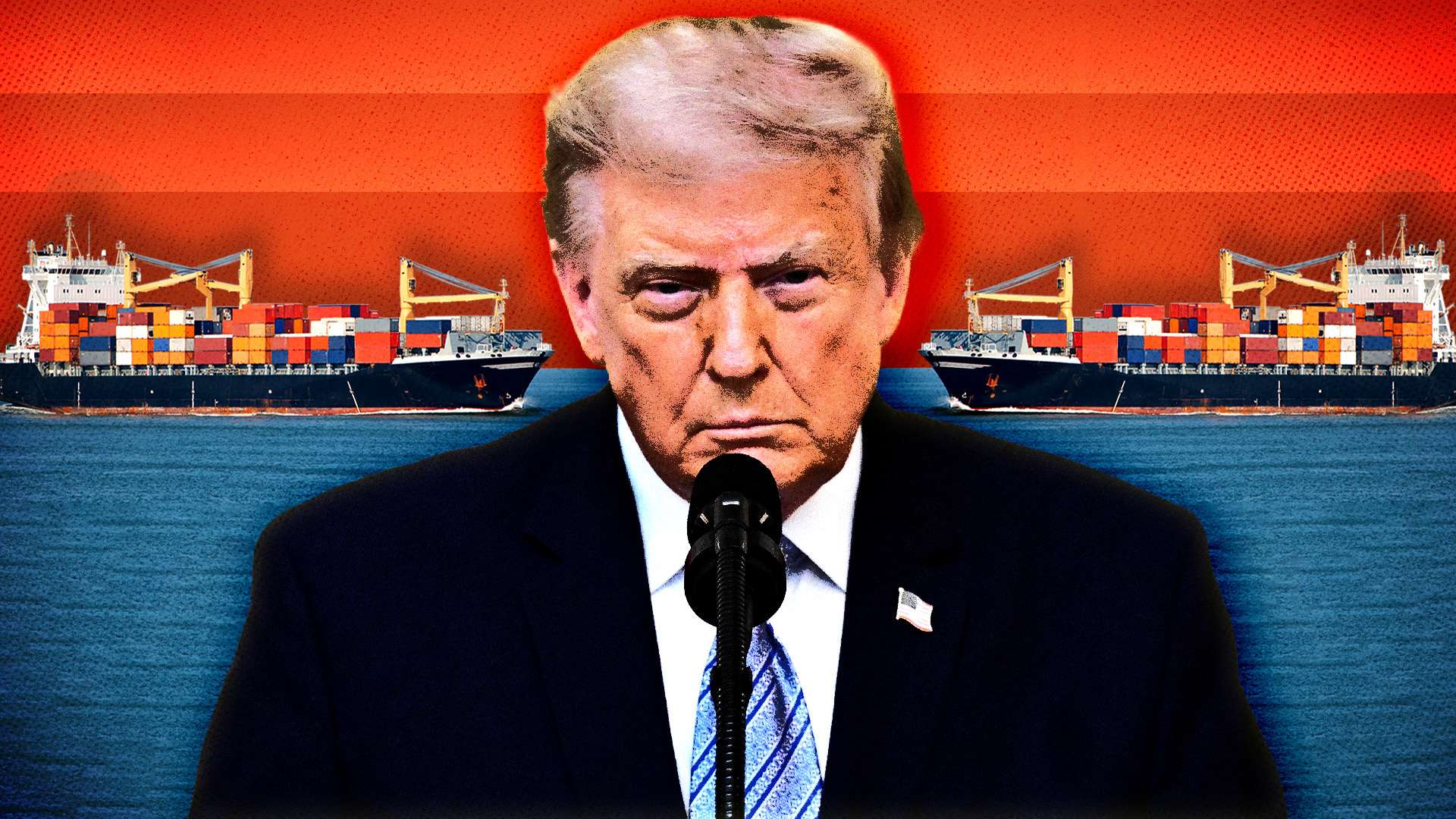
Trump’s zero-sum approach to trade is misguided and authoritarian.
Americans have grown accustomed to Donald Trump’s tall tales, including an improbable anecdote about firefighters pulling him from the rubble after 9/11. We’ve also become familiar with his brazen and imprudent proposals, such as a recent pledge to hand every American $5,000 if Republicans hold Congress after the midterms. By the way, that would add about $1.35 trillion to the national debt, and history shows he’s about as likely to fulfill such promises as he is to pay his DOGE-related obligations or to compensate his own contractors.
My Republican friends have not tired of this carnival-barker act and tell me not to take him at his word. Yet from time to time the president lays out policy views that cannot be dismissed as mere theater. One such instance was his account of how he envisions trade, the cornerstone of the administration’s tariff strategy.
At a press conference, he declared: “We could accomplish enormous benefits for ourselves by simply not engaging in trade with other nations. We would lose $200 billion annually with the European Union. If I stopped trading with them, we’d lose nothing—just one stroke of the pen. We lose with Mexico by about $195 billion a year…They have nothing we must have. I mean, hot tamales, tomatoes, a couple of items.”
That stance betrays an astonishing level of economic ignorance.
First, to claim that a single “stroke of the pen” could halt all cross-border commerce belongs to the playbook of authoritarian regimes. Do we really want a nation in which the top leader can erase millions of intricate, voluntary trading relationships with a signature?
Founding Father John Jay imagined a country where “each person, by law, could cultivate land as they wish, produce what they will, manufacture as they please, and sell the fruits of their labor to whomever they choose, at the best prices, with no duties or impositions whatsoever.” Free trade lies at the core of a free society, even as some Republicans have moved away from their party’s post‑Ronald Reagan advocacy.
Reagan’s 1987 radio address on tariffs still voices a powerful warning: “When homegrown industries lean on government protection, they stop competing and stop making the managerial and technological advances that keep them vibrant in global markets… High tariffs inevitably invite retaliation… The result is more tariffs, higher walls to trade, and diminishing competition… People stop buying. Then the worst follows: markets shrink, firms fail, and millions lose their jobs.”
What makes the Trump approach even more troubling is his belief that he alone can redraw trade policy at will, through fiat. This injects perpetual uncertainty into the business world. Whenever a foreign leader irks him, Trump floats tariffs of 50% or 100%, then balks, then trims, then raises again. Supply chains take years to assemble. In such a scenario, planning for the future becomes nearly impossible, and the outcome is higher prices and slower growth.
Let’s remember that tariffs are taxes, plain and simple. They are shouldered by American consumers. They tend to push prices up and fuel inflation. They rarely safeguard jobs because imposing steel tariffs to shield steelworkers, for example, raises costs for automakers and other users of steel. Those higher costs can lead to reduced output and layoffs.
Moreover, when domestic firms shield themselves from foreign competition, they rarely cut prices; instead, they often raise them because competition wanes and, as Reagan warned, they may stall on needed technological improvements that benefit buyers.
Tariffs and other trade restraints do not deliver the boon Trump promises. On the contrary, they deprive Americans of the considerable benefits that come with open trade—the wide array of fresh produce available in winter and the expansive assortment of goods from every corner of the globe.
As FreightWaves, a publication covering freight and supply chains, explains, the U.S. ran a $197 billion goods deficit with Mexico in 2025, yet Mexico also supplies essential vehicles, machinery, electronics, and agricultural products to American businesses and households. If every one of those items had to be manufactured domestically, it would take years to repair disrupted supply chains and would trigger substantial price increases for consumers. Haven’t we had enough inflation?
Trade deficits are often a misnomer from an accounting viewpoint. We all run deficits with our local grocers—yet we benefit from the arrangement, as does the economy overall. Republicans typically emphasize immigration limits, but what better way to ease the pressure on job seekers than to foster the growth of factories in Mexico and elsewhere and simply trade with them?
Open trade broadens consumer choice and spurs economic expansion. It lowers prices and fosters greater freedom in daily life. Sadly, the president seems intent on doubling down rather than learning the right lesson. He has even threatened tariffs on Europe after welcoming Canada—longtime ally, now seemingly an opponent—as an associate member of the European Union. We cannot afford to ignore Trump’s ill-informed maneuvers.
This column first appeared in The Orange County Register.
