
The dialogue also revolves around Pedro Sánchez, Alberto Núñez Feijóo, Vox, and the role that Spain could play in a Europe that is increasingly less cohesive. Hernández notes that “foreign policy yields few rewards in domestic politics,” while Juliana warns that the next Spanish Government will face the policy that is coming: “Europe will ask Feijóo not to set fire to Catalonia and that a Portuguese formula — a minority PP held up somehow by PSOE, PNV or Catalan sectors — could surface if PSOE is notably weakened”. Hernández, on the other hand, sees a European right that is ever more convergent on immigration, Atlanticism, austerity, defense, and energy, and believes that PP and Vox could fit into that framework. At bottom, both describe a scenario in which Spain can no longer think about its national policy in isolation from the world: “geopolitics cannot be isolated from domestic politics,” summarizes Hernández.
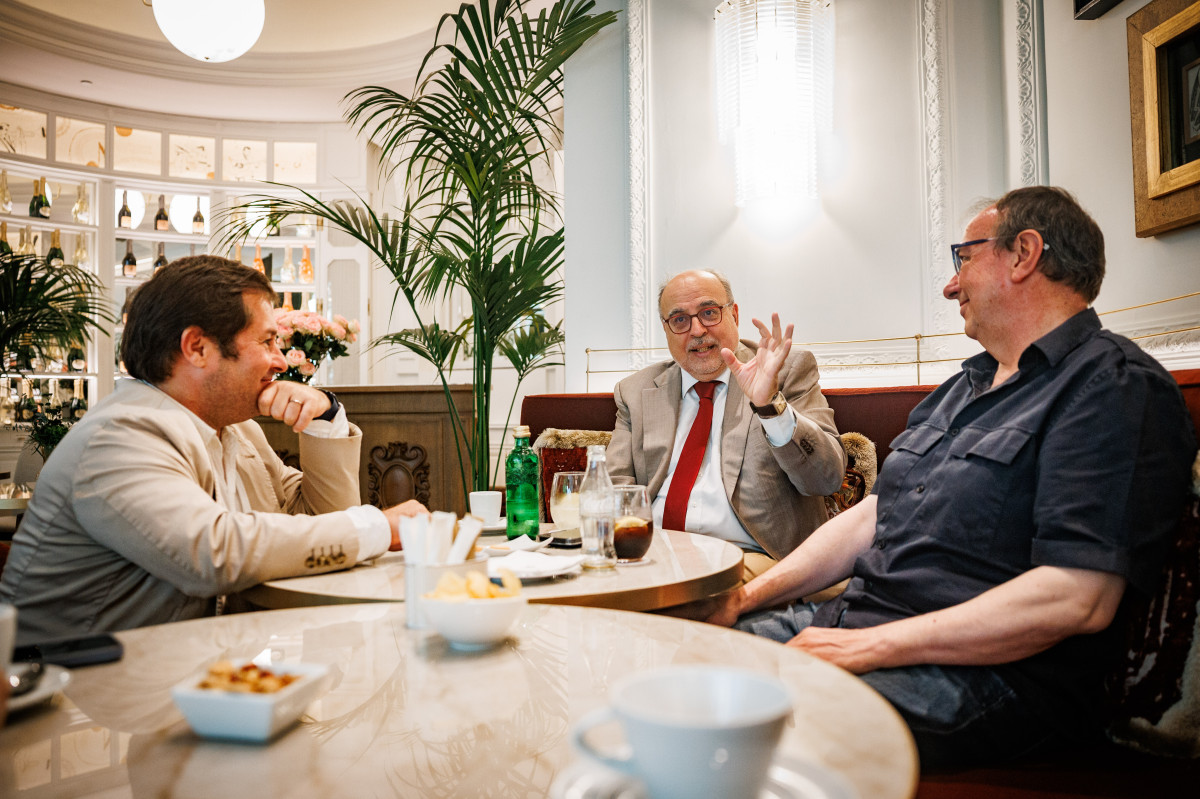
Marc López Plana chats with Enric Juliana and Esteban Hernández about Spain’s international stance on the new global map. Photo: Agenda Pública / Tania Sieira
What international image do you think Spain has today?
Enric Juliana (E. J.): A recent cover of The Guardian’s weekend supplement showed several European prime ministers floating in lifebuoys in the sea. Spain draws attention in some respects, but it isn’t at the center of a persistent spotlight. Perhaps in Italy, where the left claims Pedro Sánchez, Meloni has looked into Spain’s internal politics to craft an alternative discourse to that of the Spanish prime minister. In France I’ve recently seen a few pieces in the conservative press saying that Spain isn’t what it seems and that it also has its problems.
This semi-autonomous foreign policy effort is intriguing and, at the same time, concerns some circles. Take, for example, the issue of China. Obviously, the Germans are not tranquil about this. And I don’t know if the French are either.
Esteban Hernández (E. H.): The assessment of Spain’s external action will vary as Europe changes. As European policy adopts a new configuration, Spain’s position will be either sidelined or more integrated, especially because the Spanish government has based a good part of its external action on its good relationship with the European Commission.
“As European policy adopts another configuration, the Spanish position will be more sidelined or more integrated”
There is also a symbolic role on the international stage, whose evaluation depends on the environment in which it is received. For Latin American progressives, it’s an interesting asset; for the Latin American right, a problem to overcome. In any case, it reflects trends in the Western sphere that are already present in Spain.
In times of upheaval, a stance that is compelling today can become complicated tomorrow and regain interest later. There is, moreover, a significant political-ideological tension aimed at reducing space for social-liberal parties both inside and outside Europe. It is very hard for Sánchez to escape that tendency.
Are the two major Spanish parties farther apart than ever on fundamental elements of foreign policy?
E. J.: In the international order, many concepts have broken. What has happened in Spain is not unrelated to what is happening on the international scene. If, a year ago, someone had told us that the United States would launch a war and, three months later, would have to quickly wind it down because the scaffolding of the November elections collapses, we wouldn’t believe it. And those who had seemed destined to disappear are now celebrating victory. We feel confused trying to absorb what is happening.
Concerning Spanish foreign policy, I think there’s an old principle diplomats cite often: you cannot have a strong foreign policy if there isn’t solidity in domestic politics. Domestic policy determines foreign policy, and vice versa: if foreign policy is strong, it reflects domestic policy.
Pedro Sánchez has sought a role as captain of what remains of social democracy and tries to maximize this political capital on the international stage without crossing dangerous lines, but pushing the envelope. Skirting the limit without crossing it.
E. H.: From 2004 there is a very significant rupture in Spanish foreign policy, which corresponds to the internal rupture. The pivot toward the United States and toward Bush that Aznar had woven is interrupted with Zapatero’s rise to power, and Spain returns to the Franco-German axis. This persists in the memory of many institutions, while internal policy also breaks.
Since then, things have not been the same. The crisis arrives, new parties appear, upheaval accumulates, and it becomes very hard to form an outward-looking view because almost all parties have looked inward, toward preserving national power. That has been the fundamental priority until Sánchez attempted to play an autonomous role for Spain, also in ideological terms and beyond our borders, as captain of social democracy.
But we have now more than twenty years of rupture. This moment is special because the fracture is no longer just between parties. It’s not only that the consensus among parties has broken, which was already unstable, but there are deeper movements on the international stage, as we see in Europe. There is a significant shift leaving little room for social democrats. Added to that is a marked deterioration in institutions and politics in the West and also in Spain: citizen disengagement from politics, discontent, and thus the possibility that disruptive movements emerge against established consensus. For a time we had a controlled rupture, with new parties and weak consensuses; now the threat of inherent instability in dissatisfied societies also appears.
“Pedro Sánchez has wanted to play a role as captain of what remains of social democracy”
E. J.: This autonomous, semi-autonomous policy carries objective risks. And the question I ask myself in light of current events is: has the president made a realistic risk assessment of the world? It will be one of the elements to balance in his mandate. It is fundamental in every sphere, in people’s lives, in organizations, and in all kinds of institutions.
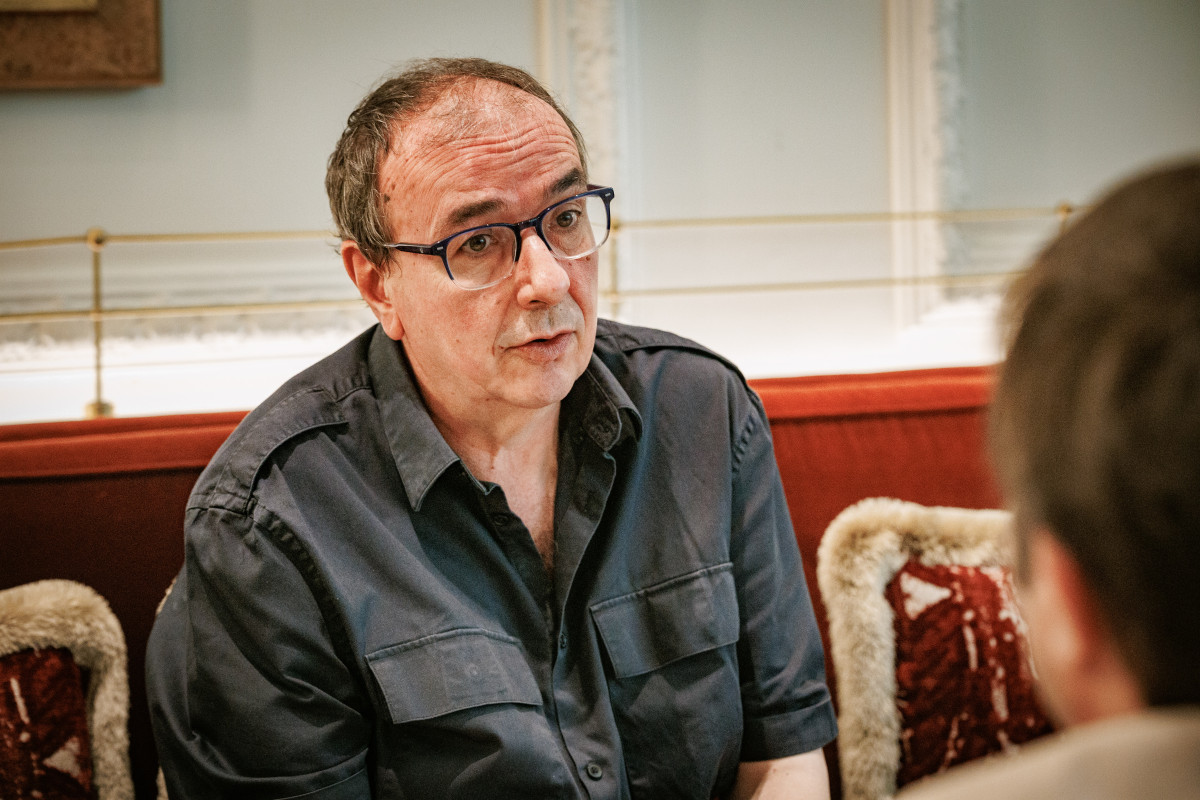
Esteban Hernández analyzes the possible costs of a semi-autonomous Spanish foreign policy. Photo: Agenda Pública / Tania Sieira
In this sense, what costs are on the horizon?
E. H.: I would start by refuting the idea that Sánchez is pursuing a fully autonomous policy. He is tied to American political currents and ideologies, albeit the losing currents. We’ve seen his relationship with Soros and with various figures in the American Democratic sphere, a space that could have a resurgence given Trump’s internal weakness.
Sánchez hasn’t crafted a policy in a vacuum. His orientation aligns with that of a large portion of American Democrats, especially those around Kamala Harris and Biden. Therefore, the consequences will also depend on shifts in the American and European order in the coming years. It’s very hard for the United States to change course, even if the Democrats return to power. The transformations are already underway, and recent history shows that once consolidated, they’re hard to reverse.
“[Sánchez] is linked to American political and ideological currents, though they are the losing currents”
Sánchez isn’t alone either. Depending on the level of support he has, the consequences will be one way or another. That’s the first factor. The second is what kind of policy PP and Vox will pursue if they come to power. We assume they would tilt international positions, and that would also have consequences for Spain. If that shift implies a strong integration into the dominant trend, the consequences could be much less aggressive. It’s a very open scenario.
E. J.: There’s a concrete point, but I find it highly significant these days. Perhaps, by the time this interview is published, the Senate vote will be nearly complete — the Chamber in the Congress has already voted in favor — for ratification of the Treaty of Friendship with France, signed in January 2023. It has been three years and Spain has not ratified it yet. France did so, not without some parliamentary discussion, and in Spain it remains rejected because they wanted to include as a symbolic novelty the possibility that ministers from both countries could periodically attend each other’s ministerial council meetings.
Vox will plant the sovereign flag and the PP moves in that direction. Puigdemont tried to make Sánchez pay for it: Sánchez wanted to sign the treaty in Barcelona and on Montjuïc. Symbolically, he said to Macron: “I have Barcelona at my feet, separatism has been defeated.” Now imagine if this remains blocked. In that case, a nearly diplomatic conflict with France, one of our main allies, would open up.
Could Morocco be one of the next consequences of autonomous or semi-autonomous policy? This question is raised by the ABC interview with the leader of the Polisario Front.
E. J.: Permit me an irony: I think the Polisario Front leader, a year ago, would not have imagined he’d be interviewed by a newspaper like ABC. And that also tells us something about how things stand. I’m not sure to what extent Morocco is today interested in the abrupt fall of Sánchez. For one reason: I believe the PP, and especially Vox, but above all the PP, will maintain essentially unchanged its Morocco policy.
“The Polisario Front leader, a year ago, could never have imagined being interviewed by a newspaper like ‘ABC'”
It’s true that when you take the field against Rabat, you’ll have to perform some feats yourself, right? Morocco is a country that is growing, that is gaining strength, that has a functioning state apparatus and knows how to process information; it has a lot of information. The question for me is whether today Morocco’s government wants the PSOE destroyed.
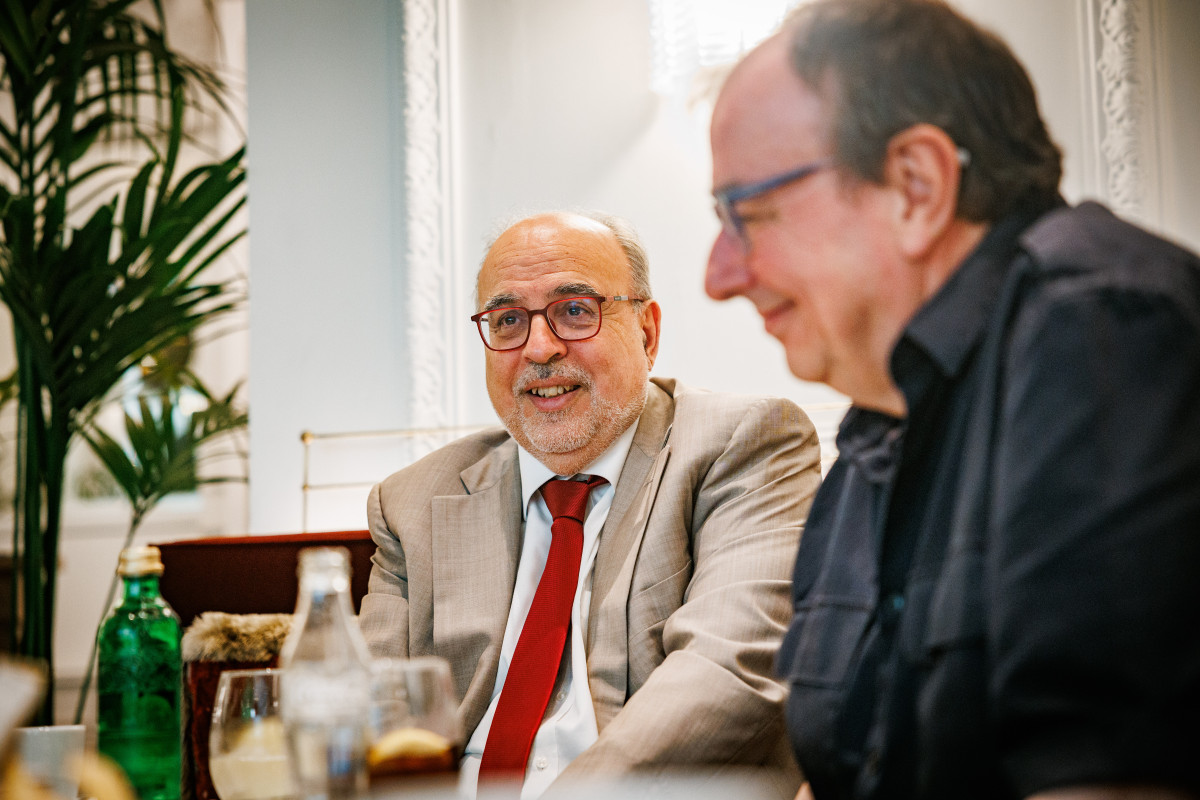
Juliana and Hernández debate Morocco, France, and the limits of Spain’s foreign policy. Photo: Agenda Pública / Tania Sieira
Do you see a clear link between pursuing a semi-autonomous or autonomous policy and the belief that doing so could yield electoral dividends for the policymakers?
E. H.: In general, foreign policy yields few internal political rewards. What matters here is to what extent Sánchez can present these elections as existential, even for the left and not just for him. It also matters under what conditions he arrives at those elections to defend that stance. If he comes with the expectation that it’s possible to repeat the government, the results will be one thing. If he arrives in a scenario where defeat is already assumed, the blow could be revelatory. From that perspective, unless he can elevate the debate to an existential plane, an autonomous foreign policy will not yield interior gains, or will yield very little.
E. J.: In the European Union today each country has a greater national priority. The very concept of an autonomous policy is equivocal, because it assumes that everyone else is disciplined around a single line, and today in Europe we see that it isn’t exactly so. Each European country has its own foreign policy, and this has become more pronounced.
Germany begins to say: “Germany first.” France offers the recent example of the failure of the European fighter jet. They say: “I cannot reduce my own interests in this project to this point, and this must be a fighter jet based on the French Rafale.” Until two or three months ago Italian policy said: “Hey, we are the bridge to the United States.” Spain has pursued an autonomous foreign policy to the left, while others did so to the right, to put it in terms we can understand. And all of them have an internal key.
This is the mosaic. The question is which of these shifts will succeed and which will fail and hit a wall. In the discursive realm, we could say that, in some core elements of his diagnosis, the facts are giving Sánchez the right. Whether it’s Iran or the relationship with Israel, the problem is that even when you are right, you can be knocked off course. And this is the dilemma he faces.
“Unless he can elevate the debate to an existential plane, an autonomous foreign policy will not yield interior gains”
E. H.: Spain is developing an autonomous policy limited to strengthening the internal fabric of the country. While Germany, France, and Italy, within their own limits, try to push elements of their economy and their future with greater breadth, Spain has bet on a policy in which the exterior weighs heavily. Spain’s growth fundamentally depends on two factors: attracting tourists and attracting labor. External linkages are solid, both with Europe and with China, but there is no equivalent strengthening of the internal. As circumstances change, this may become more or less difficult. Spain’s autonomous foreign policy aims to generate more ties outward. Germany and France are not doing exactly that.
Second, it is worth asking what kind of autonomous policy Europe can pursue and what margin the European countries have. Iran’s case is significant, because it’s another example of what happened so far with Trump. The big losers in the war with Iran have been the United States’ Gulf alliance partners. Similarly, in the tariff war, the big losers were not China or Russia, but the Europeans. That’s why there is a certain distrust: being US allies no longer yields special rewards. In the Cold War it did, but at this moment of instability, everyone eyes each other with caution, and powerful, principled countries try to modulate their position.
Third, as Enric noted earlier, there is a need to unite foreign policy with internal policy. If there is no strong internal policy, it is very hard to have a strong foreign policy.
That is often true except for empires. The Roman Empire had periods of enormous internal weaknesses that it compensated with external expansion. It happened to the British Empire as well. The United States cannot expand territorially, but it can expand its capabilities. That is, its conquest capabilities are no longer just military or about taking territory; they reside in technological expansion: “You will use my military platforms, you will be connected to my army and my finances.” That is essentially what Trump is trying to achieve.
In this context, where finance, technology, weapons, and energy come largely from the United States, what degree of autonomous action can a country have if it depends on the United States? That is the question being asked in Germany and also in Argentina, albeit in a different way. Argentina is deeply tied to American technology, but that is the game we’re all in.
In Spain’s case, the strategy has been to develop a relatively autonomous policy aimed at external activity, with the goal of preserving and diversifying its international connections. Depending on whether those connections close or open in the coming years, Spain will have greater or lesser room to maneuver.
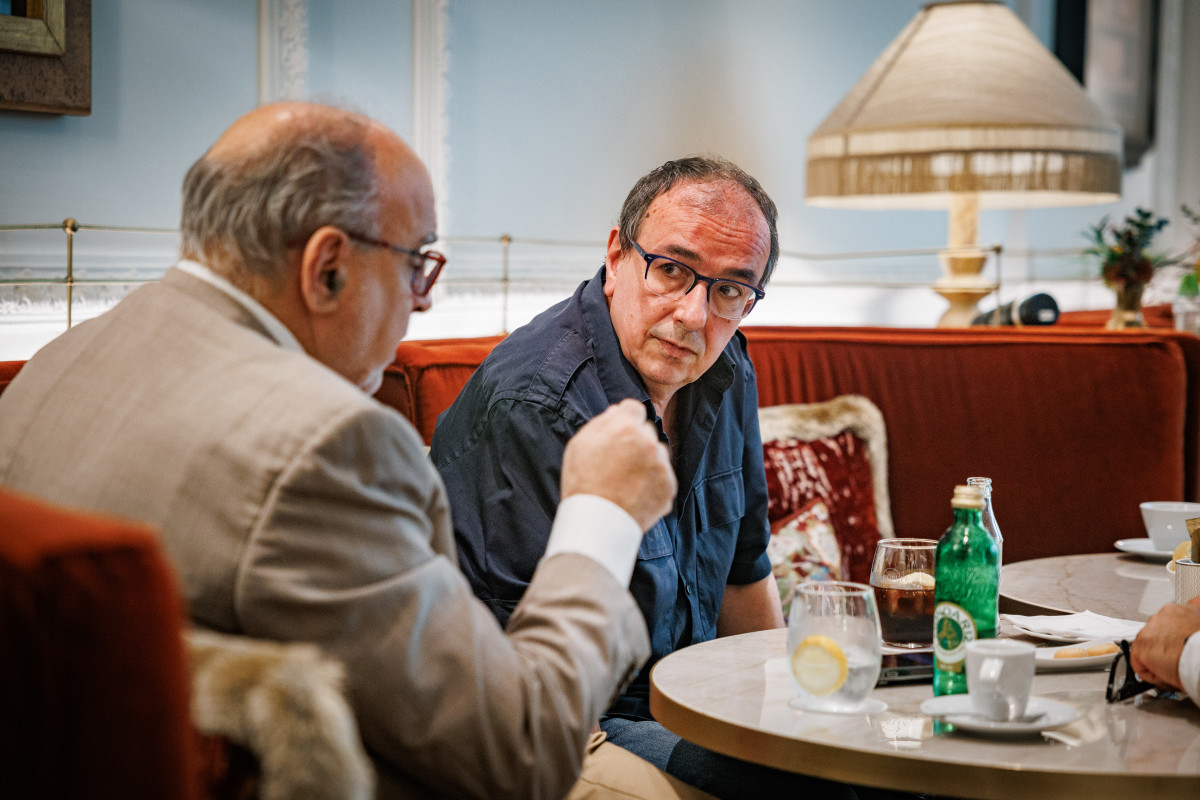
Hernández and Juliana address European autonomy and Spain’s margin in a more fragmented international order. Photo: Agenda Pública / Tania Sieira
Why had we talked so little about China in Spain until relatively recently? Has it moved into a pro-China sphere?
E. J.: It’s a factor that also appears with other topics like Ukraine and Russia. Here geography plays a role. Spain does not live with the same intensity certain perceptions of international policy that are present in the great European Union. I don’t think one can say Spain has been quietly pro-China until two years ago.
Consider this example: the first government of Giuseppe Conte in Italy signed an agreement to join the Silk Road. The Americans were in a state of shock. It was during Trump’s first term, who backed a Salvini who constantly flattered him. Pompeo, the Secretary of State at the time, said: “This cannot be.” Well, this coalition government lasted a year and a half. After that, another government of the Five Star Movement with the Democratic Party formed. Some of those things began to correct themselves. Then came the Draghi government. Draghi’s first words in Parliament when seeking confidence were: “Italy will once again have a rigorously Atlantic foreign policy.” And when Meloni arrived, she was forced to align with the Americans, which cancelled the agreement with China. For them it was difficult, because it meant entering into a certain tension with China given that Italy is an exporting economy.
Parallel to Italy’s adhesion to the Silk Road, the Chinese offered Spain to join. And, during the early months of Sánchez’s government, with Josep Borrell as Foreign Minister, Spain rejected it. This seems to me an interesting datum because it is true that Spain has made very clear moves toward China, but it has not done wholesale U-turns. After all, what is the mark of Spain’s economy policy? The search for foreign investments.
“The first government of Giuseppe Conte in Italy signed an agreement to join the Silk Road. The Americans were in shock”
Spain’s two latest trips to China have also included several projects for Chinese car factories in Spain. We are in another phase, and now more complicated times are coming for the relationship with China. The EU-China trade balance is tilting strongly in China’s favor. They sell more in Europe. There will be a European pushback against the flood of Chinese products. Tensions will emerge, and that tension will affect Spain. Pay attention.
I think the next Spanish government, whatever its composition, will face strong pressure to recalibrate the current approach to China. I think that will be one of the main axes of foreign policy. Without the China issue, some of what is happening in Spain today may not be understood. When you are in a Cold War, and we are in a Cold War, approaching the other side has its risks. Was José Luis Rodríguez Zapatero aware of the risks of approaching the other side in Venezuela and China?
The PSOE of 1977 never approached the other side. It vaguely hinted that it was against remaining in NATO, and then did a 180-degree turn. I insist: we are already in the Second Cold War, and what is happening in Spain today has to do with that.
E. H.: It’s useful to place this in a specific context. Before, China wasn’t a danger but an opportunity. It wasn’t a problem when it entered Latin America through raw materials, and the United States did not exert special pressure to avoid it. But there came a moment when Washington argued that, for the Pacifi c battle, it needed to reclaim its sphere of influence. What we see in Latin America is a succession of governments either to the right or far-right. In that sphere of influence, one of the United States’ demands is China’s withdrawal, not only from Latin America but also from Europe.
“One of the United States’ demands is the withdrawal of China, not only from Latin America but also from Europe”
The problem is that China is not only a exporting power but also an investor. The United States is demanding that investments go to its territory, and much of capital is directed to the American financial sphere rather than the European sphere to produce investment. In the gap between a great power that demands and another that offers—albeit with questionable conditions—many countries gravitate toward the power that offers. That has been the essence of China’s outward development.
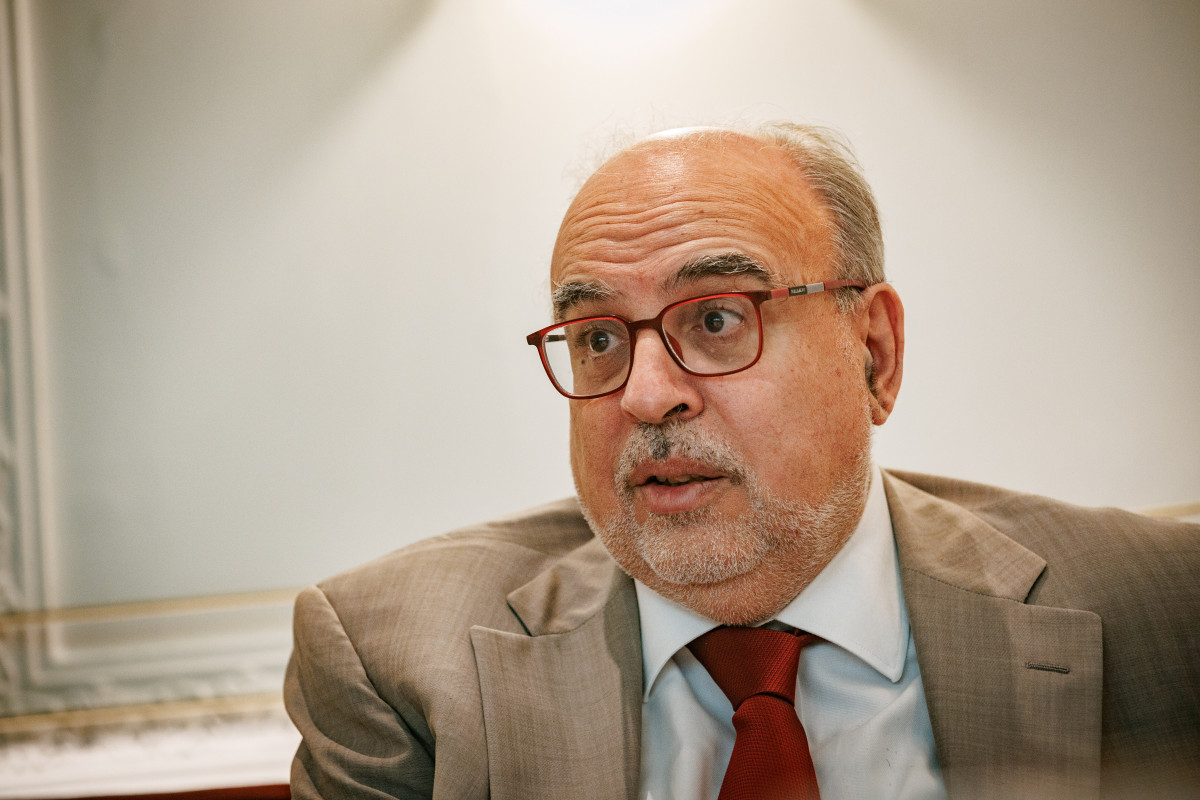
Enric Juliana warns of the pressures that Spain may face to correct its proximity to China. Photo: Agenda Pública / Tania Sieira
To what extent does the situation in Germany worry you within the European context and Europe’s ability to have more unity in certain areas?
E. J.: We must never forget that, at the end of World War II, there were influential voices in the United States, in agreement with the Soviets, even with the French, that Germany should be prevented from becoming an industrial power again. This was a way to prevent rearmament, but the European situation of ruin suggested that Americans help Germany to recover European social conditions, to avoid social conflicts, to not have to pay for everything themselves or to pay less.
Germany, as it regains economic strength, has never ceased to operate based on its own interests. The European Union process is an instrument for strengthening itself. Reunification is being accelerated, taking advantage of the moment’s historical emotion.
“Germany, as it regains economic strength, has never ceased to operate based on its own interests”
Therefore, today it is very hard to do this because there are two objective reasons: three years have brought monstrous problems. The energy base has failed; after Ukraine, the second victim of the war in Ukraine is the German economy. Moreover, the commercial relationship with China becomes more complicated. Instead of selling German electric cars to China’s doorstep, the opposite is happening: the Chinese are selling in Germany.
They realize they have underinvested in infrastructure and that it is a country of engineering, but not a country of digital technology. Moreover, socially, the old East-West divide is sharpening and taking on a political expression with AfD, which becomes the protest party first in the East and now across Germany.
There is also a process that I find harder to decipher, but I think it is very important: the current younger generation no longer understands why the weight of guilt must keep resting on their shoulders. All this goes into a shaker, and out comes a nervous, uneasy, insecure Germany that mainly needs to strengthen its muscle. The question is whether Germany will remain for the next twenty-five years the economic power it has been.
“If at any moment Germany decides there is no option but to disengage from the European Union, the European Union could bid farewell”
What happens if it cannot be? 80 million people at the center, with influence in the heart of Eastern Europe and the north. That is the temptation Germany might face: to become a regional power confined to the center, north, and part of the east of Europe. If at any moment Germany decides there is no option but to disengage from the European Union, the European Union could bid farewell.
E. H.: The United States has imposed the rules of the game to demand more from its allies, especially from Germany, one of its most prosperous partners. Washington’s message is clear: receive more without yielding anything. In turn, Germany replicates this dynamic with its traditional European partners, adopting a stance of “less Europe and more Germany.”
Really pursuing “more Europe” would require achieving strategic autonomy: independence in key areas like technology, resources, and military capability. This would necessarily entail setting limits and engaging in a firm — even rebellious — negotiation with the United States. Yet it is a political cost Germany is not prepared to bear at this moment.
There is also a third factor: during globalization, Germany was not only the great economic winner but also a beacon of ethical and moral superiority because of its values and worldview.
No one believed in globalization as much as Germany did. While powers like China or the United States always acted with their own interests in mind, Germany believed it could do the same by relying on its dominance over Europe, which provided a tailored environment.
“The United States’ message is clear: receive more without giving up anything. In turn, Germany reproduces that dynamic with its traditional European partners”
Yet when its capacities have been tested, its current weaknesses have become exposed: lack of military capacity, heavy dependence on external energy, and the fact that China remains focused on its own expansion. As Enric noted, this German vulnerability is a direct thorn in the heart of Europe.
At this point, there is a real risk of fragmentation. Just as the Soviet Union dissolved when Russia decided it was more profitable to go it alone than to carry the rest of the republics, the European Union could undergo the same fate if Germany pursues that path.
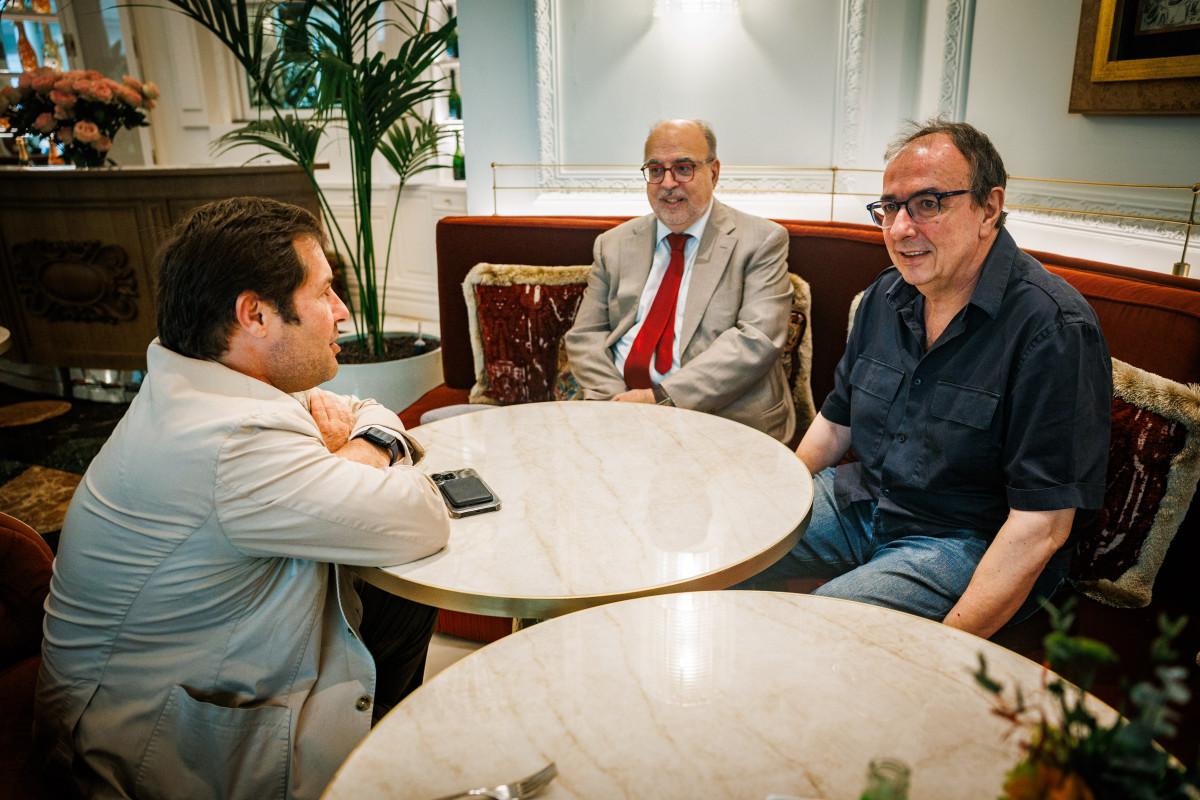
Marc López Plana steers the conversation with Juliana and Hernández toward Germany, European right, and the social democracy crisis. Photo: Agenda Pública / Tania Sieira
I think Europe asked Pedro Sánchez, when he took office, for two important things. One was to prevent Podemos from rising further. The other was Catalonia. I believe Sánchez has succeeded on both fronts. What European and international challenges await Feijóo with Vox in the sixtieth-odd seats in the polls?
E. J.: Indeed, Sánchez had two strategic European-minted demands: curb Podemos and calm the Catalonia situation. Sánchez has neutralized Podemos and calmed Catalonia. In the first case, just look at the current parliamentary arithmetic. In the second, the amnesty law is close to being validated by European justice. Puigdemont remains in Brussels, but we already see Junts making acrobatic flights with the PP in Congress. That was unimaginable two years ago. Well, I must say that two years ago I warned: from the mist you could already see a Junts-PP rapprochement coming.
Another issue is that Junts cannot today vote a motion of no confidence led by Núñez Feijóo, and he still has reservations about traveling to Catalonia. He doesn’t want to show himself as overly friendly: Vox is watching.
Sánchez has calmed Catalonia; history will recognize that, but the amnesty law has costs for the PSOE. Amnesty means “everyone inside.” And this “everyone inside” we’re seeing these days: those desires to pact again between Junts and the PP. There we have a historic event.
Europe will ask Feijóo not to spoil what has been fixed in Catalonia. That is: “Don’t set fire to Catalonia.”
“I was struck by the fact that Feijóo did not attend the Sagrada Familia event in Barcelona a few days ago. It is inexplicable”
In this respect I was struck by Feijóo not attending the Sagrada Família event in Barcelona recently. It is inexplicable. It is clear that it was not merely a religious act. It turned out to be something much more, and the leader of the Spanish right is not in that moment. And then there will be alignment issues. I think that, given the case where Feijóo leads the Government of Spain, he would seek a strong harmony with the German chancellor.
E. H.: Today, the West is undergoing an internal tension within the conservative bloc to decide which faction leads the right. Yet across Europe there is a clear convergence of positions. In Italy, Giorgia Meloni comes from the radical right, but she has forged stable agreements with the traditional sector. In Germany, Friedrich Merz represents the traditional right but is adopting measures typical of the radical right. And in France, Jordan Bardella is pursuing the same goal: to integrate the moderate right into his political project.
Beyond differences in intensity, all these currents share a common agenda: tougher policies on immigration, an unequivocally Atlantic foreign policy, and an economic program based on austerity, public-finance cleansing, and increased defense spending. On the energy front, both factions show reluctance toward green policies and advocate nuclear energy, as well as prolonged use of fossil fuels.
“Beyond the differences in intensity, all these currents share a common agenda”
In Spain, both the Partido Popular and Vox would subscribe to these lines. Therefore, the specific weight of each party in a hypothetical coalition would not alter the general direction of the economy or foreign policy; it would only change intensity or particular spokespersons. The only relevant exception would be domestic policy, for example Catalonia management, where greater Vox influence would indeed make a substantial difference.
E. J.: There were two tacit demands, those that never appear in official documents but are very real: “Stop this and resolve it,” in the name of stability. For a while, Pedro Sánchez and the Socialist line proved very functional in answering that structural requirement.
However, the question we must now ask is whether the problems Sánchez currently faces are partly due to the fact that that “functionality” has run its course. The task they asked of him is done. Now, the elements he introduces into the European political equation run counter to Brussels’ interests.
The Europe that once demanded certain policies from Pedro Sánchez is no longer the same as today. It was a cycle with a particular logic, where there was European consensus and the Spanish government rode the current. But once that initial objective was achieved, the new measures he seeks to promote go against the current, which explains the strong resistance he is encountering.
In this context, and depending on the outcome of the elections, it is very likely that the “Portuguese formula” will be put on the table: a minority PP government supported, in one way or another, by PSOE, the PNV, and certain sectors of Catalonia. Obviously, we are no longer in the 1996 pact scenario, so articulating something like that will not be easy and will depend on the strength the PSOE wins at the polls. If the PSOE resists and Sánchez remains in opposition, this option is ruled out.
“The Europe that at the time demanded certain policies from Pedro Sánchez is no longer the same today”
On the other hand, if the PSOE emerges weakened and a domestic crisis opens, anything could happen. In fact, this tacit grand coalition could be the preferred formula of European centers of power. Still, we must speak in the conditional, because the intense electoral calendar of next year — with presidential elections in France and legislative elections in Spain, Poland, and Italy — could again completely redraw the board.
E. H.: The two points raised by Enric converge on a single central idea: the crisis of social democracy in today’s European environment. It’s not just a question of whether Pedro Sánchez is useful to the system, but of questioning the viability of an entire ideology that built European consensus in the last decades and now seems obsolete.
In fact, if Europe moves to the right, a Spanish government formed by PP and Vox would be much more functional and aligned with the bloc than a PP government supported from outside by PSOE. Socioliberal options are losing so much strength that even El País has run editorials praising their historical value.
“It’s no longer just about evaluating whether Pedro Sánchez is useful to the system, but about questioning the viability of an entire ideology”
On the other hand, it’s essential to understand the extreme tension our societies are undergoing. We come from a decade of drift toward unimaginable political positions and a strong punitive voting trend: today the opposition tends to win elections, as seen in the cyclical swing between Trump, Biden, and Trump. In an economic moment in which “the seams are coming apart,” it is very difficult for governments like Donald Trump’s or Germany’s current chancellor, Friedrich Merz, to generate consensus. It is most likely they will provoke strong counter-reactions.
Ultimately, geopolitics cannot be separated from domestic policy; the values, ideals, and expectations of citizens are changing radically. If German society, for example, turns its back on Merz and he leaves government, Europe will face years of deep instability. We must take this mood of upheaval seriously, a warning about the importance of living together that, curiously, today almost only the Pope seems to emphasize.
A final question. The answer must be what you think, not what you believe is best, and it must be yes or no. Will Vox enter the PP government?
E. J.: No.
E. H.: Yes.
Thank you both very much.
