
Spain is a society that is growing ever more divided, not only by the distribution of economic resources, but also by future expectations, the spaces where people socialize, and the way reality is interpreted. The journalist and writer Esteban Hernández has just published Two-Story Spain, a book in which he analyzes the economic, social, and cultural transformations that have widened the gap between the elites and ordinary citizens. He himself explains the metaphor behind the title of his latest essay: “It is no longer only about the difficulty of climbing socially, but that interests, perceptions, aspirations, and desires are also pulling apart.” What is disappearing are the shared spaces and, ultimately, the ability to recognize oneself as part of the same society.
On the eve of the general elections on November 29, I spoke with Hernández about how these transformations are reshaping Spanish politics in an international context marked by the shift from financial capitalism to technology. “The major political changes of the last 45 years have been instigated from the right”, argues the author, who places the European center-right crisis within a framework of a deeper transformation of the Western economic and political system. In Spain, he identifies Vox and the PSOE as the two engines of politics, though attributing to them very different roles: while the former drags the People’s Party toward new ideological positions, the latter has managed to “channel the resistance of the Spanish progressive population against what is coming”.
The subordination of Spain’s economic elites to foreign capital, the fracture between large cities and inland territories, and the rising centrality of the cost of living are some of the issues we discuss. In our dialogue, the journalist reasons that the symptoms of exhaustion no longer confine themselves to the losers of globalization, but also affect its winners, especially the children of urban middle classes who are beginning to realize that their academic and professional credentials do not guarantee the standard of living they aspired to. In other words, it is a double social and territorial fracture that, in his view, is bound to shape politics in the coming years.
Beyond the electoral date of the coming Sunday, the conversation moves toward a latent question: how to build new political majorities and recover a common language in a society whose two floors have stopped communicating. Hernández advocates for a different way of approaching reality, in contrast to a political culture overly reliant on quantitative indicators: “Politics, society, and the economy are not physical or mathematical”. Knowing citizens better, understanding their aspirations and discontents, and reclaiming the value of history, culture, and the humanities are, for the author, indispensable conditions for good politics again.
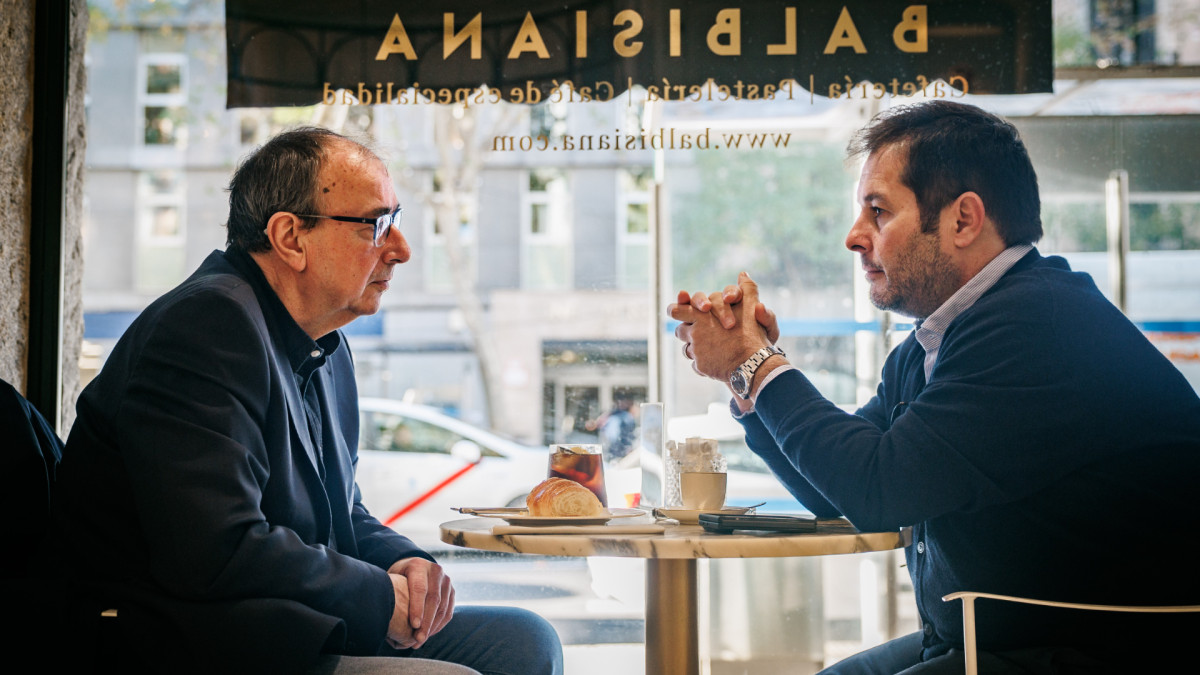
The author of Two-Story Spain chats with López Plana in Madrid. Photo: Agenda Pública / Tania Sieira
Let’s start with the book title, Two-Story Spain. Why two floors? Is it an image you had in mind when you started writing, or is it a title that came up later?
In the end, publishers always look for what they think has the most potential. The book covers several issues, but there is an image in the title that I think fits very well with the moment we are living. Spain is a society increasingly divided in terms of resources and future possibilities. And a two-story society is also one where there is no interior ladder, no communicating vessel between the two strata. Each has its own way out to the street, its own sphere of interaction, and its own media environment. It is no longer merely about the difficulty of social ascent, but also that interests, perceptions, aspirations, and desires are diverging. A two-story society is an image that reflects that split society.
To what extent does immigration complicate that social structure? To what extent does it represent an expansion of the bottom floor and a widening distance from the top?
Spain has long benefited from external factors, as macroeconomic figures show. It is foreign investment, European funds, but also tourism and immigration. That has different political interpretations. We see it in this electoral campaign: there is a left-wing discourse that is quite hostile toward tourism in large cities and in tension-prone areas, and a right-wing discourse that is quite hostile toward immigration in more peripheral regions. Both things suit us well. It is good to have foreign investment, tourism, and immigration, but they also generate negative effects. Immigration increases pressure on public services that are undersized for the population we are, and also affects housing prices. Tourism drives prices up in cities in a very evident way. Rather than focusing on immigration, we need to think, and I think this is the moment because other major countries are doing it, about how to balance what has hitherto depended mainly on external factors from within.
“A two-story society is also a society in which there is no interior ladder, no communicating vessel between the two strata”
You need to build your own activity, boost your market, your demand, and your companies, because if external factors dry up—fewer tourists due to a European crisis or a halt in foreign investment, partly due to the absence of European funds—you end up in a very weak position. I think one of the worst things this government has done is not using European funds to organize a strategic plan around obvious sectors, such as energy. You have renewables, a link with Algeria, and refineries. You could leverage that energy advantage to develop Spain, but we face grid issues and insufficient investment. You have to look at the complete map. When asked about immigration, I say it has both positives and negatives, but it is part of a larger picture. We must think with much more strategic vision, with a broader sense of national and medium-term planning.
Hernández questions Spain’s dependence on foreign investment, tourism, and European funds. Photo: Agenda Pública / Tania Sieira
Those who study the processes of democratic erosion insist on the role of center-right parties in incorporating certain social classes into democracy. Could the existence of an ever-stronger, yet perhaps smaller, top floor undermine the center-right’s ability to fulfill that role?
We are living a system crisis because we are experiencing a system change in the West. As in any era of transformation, institutions designed for earlier times become much more fragile. We come from industrial capitalism, then moved to financial capitalism, and now we are entering technological capitalism. They are very different systems. In Spain, but also in Europe in general, we have an institutional system designed for a world of consensus. The world was social-democratic, whether the left or the right governed. Then, the world was neoliberal, whether the left or the right governed. Now we are entering a new phase. One of the main characteristics of governments today, both in France and the United States, is the tension between different institutions. There are clashes between the executive and the judiciary and also a need, in order to act as a government, to maneuver around certain difficulties using all available institutional instruments. The weakness of the governments does not allow them, for example, to legislate without going around in circles because they lack the necessary political weight.
“Spain has long benefited from external factors […]. You need to build your own activity, boost your market, your demand and your companies”
There is a weakness in democracy in the sense that those who govern cannot govern. Add to that the polarization of the citizenry. But first we must understand that the great political changes of the last 45 years have been instigated from the right. Reagan and Thatcher are the ones who propelled the shift from industrial capitalism to financial capitalism. And it is the American right, the Trumpist right, supported by part of the finance sector, the defense industry, and fossil fuels, that has changed the pace in the face of the China threat. In that drift, the right becomes something else. Thatcher was not the same as the Christian Democrats, and today’s right is not the same as the neoliberal right. In that pulling process, the left-wing parties also adapted to the moment. The socialist parties became social-liberal, and now we will see where we all end up. When the next step, the revolutionary step, comes from the right, the center-right party is left without space.
Why is it the radical right that is leading the transformation?
Because it tends to become the party of the new era. Trumpist right-wing factions have a trajectory because they accompany structural changes. For the moment, regarding what is coming, I see two functional ideological visions for this era. One has been put on the table by the Trumpist right, the other by the Pope. The left is still trying to reorganize to understand what role it will play.
“When the next step, the revolutionary step, comes from the right, the center-right party is left without space”
In that sense, developments in the United States are important because they always serve as a focus for ideological expansion. We will see what the Democrats do and how they organize. The midterm elections sent a powerful message, but it must be taken up by the Democratic Party. The forces of politics of this era must begin to be built. The right has the advantage, but that right leaves you without a center-right, because the center-right belongs to financial capitalism, to neoliberalism, which is already finished. Up to now we have had a right that ends liberalism in foreign policy but remains very neoliberal in domestic economic policy. That, too, will change.
The conversation with Marc López Plana tackles capitalism’s transformations and the future of the Western center-right. Photo: Agenda Pública / Tania Sieira
Where does Spain fit in this context? In a highly interconnected world, these transformations end up impacting Spain’s realignments.
Spain is close to that international ideological shift, but it has its own specifics. We saw it in the 2023 elections and we will see it again in these elections, starting with the fact that the two main parties remain the two establishment parties. That is already quite unusual. In other places, like the United States or the United Kingdom, the conservative parties have swung to another place. Here, that has not happened yet. We are in a phase that shows a certain delay compared to other countries. What does happen is that Vox is the engine of the right.
What does it mean to be the engine of a political space?
If you look at Europe, especially Northern Europe, you’ll see how countries, not only parties, are turning toward a much more restrictive stance on immigration, toward greater control of public spending, toward investment in defense, and toward a more combative position toward Russia. There are a series of structural changes in European countries that Vox has represented well here. The PP was pro-immigration and is now a little less so. In the battle against certain rights linked to identity politics, Vox has been much tougher than the PP, and the PP has moved closer to Vox’s positions. In the economic realm they largely agree, but Vox’s greater energy could push the PP, especially if they govern together, to take sharper measures. You also see it in foreign relations. Vox is better integrated into an international ideological sphere that is reshaping the world.
“There are a series of structural changes in European countries that Vox has represented well here. The PP was pro-immigration and now it is a little less so”
They are the ones who pull the strings in Spain and are dragging the PP toward the other side. And that usually ends in a substitution process. One eats the other. Either the PP transforms and eats Vox, or Vox grows, absorbs the PP’s positions, and plays its role. Against that world, the left has experienced the opposite. What the PSOE has done, from social-liberalism, is to channel the resistance of the Spanish progressive population against what is coming. It is a retreating stance, not an attacking one; it is a defensive stance, but it is channeling that resistance. The ideas from the left and its concrete proposals may fit better or worse, but the elections of the last few years in the United States, France, or Italy have been conditioned by building a dam against the ideological forces that are transforming the world. Sometimes it has worked, as in France, but the world is changing. Here, in Spain, the PSOE is playing that role of defending a certain establishment from what is coming. That is why they are the two engines.
The essayist analyzes Vox’s and PSOE’s roles in reconfiguring Spanish politics. Photo: Agenda Pública / Tania Sieira
Back to the two floors. What is the upstairs floor like? The other day, on the channel 24 Horas, there was talk of an attitude of certain contempt toward those below. Who makes up that upper floor, and how do they behave?
Spain, like much of Europe, in recent decades has been a setting where social differentiation was very clear, established by two paths: money, obviously, the possession of resources, or credentials. You worked in a particular field, you had some track record, you met certain requirements, and you were granted symbolic capital. That allowed you to differentiate yourself from the ordinary citizen. In the public space it was very noticeable because the opinions, positions, and ideas that were respected belonged to people who had achieved success and to those with credentials. You were the expert, the professor, the entrepreneur, or someone who knew about technology. That shaped the public space and also made Spain a fairly pretentious country in its ideas and impulses. In that process, the ordinary citizen was gradually removed from politics. On the one hand, because fewer people of humble origins enter politics as representatives, and on the other, because the goals of politics no longer necessarily align with the goals of ordinary people and their well-being.
“Or the PP transforms and eats Vox, or Vox grows, absorbs the PP’s positions and plays its role”
On the right, the goals were to have a sound economy, a controlled deficit, and economic growth. On the left, the expansion of rights, technological renewal, and the fight against climate change. Now we are seeing that questions related to living standards and future possibilities are increasingly present. When you have a set of experts and winners who speak in politics, and you turn that into a meritocratic element, it is very hard for there not to appear contempt for ordinary people. You understand that they lack the arguments, the vision, and the positions you must display to speak in public, to have a voice, and to carry a public discourse. That was very common in the years before and after the financial crisis, but it is starting to break. And when it breaks, what you see is a much wider social distance. Wealthy clubs appear in some cities, leisure spaces become segmented and increasingly belong to specific groups. Popular needs and the needs of upper-middle classes drift apart.
We live in a world where, as meritocracy dictates, you must demonstrate your difference. If you do not demonstrate any difference, you become someone of little value. That happened first in the economic world, with the search for added value over what was considered a commodity, and has now spread to the social sphere. That contempt appears in a relatively gentle, relaxed, and evasive way compared to other places, but it is fully present. You see it even in this electoral campaign. On the one hand, there are serious, technocratic arguments, the numbers; on the other, memes, songs, and jokes for the people. And they tell you that this is what people like, jokes and memes. That very much signals what the two floors are and how you address each one of them.
But who exactly makes up the upstairs floor? What are the characteristics of Spain’s elites?
The upstairs in Spain is peculiar because we must bear in mind that rich Spaniards, the people who have resources, are subservient elites. The companies on the IBEX are in the hands of funds, and their executives are employees of those funds.
They are not the owners.
Exactly. And that says a lot, not only about the strength of the Spanish state and its presence in strategic enterprises, but also about the position of Spain’s millionaires, who do not hold a great deal of influence over the future of their companies. When the owners are others, you have to meet their demands. The owners want dividends, and your main task becomes delivering the dividends the shareholders demand. If we move to non-listed companies, increasingly private equity is buying small Spanish companies, so there are fewer and fewer Spanish firms in the hands of national owners. Those entrepreneurs may have money because they sold their company or created a family office, but they have very little say in the country’s political life because they no longer have entrepreneurial colleagues. They have money, but not colleagues.
“The rich Spaniards, the people who have resources, are elite subordinates”
In reality, a significant portion of Spain’s business fabric has become a layer of mediation between foreign capital, investors, and the national territory. You manage, you look for opportunities, you provide support. There are entire sectors of tax advisors, lawyers, lobbying groups, and consulting firms that help bring capital in here and give it traction. But your relationship with the territory is different, because your real connection is with the owners of the companies. That signals a different position for the elites. At the top are those closest to the founding figures, and then comes all that service, intermediary, and management structure. And that usually sits in Madrid.
Mostly in Madrid?
Madrid, partly Barcelona, and to a small extent Málaga. But mainly Madrid. And that also geographically divides the country.
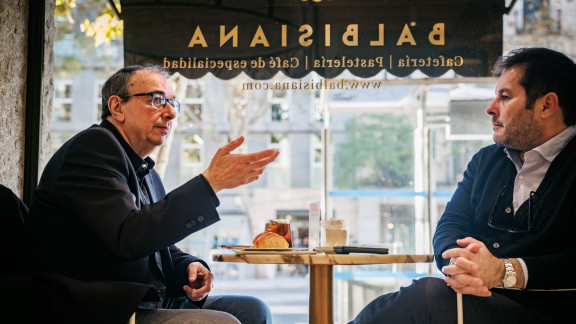
Hernández and López Plana discuss the role of economic elites and resource concentration in Madrid. Photo: Agenda Pública / Tania Sieira
In one of his latest articles he spoke about cities and the left. I think this has a lot to do with what you just explained.
Spain, like other European countries, beyond the map of autonomous communities and provinces, is a country divided between a very powerful center that absorbs a substantial portion of resources and the rest of the territory. There are two or three large urban centers, especially two, that concentrate resources, investment, and employment. Who comes to Madrid? Middle classes come, the children of middle classes from other regions, because that is where they can work in the field they have trained for. If you want to be a consultant, journalist, or architect, a large share of opportunities are here. Tourists arrive, immigrants arrive because there is a need for services, and wealthy people from other countries come to live here because it is attractive. All of that forms a world with a great growth potential and vitality. It is a hopeful society because, although things may seem complicated, there are perceived future possibilities. Young people can think that now things will be okay, but in the future they will have the chance to build a professional career.
At the same time, inland territories experience the opposite process. There is no investment, young people leave, and there is a sense of decline. In those environments there is a contradiction: there is a sense of decline, but the standard of living is quite good. Not only because everything costs less, but because these places are more friendly and much more comfortable to live in. In Madrid and Barcelona you have the possibility of a future, but in much more expensive, harsher cities with long commuting times. You have future possibilities and poor living conditions. More or less like that has been Spain until recently. What is happening now is that in inland territories the signs of decline are becoming much more palpable, and that gives Vox a special trajectory. In the last regional elections we saw it gaining traction in small and medium-sized cities.
“Tourists come, immigrants arrive because there is a need for services, and wealthy people from other countries come to live because it is attractive”
And if you go to the big cities, what you start to see are not yet the claims of urban peripheries or more deteriorated places, but the claims of the children of the middle classes, disillusioned because they can no longer afford the city’s standard of living. Those are the two major political gaps today. The peripheral areas still need to join that gap, but what we are seeing are signs of exhaustion not only in the deteriorated places, among globalization’s losers, but also among the winners of globalization. Those political gaps have shown up in the general strike. Among those participating in tenant unions there are many university graduates. Here we have a significant change.
Precisely, I wanted to ask you about a concept that has become central to the international political debate: the cost of living. Do you think it will be one of the major political axes after the elections? Are we witnessing the emergence of the downstairs floor?
Yes. The left-wing sectors that have gained some electoral traction in other countries, with figures like Mamdani, have an urban implant among impoverished middle classes and are already pointing in that direction. If you analyze the midterm elections in the United States, there are also significant populist elements. But for me, the key, in a country with such a marked territorial division as Spain, and a division that exists in much of the West, is to understand the change we are experiencing and how it will be reinterpreted politically. Until now, when building majorities and acting politically, what underlay was the identification of where power resided. The left has long had a clearly capillary view of power, à la Foucault. Power is distributed: it lies in the relationship between man and woman, between the young and the old, between the national and the immigrant, or, in Spain, between centralist nationalism and peripheral nationalism. From that conception of power, the way to forge a majority was to mobilize the groups that had grievances, the oppressed groups, and build a political majority with them.
“What we are seeing are signs of exhaustion not only in the deteriorated places, among globalization’s losers, but also among the winners of globalization”
When Trump and the new right appeared, although for us Trump and Brexit seemed like a blow, all this had already been happening for some time elsewhere, like Russia or Israel. In 2016 we have their concrete manifestation. What these forces say is that all these internal divisions we are making in society only end up pitting us against each other, when power actually resides in the nation, in a national body that is being oppressed by multinational and global power. Their proposal is to reinforce that national body so that it can command resources. There is a kind of unity that transcends the divisions. And if you look at what the US Democrats did in the midterms, they positioned power in the oligarchs, in the tech billionaires, but not only in them.
The journalist places the cost of living and the discontent of the middle classes at the center of political debate. Photo: Agenda Pública / Tania Sieira
Are we, therefore, facing a different way of identifying where power resides and, consequently, of building political majorities?
Whoever has real money also wields political power because they can buy it, and that creates an economy that harms the vast majority of society. So what is the political action? Mobilize that harmed majority, which particularly feels the consequences in their living standards, to fight against the oligarchies. In Europe that populist left framework has not developed in the same way, and we continue to move much more within that capillary conception of power. The right has indeed done so with the idea of the nation. Here it has difficulties due to the peculiarities of the national concept, but it is true that idea needs to settle and correspond to everyday well-being. The different political formulas also depend on their real effectiveness. Milei has to respond to Argentina’s economic situation, and Trump has suffered wear in the midterms for not meeting certain expectations of the American population. We are still in democracy, and therefore a citizen will cast a ballot in a poll and decide.
“Whoever has real money also wields political power because they can buy it, and that creates an economy that harms the vast majority of society”
What I mean is that we have moved from an ideological environment of internal division to one that tries to unite or forge majorities through unity, even though that unity can also be problematic. We are entering an ideological moment in which the parameters of political struggle will be different. In Spain we are still within the previous frame, but the frames are moving somewhere else. I think that will be one of the keys for the political forces of the future.
The presence of large technology corporations directly influences what people see, read, and hear and, therefore, is fundamental to shaping public opinion. How does the existence of these two floors affect public opinion and, more broadly, the construction of the common good?
We are at a moment of ambiguity. Today all parties handle data, but the data are no longer believed. And I don’t even say that when someone speaks of figures, people think it is true or false. What happens is that people disengage. You start talking about percentages and the reaction is: “Look, I’m not interested.” You are talking about a reality that for a long time was presented as objective, in which everyone dealt with numbers and percentages, but now, as soon as you mention them, part of the population disengages. That is the sign that the discourse with which you addressed the population, and which the population accepted, has broken. That vehicle is no longer available because it is no longer functional. Then there is the other side, the circulation of messages through social networks and the use of language suited to networks. That is a bad idea, not because networks shouldn’t be used, but because networks are not yours.
“We have moved from an ideological environment of internal division to one that tries to unite or forge majorities through unity”
There are people who made the mistake of thinking that with networks they could have a huge reach, precisely the one not given by the mainstream media because they were a peripheral actor. But the algorithm changes, and your reach ends. I’m not even getting into whether that language is good or bad, but into the fact that your space of circulation and distribution of messages is not under your control. You cannot fully trust that mechanism to reach people. What we have is a population in which the party of ‘I don’t believe in anyone, I don’t care about any of them’ is growing heavier. Some people will not vote, and others will vote in these elections, but they do not trust politics. They will vote against someone, but they lack a real attachment to a positive country project. That makes shaping public opinion much more difficult, not only because of the inherent tension of an electoral process and because media are increasingly tied to particular political spheres, but also because we do not have a common language that is reliable for a substantial portion of the population.
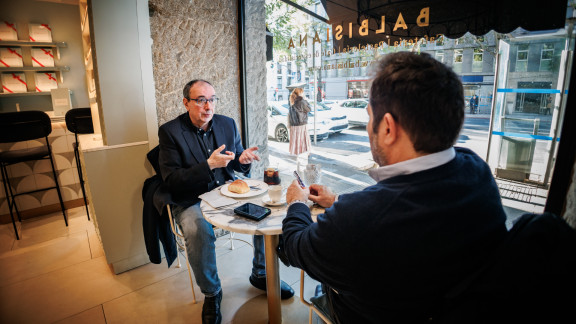
A broad view of the interview, in which Hernández defends the need to recover a common political language. Photo: Agenda Pública / Tania Sieira
How can that common language be recovered?
Both the traditional mechanisms of information transmission—such as the major media—and social networks have their own deficits. In the case of networks, they are also governed by algorithms that are not transparent. That leads me to a point I stress repeatedly in the book. We are moving toward an increasingly technological period, mediated more and more by artificial intelligence, and it is very difficult to make decisions, analyze, envision the future, or address others when in recent years we have focused only on that part of reality that can be measured. That would be logical if we were talking about physics, but politics, society, and the economy are not physics or mathematics. We have fallen into the enormous error of undervaluing history, culture, the humanities, and that part of the social sciences that cannot be quantified. Without that, you cannot make good decisions. You cannot address others because you do not know them, nor do you know what they want, where they are, what they desire, or what their worldview is.
“We have fallen into the enormous error of undervaluing history, culture, the humanities, and that part of the social sciences that cannot be quantified”
And, of course, you cannot conduct good politics. There is a preliminary step that consists of recovering a view of society in which the non-quantifiable elements also have a place, which sometimes are tangible and other times invisible, but that are there. I have always believed that if you know one thing well, it is much easier to act on it. If you understand better what people want, where they are, and what their troubles are, it is much easier to reach them, to have them understand you, and even to offer them something with which they can connect. For me, that is a preliminary step to shaping a public opinion that can have elements of connection and dialogue.
Thank you very much.
