

It is a rare bird in Spanish journalism. He possesses analytical capacity, a well-stocked intellectual repertoire, and a remarkable ability to connect the density of fundamental issues with the currents of Spanish politics. Journalist Esteban Hernández has just published The New Spirit of the World (Deusto), where he tries to answer how and why the global board will crack in the coming years. We already see some symptoms. But Hernández goes further and has the capacity, even in this conversation, to relate underlying movements to what happens in the day-to-day life of our more local politics.
Hernández notes that Trump will propel the rise of the radical right worldwide and will help consolidate illiberal trends that are shaking the West, and he analyzes, in particular, its Spanish derivative: “The Disenso Foundation, VOX’s foundation, has a very broad link with the Trumpist right and FAES”, traditionally tied to the Partido Popular, “has lost all contact with that. The Spanish PP has been sidelined internationally in relation to geographic areas outside the European Union”, he points out. “Outside of that Vox has already won the game,” he concludes. What implications could that have for Spain?
Marc López and Esteban Hernández during the conversation. Photo: Agenda Pública / Tania Sieira
How does Spain’s geostrategic position look after Trump’s victory?
The initial news is negative. The two relevant powers are China and the United States, which relegates Europe, already suffering in these new times, to face greater difficulties. Within the European environment, Spain is not in a position of advantage: the part that could lose the most in the EU is the south.
The new European axis, Paris, Berlin, Warsaw, at a glance indicates a geographic position that distances us from the most influential places within the EU. Moreover, the economic exit from this crisis could cause us serious complications, somewhat in terms similar to those of the 2008 crisis. Germany can undertake large investments and tax cuts because it has the capacity to assume a debt margin that Spain or Italy lack. If the planned defense investments proceed without a common European financing instrument, and nothing points to that, they would leave Spain in a difficult situation, as with other southern countries. We would have to spend large amounts that we do not have. There are northern countries that can undertake that effort.
“Within the European environment, Spain is not in a position of advantage: the part that can lose the most in the EU is the south”
Good news is that Spain has opportunities to develop its relations with the Mediterranean and the Arab world, and we have ties, albeit diminishing, with Latin America. The great powers use their power, the not-as-big ones practice diplomacy. Spain now has to do it, both domestically, with Brussels and Berlin, and externally, by expanding connections with geographic areas with which we have good relations.
Do you think the relationship with Morocco, which seemed calmer, may enter a stage of greater complexity given Morocco’s privileged relations with the United States and the Trump administration?
Undoubtedly, Morocco is a priority partner for the United States, and also an ally of Israel after the Abraham Accords. These new Rabat alliances have had repercussions in its relations with Spain in recent years. But this is a moment in which all pieces are moving and positions are not static. Spain must know how to use its cards, including diplomatic ones, so that Morocco’s ascent does not translate into a drawback for Spain.
What does Trump think about the world?
I think a certainty is already taking shape. The most common approach has been to analyze the Trump administration through the peculiar personality of its president. Yet there is much more than that. The diagnosis Trump has offered about the changes in the international situation produced by globalization is fairly accurate. The other day I listened to Borrell giving an analysis of the moment, and it bore a striking resemblance to Trump’s, which I found significant.
One must keep in mind that Trump is a solution to two American problems. One, obvious, of hegemonic status. And in that task of recovering power, his government is supported by part of the American elite. He is not an actor who emerges from nowhere. The second problem is social cohesion. The Republicans have expanded their electoral base among the working classes because they have offered them an exit, good or bad, but containing a promise to restore their standard of living. The two problems are products of the era, and they also relate to the different visions their elites hold about the path to take.
Until now, the United States had maintained its hegemonic position thanks to the dollar’s status as a reserve currency, which allowed it to attract capital from around the world. That enabled it to finance its public deficit, sustain the cost of a large army, and not worry about the trade deficit.
“Beijing and Washington are so tightly coupled that they cannot fully break their relationship without causing each other significant harm”
Now Washington has recognized that this structure produced two deeply negative internal effects. The first is the loss of strategic capabilities. It no longer produces many of the things necessary to guarantee its security or its dominance. I doubt that Trump wants T-shirt factories to return to the United States, but surely he needs to recover productive capacities in key areas, as well as secure its supply chains. The second problem is that the trade deficit, being a result of offshoring, entailed a substantial deterioration in the living standards of middle and working classes.
The response he has given to both problems has been tariffs. There are others, but that is the most significant. And one must note what it implies for a reconfiguration of the international order through bilateral negotiation. The United States will not negotiate through common institutions, but through country-to-country agreements. In that move, there is a very difficult obstacle to overcome, which is China. Beijing and Washington are so tightly coupled that they cannot completely break their relationship without causing substantial harm to both. And since it will be hard to win the upper hand against China, the United States wants to gain power at the expense of other countries, especially its allies. It has asked the EU to buy more armaments, and we will; to buy more gas, and we will. And now, with trade agreements, it will also demand that we fully open the doors to its technologies, which are an essential part of the future development of the United States, and we will likely do so. Additionally, there is the capacity to attract European companies to manufacture in the United States, which does not seem minor. Europeans are facing that reconfiguration. Like empires, when they cannot expand geographically anymore, and China has set clear limits, they tend to be less fair with their partners.
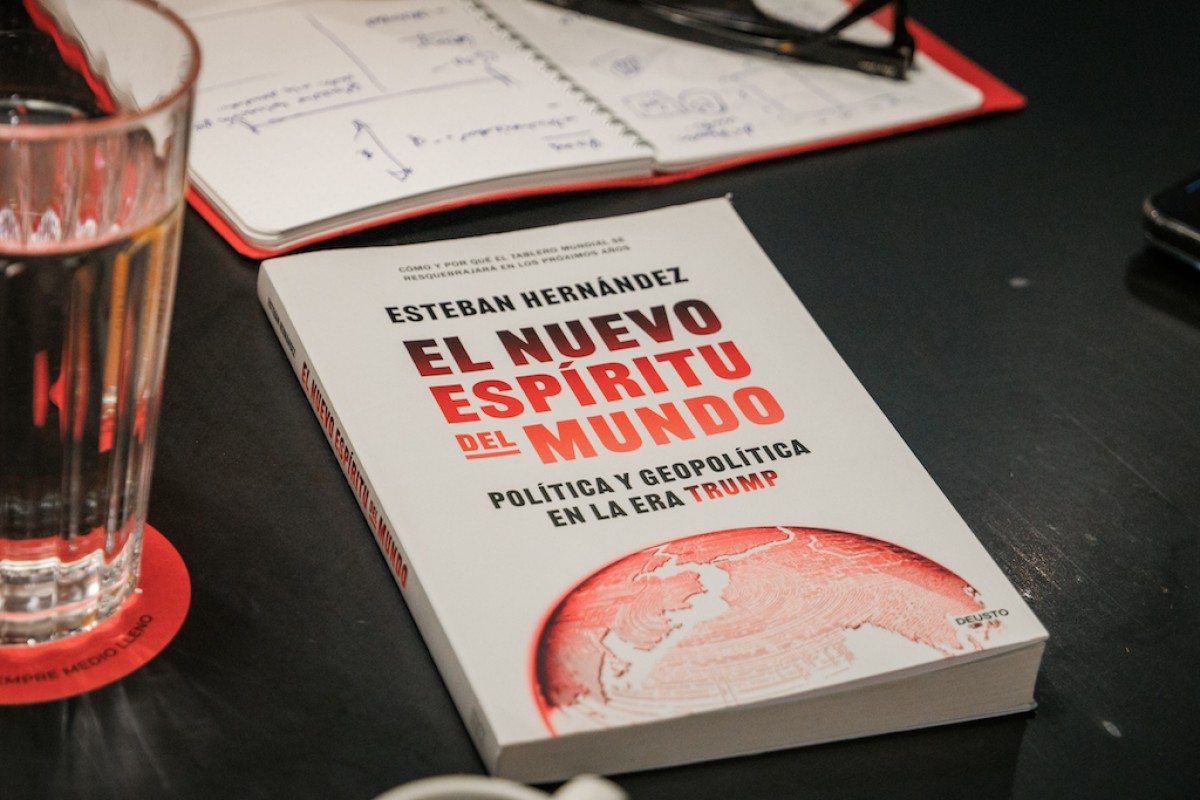
The latest Esteban Hernández book. Photo: Agenda Pública / Tania Sieira
You have cited armament as an important element of the relationship between the United States and Europe. I think the German defense minister has hinted that it’s important to put more money in, but also that this money should not be used to buy more armaments from the United States, but to produce in Europe. Isn’t Trump achieving, or could he achieve, that we do not gain more strategic autonomy in defense by spending more, but end up spending more without greater strategic autonomy but by buying from the United States? So, isn’t this debate biased or not sufficiently understood by European political elites?
Yes, certainly. At first glance, defense is obviously an important matter in itself, but also symbolically. One of the major problems with the Ukraine war from a European perspective is that if the United States withdraws, Europe lacks the necessary capabilities to help Ukraine and tilt the war in its favor. It would have to invest a lot of money, but wars are fought not only with money: armaments that Europe does not produce would be needed and would take time to develop. And it also lacks the technological capacities to ensure that armaments are truly effective, which places European countries in a subordinate position. The same applies to trade. When you are an exporting country and what you produce is not essential to the importing country, the seller holds the cards. In this case, even more so, because Europe, China, and Japan are export-oriented regions and the U.S. is a crucial market, giving it great negotiating power.
“Why limit yourself to investing only in defense? Wouldn’t it be necessary to recover productive capacities, secure energy supplies, develop technology, and encourage the use of the domestic market?”
These weaknesses have made it possible to say aloud, for the first time in a long time, that the idea of the end of history was false, that Europe believed it, but it wasn’t so, and that the result of that belief is that we have lost essential capacities. The curious thing is that, after acknowledging this, we are told to speed up and invest, but only in defense. It is absurd. Europe has lost technological capacities, since twenty-five years ago we thought it was a sector where the continent could be a leader, and the opposite has happened; Europe has serious energy deficits. It produces goods that are losing value, like cars, or goods that are of little use, like luxury items. It has wasted its domestic market by outsourcing it. In that context, why limit ourselves to investing only in defense? Wouldn’t it be necessary to recover productive capacities, secure energy supplies, develop technology, and foster the use of the domestic market? We cannot keep thinking only about defense: a much broader and better-designed investment is required. Because if we limit ourselves to defense, the final destiny will be to buy weapons from the United States until we can produce our own advanced weapons.
That this has not been set in motion reveals the European elites’ poor understanding of the world. They remain in the past. And this moment offers only two possibilities: either Europe takes steps forward toward greater integration, which would mean fiscal union, capital markets union, and a real single market, or it moves backward and states will distance themselves more from Brussels. Starting with Germany, which is already taking serious measures to strengthen itself, but only on its own terms. The EU is at a moment where it will lean toward integration or toward dissolution. Even if it is desired, continuing as before is not possible.
In this sense, we had important elections on Sunday for Europe and I think also for Spain. Poland remains a country that shifts European power toward the East. Although we have talked about the G5, in reality the Weimar axis still plays a more important role than the G5. So, two questions: how do you see Spain in this relationship? What does Trump’s victory of radical-right forces in Poland’s presidential election mean?
There are several planes. One is ideological. In Europe we are witnessing a confrontation between traditional right and that cluster of right-wing forces—far-right, extremist, populist, etc.—to the right of the European People’s Party. They are two blocs where there can be some overlaps, for example on immigration and renewable energies, but they differ in the type of Europe they aspire to. The right of the European People’s Party wants states to have a larger space for decision, while the PPE aims to keep the current system more or less. The other essential political difference is that European far-right parties want a closer link with Washington than with Brussels. So, ultimately, there is a confrontation between the PPE, led by the CDU, and European parties close to the American Republican Party. Poland is a very interesting country in that sense because it is pro-Atlantic for obvious reasons, but also because of the ideological struggle being fought there. In the elections you refer to, the European Conservatives and Reformists and Patriots supported the nationalist candidate, who won narrowly over the candidate backed by the PPE, the European Social Democrats and the Commission. That division is significant. Moreover, one must consider that what Trump intends is to dissolve, as much as possible, the Union. This is evident in trade terms: the United States would prefer to negotiate country-by-country rather than with the EU as a whole, which would be easier for it. In that context, Germany must decide whether it truly wants to form alliances with other European countries to strengthen the EU or prefers to go its own way and relegate Europe to a secondary role. Germany will have to decide.
Hasn’t it decided?
“Germany has to decide whether it really wants to establish alliances with other European countries to reinforce the EU or whether it wants to go its own way and relegate Europe to a secondary plane”
No. It has to make clear whether it wants to be the engine of the EU or just wants to be so for itself. What is the fundamental problem? Europe is permanently looking outward. Its priority has been to export and it has paid very little attention to strengthening its own capabilities. And it remains on the same path. It is mindful of Russia, mindful of the United States, mindful of China. And it would be necessary to act the other way around. The question is what we can do for ourselves and what we can do to secure our own interests. Because the more power you have, the greater your bargaining power as well.

Estenan Hernández during the conversation with Agenda Pública. Photo: Agenda Pública / Tania Sieira
That, by the way, is what everyone else is doing. China and the United States are doing this.
But also Turkey, Saudi Arabia, or India. In fact, all major countries are doing this except us. Certainly, Spain is not thinking in these terms. We are lagging behind. Moreover, the EU is especially weak in the new scenario because it is not a state and lacks the strengths that this implies. But, in addition, the lack of consensus and the divergent interests of the member states make responses difficult. The problem is here: Will Europe build an inward-looking continent, one that looks at what it can build for itself and do by itself, or will it be a Europe that always looks outward and wonders how dependent it will be on other countries?
“Spain has to work strategically, something we have not done for a long time. We must reinforce Spanish capabilities”
What can Spain do? I insist on the starting point. Spain is the loser among losers and therefore needs to do two things. We must work strategically, something we have not done for a long time. We need to reinforce Spanish capabilities and a strategic plan with that aim. Second, we must push for another relationship with Europe and another economic perspective. We cannot continue to be the losers. There is talk all the time about the need to boost growth, but what must be boosted is development.
What is development?
Growth, in the end, is a few numbers that can be achieved by diverse paths, not always beneficial. You have to build things, you have to produce things, you have to boost the capacities you already have. You have to have a view of the world. You have to have work, you have to have a domestic market that works. You have to have people whose incomes provide them with surpluses for consumption. In a way, that is what Trump has told Americans. And we will see what China does. It is a power with great export capacity, but it also has an internal market to which it can turn if exports slow down. It is unlikely they will decide now to foster growth through domestic consumption, but it is a possibility they consider. Europe also has it, and it is wasting it. But choosing this shift implies a large transformation in mentality and in the approach to the economy. Spain should be a driver of this approach. The geography of these times pushes us toward a more fragile position in Europe. We must turn that weakness into an opportunity.
“European intellectuals and experts claim that arming and building fighting vehicles and airplanes is enough to move forward”
What I find strange in all this is that after the 2008 crisis and the Covid crisis, with the Ukraine war and the changes driven by Trump, the very concept of Europe and its role in the world has fallen into crisis. That should have produced a European version of the 98th generation—a deep reflection on the continent. And it has not happened. European intellectuals and experts claim that, ultimately, it is not so grave, and that arming themselves and building battle tanks and planes is enough to move forward. If that is the program, we will need a lot of luck.
There has been talk about the Right’s International and the great opportunity that Trump’s victory should represent for it. But isn’t it contradictory to advocate for a radical international and maintain nationalist policies? Could these Trump-style policies hurt the electoral prospects of the far right in various European countries?
First of all, we must acknowledge something quite evident. One of the most obvious electoral trends in recent years is government turnover. It is most common in elections for the party in power to lose. We are in a period of high political instability and governance difficulty for countries. And in that context it is logical that new players have relevant weight, especially when they position themselves as anti-system actors. Western populations do not trust the system or the politicians. With that backdrop, nationalist forces gain ground: class struggle has been replaced by the struggle over territory, and nationalism thrives. Then one can argue, as you do, that nationalist forces will clash with one another, because each country has different interests. And that is to be expected, but so far it has not happened. There are frictions, but not major dissonances in that right-wing international. Patriots for Europe is a group that, despite all its internal difficulties, is fairly cohesive. For instance, in Romania, where tensions with Hungary are evident, Orbán has supported the candidate of his ideological camp despite everything that implies for the Hungarian minority.
“Trump is different from European right-wing movements because of the social composition of his bases, as he has appealed to both elites and working classes”
Right-wing nationalist forces are cohesive because they believe they are really changing things, that they are doing real politics, and that a very different mindset is needed from what progressivism proposes. They are cohesive in demanding a much greater freedom of action for national states vis-à-vis the European Union. They are cohesive in their closeness to Washington or to Israel. And they operate in Western societies that are living a moment of challenge, where they emerge as the challenger to the system. Their common program is stronger than their differences. Another thing will be when they reach government and have to defend their countries’ concrete interests, but for now, their vision is united. Trump is different from Europe’s right because of the social configuration of his bases, since he has appealed to both elites and working classes and has set professional managers as a common enemy. To elites and to workers he promised solutions; to the former through the traditional route of tax cuts, to the latter through the restoration of better-paid jobs. Tariffs play that double role because they can spur the relocation of industries, but also provide resources to offset what is lost with tax cuts. However, the aspirations of these two blocs are quite different, and at some point Trump will have to betray one of them. If he defrauds the working classes, it is likely that the Republicans will lose the next elections, and this already happened in 2020. But if he manages to maintain the balance between elites and ordinary citizens and satisfies both, he could open the door to a Republican hegemonic era. Europe is another matter, because most of the continental Trumpist right has a very settled cultural view and clear objectives, but their economic programs tend to be a prolongation of neoliberal recipes, which makes it hard for them to build political options that satisfy the economic demands of the middle-lower classes and the working poor. Trump could succeed because he is the president of the world’s most important country, which gives him a very significant advantage; but the European right faces greater difficulties. We will see what happens when Le Pen or Bardella take power, if they do, because Bardella is the most populist of Europe’s Trumpist right. The difficulty, for me, does not lie in the disagreements among the far-right that their nationalism could lead to, but in their ability to stay in government when they reach it. Let us not forget recent experiences: Trump left after his first term, like Bolsonaro. Milei is following the same path. The success or failure of a second Trump will be crucial in that sense.

The editor and director of Agenda Pública, Marc López, listening attentively to Esteban Hernández. Photo: Agenda Pública / Tania Sieira
To what extent do you think there could be internal dissensions within republicanism as time goes by and the midterm elections approach?
In Europe there persists a belief that it is possible to return to the old republicanism. Trumpism will reverse at some point during its term, forced by the effects of an overly risky program. They also think Trumpists will lose the next elections and we return to the mental framework of globalization with some tweaks. Larry Fink spoke the other day of a second globalization carried out in a different way. I think that is no longer possible, and anything that resists change, that is, anything that does not push change in a positive direction, will generate negative changes. Why do I say this? Because the tension between the United States and China is there and it will not stop. The United States and China are fighting for hegemony and, from there, everything transforms. With that, trying to maintain the conceptual bases of the era of globalization and thus to trust that a moderate American republicanism could exist within the same frame of mind as a European conservative party is a waste of time.
“The two positions facing the Republican Party are the technocratic one and cultural conservatism that nods to the New Deal”
The tensions within American republicanism come from another place. There is the technocrats’ view, those American elites who believe that algorithms will replace technocracy and that many fewer technocrats and many more people versed in technology with a different mindset are needed. Remember that technology is seen as a solution to almost every problem, including the efficient management of the public sector. Recently, Peter Mandelson, the British ambassador to the United States, insisted on this position as the real basis of the trade agreement between the United States and the United Kingdom. On the other hand, there is the MAGA program. Essentially there are two positions: one that seeks to exit the global era by accelerating processes and insisting on old formulas, such as tax cuts, much less regulation, less social protection, and more technology, which would benefit the U.S. economy and its citizens. It is a modernized form of trickle-down economics. The other is the new conservatives, including former neoliberals like Marco Rubio. The U.S. Secretary of State recently wrote a book, Decades of Decline, which marks a completely different direction from what existed before. And there is an interesting movement around J.D. Vance, well represented by the think tank American Compass, led by Oren Cass. He has just published a collected volume, The New Conservatives, worth a look, which contains an attempt to rebuild republicanism from an inclusive, social and economic base. These are right-leaning people who pay special attention to work and the strength of communities. This is the other option, the one embodied by the MAGA that can be better understood by the average U.S. voter. These are the two positions facing the Republican Party: the technocratic one and the cultural conservatism that nods to the New Deal. Trump is a compromise solution between both, so we must watch how his term evolves. History suggests that in these circumstances it is usually the common people who are betrayed. We shall see.
How does the American internal Republican debate play out in Spain’s center-right and radical right space?
It is very interesting due to its impact inside and outside. First, confirm a fact: the Disenso Foundation, VOX’s foundation, has a very broad link with the Trumpist right that FAES lacks. The Spanish PP has been sidelined internationally, especially in non-European regions: in Latin America, for example, Disenso holds far more weight than FAES. But second, Vox’s influence within Patriots is notable, while the PP is well positioned in the PPE but does not have significant influence. On the international front, Vox is gaining ground. And this has repercussions in Spanish politics. According to current polls, the PP would need Vox to govern, unless PSOE abstains improbably. Moreover, for the PP it would be advantageous, given Spain’s electoral system, for Vox to stay around 14-15%, as that would secure the government. The risk is Vox flaring up to 18%, which would translate into greater influence in a potential government. And this is important because the European People’s Party is now building firewalls against the extreme right. Manfred Weber stated at the Valencia congress that the enemy of the conservatives was the extreme right, not the social democrats. The PPE may have ties with Meloni, but Meloni is not in Patriots. The problem for the conservatives is Patriots, but also the Europe of the Nations and Sovereignties, the AfD’s group. Germany’s model, a systemic coalition that excludes AfD, is what they are using in the European Union institutions. And that aim clashes with a Spanish government in which PP and Vox would be together, because Vox is part of the currents that seek to exclude. European authorities would not worry about that coalition, as long as Vox’s number of deputies did not give them excessive influence in that future government. A Vox that skyrockets to 18-20% would worry them greatly and clash with PPE directives. Also, one must look at the map as a whole, since Europe’s Trumpist right is closer to Washington and distant from Brussels and Berlin. So if there were elections that brought PP and Vox to share government, it would cause concern in Europe. At least for now. We’ll see how Europe evolves when Spain’s elections take place.
