
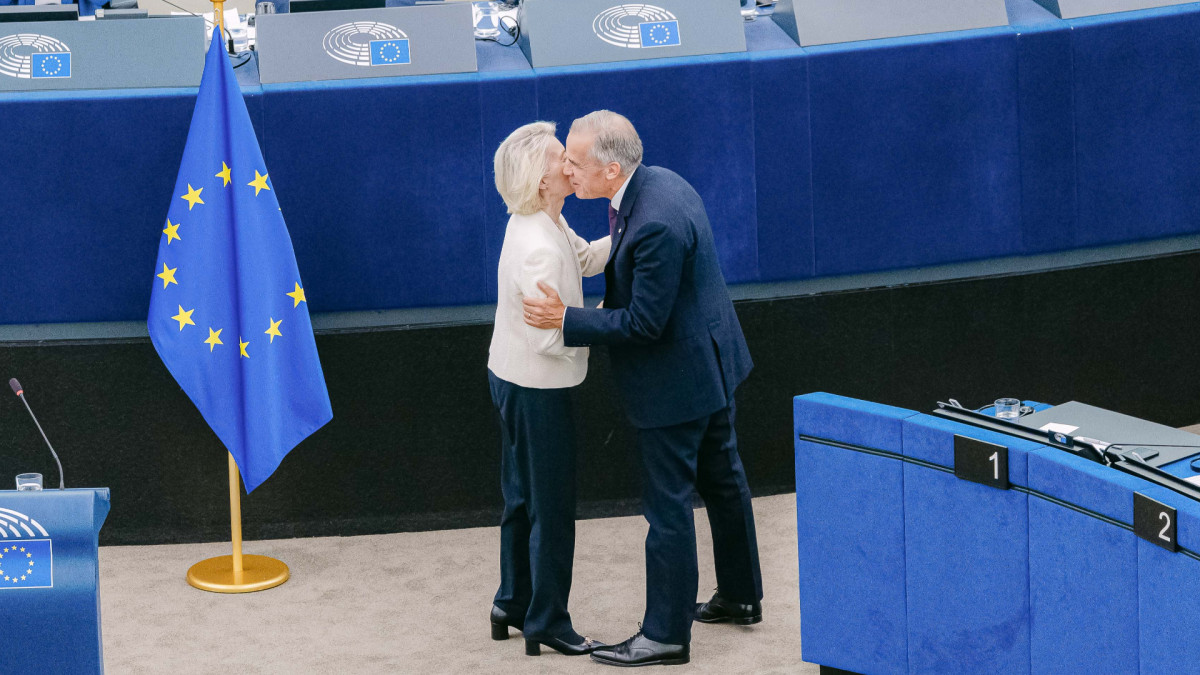
The European Commission views with approval the idea of tightening cooperation with the Canadian government led by Mark Carney, but the concrete formula has not yet been defined. The president of the Commission, Ursula von der Leyen, has opened the door for Canada to become the EU’s “first associate member.” She did so during her State of the Union address, to which Canada’s prime minister attended as a guest. Von der Leyen pointed to as priority areas smart manufacturing, technology, the integration of defense industrial bases, Arctic cooperation, raw materials, energy, and artificial intelligence. Carney himself will address the European Parliament on Thursday, September 17.
Most political groups view the rapprochement with Ottawa positively, although the exact formula proposed by the Commission has not been disclosed. Carney’s January 20 speech in Davos, in which he developed an argument in favor of middle powers — such as the EU and Canada — has served as a catalyst for this unity. Metsola and Carney later met in May, during the European Political Community summit in Yerevan, where the president of the Parliament invited him to visit Strasbourg this week. Across the left and right, European political representatives often recall those words of the prime minister, who today faces an intense trade battle with his neighbor, the United States.
“The speech by Carney on January 20 in Davos, in which he developed an argument in favor of middle powers has served as a catalyst for this unity”
Ottawa has carried out a firmer strategy with Washington than Brussels has had so far. And it has done so despite the fact that the vulnerabilities it faces are greater than Europe’s. That stance has been welcomed in some European quarters because it shows An alternative path to the one pursued by European capitals so far. It remains to be seen whether it will prove more beneficial.
The big question now is how Canada could move closer to Europe. Full membership as a state seems politically ruled out today and faces a legal difficulty: Article 49 requires being an “European state.” However, this concept is not defined strictly geographically, so Canada could argue its political and cultural ties with Europe to defend its eligibility. Even then, entry would require the unanimity of the Twenty-Seven and ratification by all member states. In that scenario, Von der Leyen has proposed the label of “associate member,” a category that is not currently in the treaties.
The relationship already includes CETA, provisionally applied since 2017, though ten member states have not yet ratified it. That lack of closure underscores the difficulties of translating a new political formula into deeper integration.
“The adhesion as a member state seems today politically ruled out and faces a legal difficulty: Article 49 sets as a requirement to be an ‘European state'”
The EU already maintains
Canada is already part of SAFE, the EU instrument offering up to €150 billion in loans for defense investments. And it has also collaborated with PESCO since 2021, specifically on the military mobility project. In an analysis published by the European Council on Foreign Relations (ECFR), Anand Sundar takes a further step and proposes linking the EU’s anti-coercion mechanism with equivalent measures by Canada, so that both sides could activate them jointly in the face of an economic or trade crisis. This mechanism was designed primarily to counter China’s economic coercion and has also been proposed for use against the United States during the tariff war with Trump.
The most ambitious, and perhaps riskiest, area for both sides is security and defense. The same analysis suggests that Canada should cease to be treated as a third country for the purposes of the European defense technological and industrial base and be able to access EU-funded programs on terms similar to those enjoyed by member states. On the other hand, as explained by Guillermo Íñiguez, a PhD in EU Law from the University of Oxford, “Canada could, in fact, join a customs union, enter the EFTA, or adhere to the internal market.”
In short, the potential for closer ties between the two sides is fairly considerable. It would also help in sectors the European Union itself regards as priorities in achieving strategic autonomy.
However, one must not forget that there are other fronts in the field of accession or intermediate memberships. Ukraine continues to trust in joining the EU. Moldova and several Balkan countries have been preparing and reforming their institutions for years to meet European demands. There is also the issue of the United Kingdom.
“Moldova and several Balkan countries have been preparing and reforming their institutions for years to meet European demands”
The leaders of the SNP, Plaid Cymru, and Sinn Féin in Scotland, Wales, and Northern Ireland, respectively, are preparing for the breakup of the United Kingdom, which has direct implications for the EU. First, because, if reunification were to occur, the entire territory of a united Ireland would become part of the EU. This was decided by the European Council in 2017, when the issue was also under discussion. On the other hand, the SNP and Plaid Cymru have expressed their desire for Scotland and Wales, respectively, to stand as candidates for accession. Amid all this turmoil, Prime Minister Andy Burnham has continued a policy of rapprochement with Europe, just like his predecessor Keir Starmer.
The Union faces numerous formidable challenges. And some of them are existential. The strengthening of new alliances will be decisive for the EU’s future, but the simple fact that so many allies are willing to cooperate more closely, in whatever form, paints an optimistic path.
