
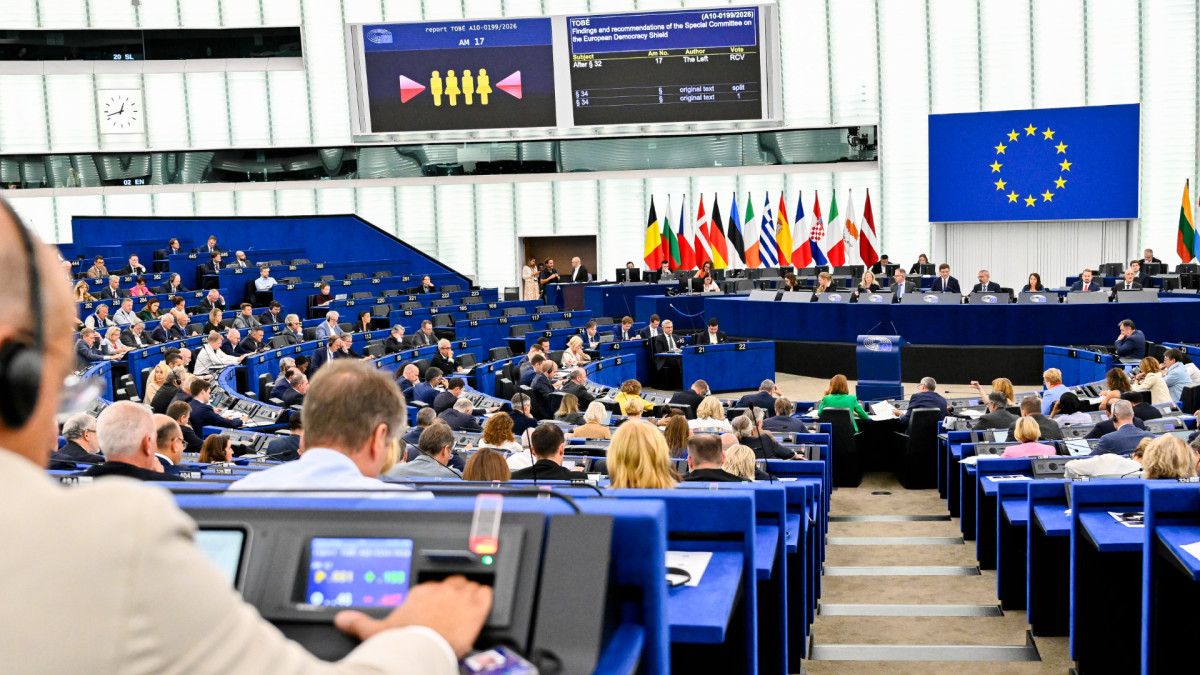
The Ceuta crisis has a more European role than ever. The vote on a resolution regarding the need for a coordinated EU response in Ceuta next Thursday comes after an intense debate in which some voices within the People’s Party propose that trade responses could be discussed against Morocco. From Vox, MEP Jorge Buxadé takes a step further and calls for both suspending the association agreement with the neighboring country and “seal the border shut”.
The discussion of a trade response has gone somewhat under the public radar. The reason is that this would be a decision for the European Union to take, and it would not fall to the government of a single country. However, the Vice-President of the European Parliament, Javi López, has ruled out this path and argues that there is no possibility that the Twenty-Seven will initiate any kind of trade escalation with Morocco. The same option is rejected from Moncloa. Until now, the Spanish government’s strategy has been to try to maintain cooperation with Morocco and to keep the debated link between Moroccan security forces and the July 30-31 episodes out of the discussion.
“The discussion of a trade response has gone somewhat under the public debate”
The European Parliament approved a harsh resolution against Morocco in 2021. In it, the neighboring country was explicitly held responsible for the crisis that caused about 9,000 people to illegally cross the Spanish border into Ceuta. At the time, the European chamber’s stance was backed by the Spanish government. Ten days before the resolution’s approval, Sánchez spoke of a border opening “due to disagreements and differences in foreign policy.” Five years ago, the political escalation did not go any further. Now, all parties agree that the crisis is far larger: nine times larger, if we compare the number of entries. But a trade escalation would require some elements that have not yet surfaced.
The most evident is that the position of the Spanish government is substantially different from what it was a few years ago. In this case, the Socialist Party remains firm in rejecting, for the moment, attributing responsibility directly to Morocco. Asked about this, Socialist MEP Juan Fernando López Aguilar says that “we must keep a cool head and use all tools available within that structured cooperation,” but he opposes a diplomatic, European, or Spanish escalation with Morocco.
“We must keep a cool head and use all tools available within that structured cooperation”
Spain is one of the indispensable players in any attempt to harden the European position against Morocco. Therefore, Madrid openly demanded a response to Rabat and the European Parliament supported that move. Now, the Spanish government tries to separate crisis management from a direct accusation against Moroccan authorities. Without that Spanish push, it is much harder to build the necessary consensus among the Twenty-Seven to transform a parliamentary condemnation into concrete measures against Morocco.
In the European People’s Party, Javier Zarzalejos explains that the party is “satisfied” with the resolution proposal that will be voted on Thursday. He also emphasizes that “it is very difficult to maintain a completely normalized political and trade relationship with Morocco.” This stance places the EPP in a position closer to Vox and raises at the European level positions that are also held in the national debate. The Christian Democrat bloc, which puts security and borders among the pillars of the remainder of the European legislature, continues a trend of dispute on some of the issues most important to radical-right parties.
The resolution, in any case, will have a fundamentally political scope. The European Parliament has the capacity to heighten pressure on Morocco and demand a community response, but it cannot decide—on its own—the suspension of the trade relationship. Moreover, the text is still under negotiation. The EPP aims to clinch it with the socialists, liberals and greens, which requires finding wording capable of garnering support from groups that, for the moment, are not aligned in a strategy of breaking with Rabat.
“This positioning places the EPP in a terrain closer to Vox and elevates to the European level positions that are also maintained in the national debate”
From Vox, Buxadé maintains that the Twenty-Seven should suspend the agreement with Morocco and halt European payments to the country. “That is European solidarity,” he asserts. Meanwhile, Estrella Galán, MEP for The Left, criticizes the outsourcing of European border control. Aware of the “unacceptable pressure” experienced in Ceuta, she also recalls that there is an existing reception system in Spain, whose competence lies with the State, and points to the Ministry of Inclusion. This is a matter of “political will”, she notes.
The European Trade Strategy
Since the second arrival of Donald Trump to the White House and in light of the rising trade tensions with China, the European Union has sought to diversify its economic relations, strengthen existing agreements and find new partners. Opening an escalation with Morocco would entail introducing a major exception to that strategy and turning access to the European market into a tool of political pressure.
“Opening an escalation with Morocco would entail introducing a major exception to that strategy and turning access to the European market into a tool of political pressure”
The dimension of that relationship explains part of the cautions. In 2025, the exchange of goods between the European Union and Morocco reached 62.2 billion euros. The Twenty-Seven are Morocco’s main trading partner and Morocco is, in turn, the EU’s main partner among southern neighboring countries.
The Thursday debate will thus serve to measure how far Europe is willing to go in its response to the Ceuta crisis. The trade threat has entered the discussion, but turning it into a European policy seems considerably more difficult.
